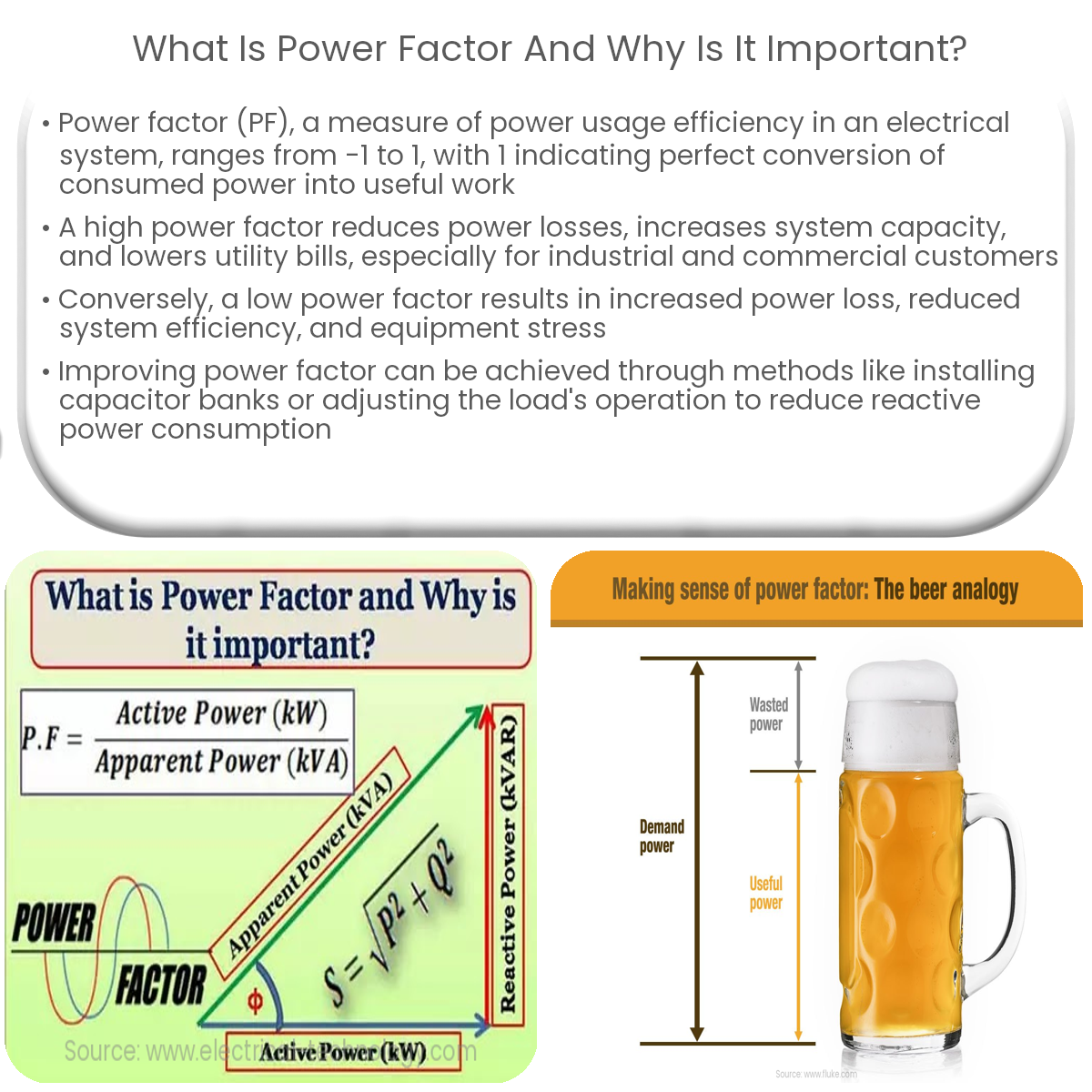
Power factor is the efficiency of power usage in an electrical system, affecting power losses, system capacity, and utility bills.
Understanding Power Factor and Its Importance
Power factor is a crucial concept in the world of electrical engineering, but it’s often misunderstood. In this article, we will delve into the definition of power factor, its significance, and the potential consequences of a low power factor.
What is Power Factor?
Power factor (PF) is a dimensionless ratio that represents the efficiency of power usage in an electrical system. It is defined as the cosine of the angle between the current and voltage waveforms, with a value ranging from -1 to 1.
A power factor of 1 (or unity) indicates that the voltage and current are perfectly in phase, meaning all the power consumed is converted into useful work. On the other hand, a power factor less than 1 signifies that some portion of the consumed power is wasted as reactive power, which doesn’t contribute to actual work.
Why is Power Factor Important?
- Reduced Power Losses: A higher power factor leads to reduced power losses in the distribution system. This is because less reactive power is drawn from the source, which in turn lowers the overall current in the system.
- Increased System Capacity: A higher power factor means more active power can be delivered to the load without increasing the system’s current capacity. This enables the system to operate more efficiently and with lower costs.
- Lower Utility Bills: Most utility companies charge industrial and commercial customers for low power factors. By improving the power factor, businesses can reduce their energy costs significantly.
Consequences of a Low Power Factor
- Increased Power Loss: Low power factor results in higher current flow through the system, which in turn increases power loss as heat dissipation in the conductors.
- Reduced System Efficiency: With a low power factor, the electrical system’s efficiency is compromised as more reactive power is drawn from the source, leading to higher energy consumption and utility bills.
- Equipment Stress: A low power factor can cause increased stress on electrical equipment such as transformers, generators, and motors, reducing their lifespan and efficiency.
Improving Power Factor
There are various methods to improve power factor, with the most common being the installation of capacitor banks. These capacitors store reactive power and release it when needed, helping maintain a higher power factor in the system. Other methods include using synchronous condensers or adjusting the load’s operation to reduce reactive power consumption.
In conclusion, power factor is an essential aspect of electrical system efficiency. A high power factor leads to reduced power losses, increased system capacity, and lower utility bills. By understanding and addressing power factor issues, businesses can significantly improve their electrical systems’ efficiency and performance.