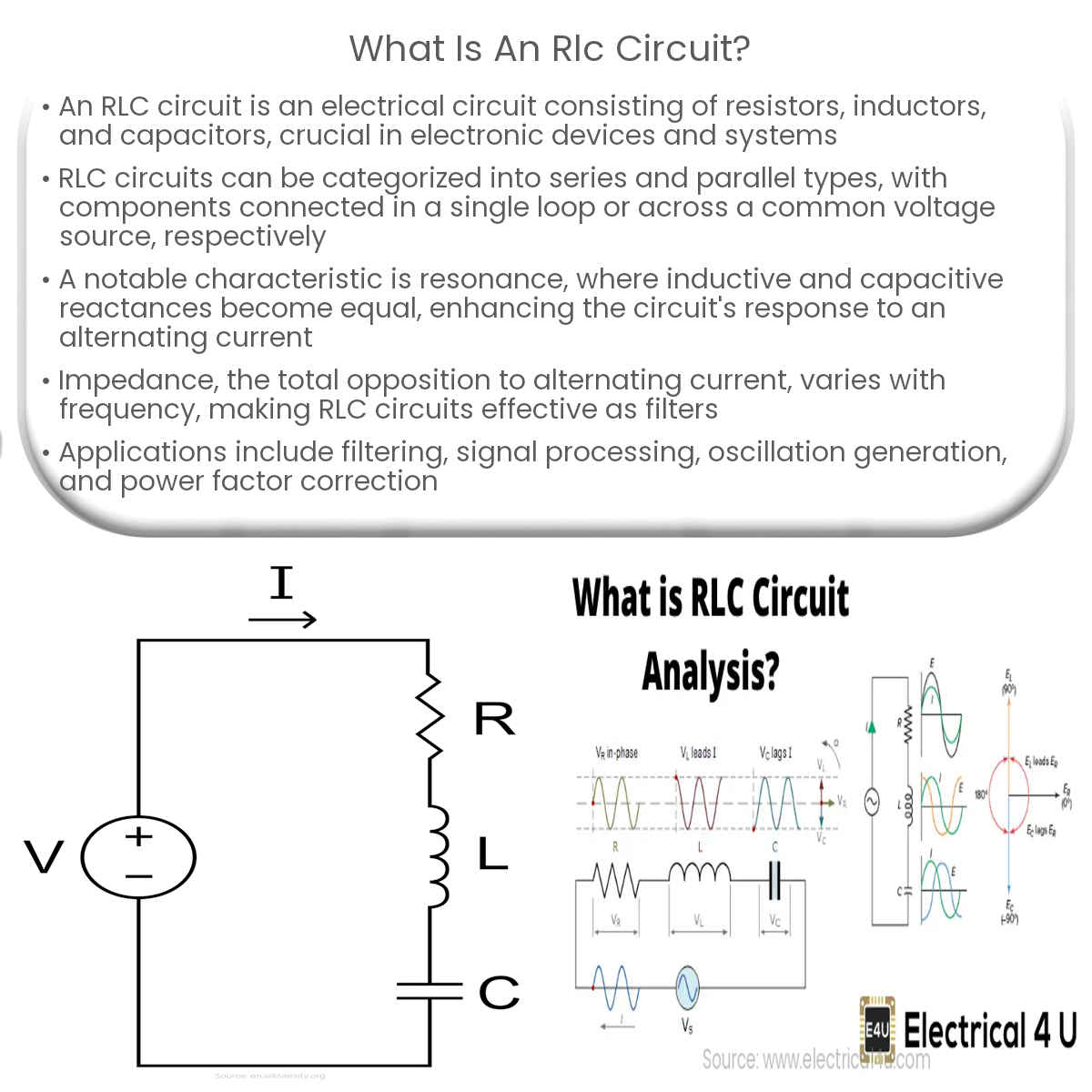
An RLC circuit is an electrical circuit containing resistors, inductors, and capacitors, used in filtering, oscillators, signal processing, and power systems.
Introduction to RLC Circuits
An RLC circuit is an electrical circuit that contains resistors (R), inductors (L), and capacitors (C) as its primary components. These circuits play a vital role in various electronic devices and systems, such as radio and television receivers, filters, oscillators, and signal processing circuits.
Types of RLC Circuits
There are two main types of RLC circuits: series and parallel. In a series RLC circuit, all components are connected in a single loop, with the current passing through each component sequentially. In contrast, a parallel RLC circuit has each component connected across the same voltage source, allowing current to flow through them simultaneously but independently.
Resonance in RLC Circuits
One of the most critical characteristics of RLC circuits is resonance. Resonance occurs when the inductive and capacitive reactances in the circuit become equal, causing the impedance to be purely resistive. At resonance, the circuit’s response to an alternating current (AC) input signal is maximized, enabling it to efficiently filter or transfer energy at a specific frequency.
Impedance and Frequency Response
Impedance (Z) is the total opposition to the flow of alternating current in an RLC circuit, considering both resistance and reactance. Impedance is frequency-dependent, and the frequency response of an RLC circuit describes how its impedance varies with the input signal frequency. This frequency-dependent behavior allows RLC circuits to be used as filters, selectively passing or blocking signals at specific frequencies.
Applications of RLC Circuits
- Filters: RLC circuits are commonly used as filters in electronic systems, selectively allowing or blocking signals of specific frequencies.
- Oscillators: RLC circuits can be used to generate oscillating signals, producing stable output frequencies in devices like radio transmitters.
- Signal Processing: RLC circuits are employed in various signal processing tasks, such as smoothing, differentiation, and integration of input signals.
- Power Factor Correction: In power systems, RLC circuits can be used to improve the power factor, reducing energy losses and improving system efficiency.