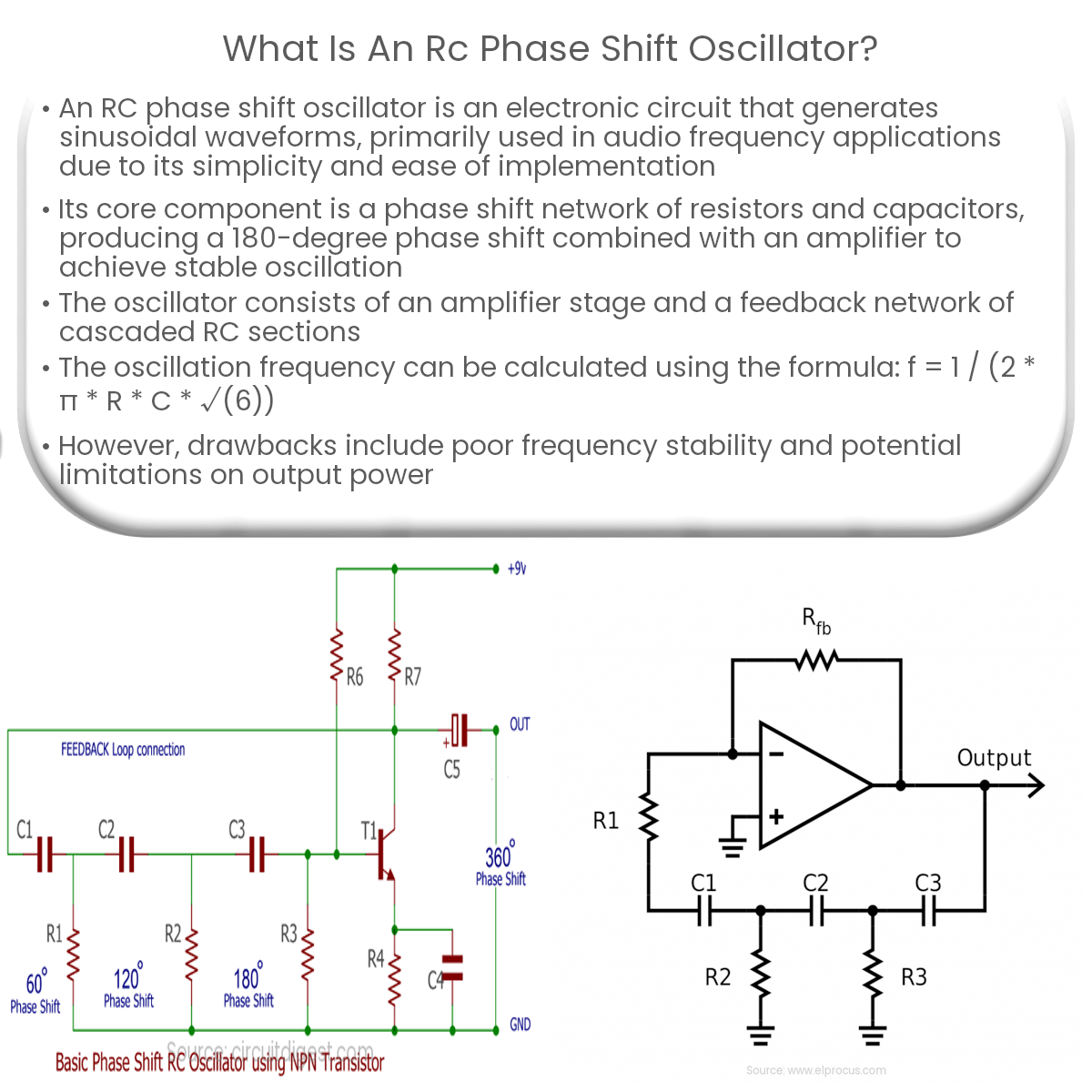
An RC phase shift oscillator is an electronic circuit generating sinusoidal waveforms using resistors and capacitors, often used in audio applications.
Introduction to RC Phase Shift Oscillators
An RC phase shift oscillator is a type of electronic oscillator circuit that generates sinusoidal waveforms through the use of resistors (R) and capacitors (C) in its design. This type of oscillator is widely used in audio frequency applications due to its simple design and ease of implementation.
Working Principle
The primary component of an RC phase shift oscillator is a phase shift network consisting of a series of resistors and capacitors. This network generates a phase shift of 180 degrees at the desired oscillation frequency, which is then combined with an additional 180 degrees of phase shift from an amplifier to create a total of 360 degrees phase shift. When the total phase shift is equal to an integer multiple of 360 degrees, a stable oscillation is achieved.
Circuit Configuration
An RC phase shift oscillator typically consists of an amplifier stage and an RC feedback network. The amplifier stage can be implemented using a variety of technologies, such as bipolar junction transistors (BJTs), field-effect transistors (FETs), or operational amplifiers (op-amps). The feedback network is composed of a series of RC sections that are connected in a cascaded configuration.
In most designs, three RC sections are used to generate the desired 180 degrees of phase shift. Each RC section contributes approximately 60 degrees of phase shift at the desired frequency, and their combined effect results in the total phase shift required for oscillation. The output of the last RC section is fed back to the input of the amplifier stage, creating a closed-loop feedback system.
Frequency Determination
The frequency of oscillation for an RC phase shift oscillator can be calculated using the following formula:
f = 1 / (2 * π * R * C * √(6))
where f is the frequency of oscillation, R is the resistance of each resistor in the network, C is the capacitance of each capacitor in the network, and π is the mathematical constant pi (approximately 3.14159).
Advantages and Disadvantages
RC phase shift oscillators offer several advantages, such as simplicity of design, low cost, and ease of implementation. They can also generate relatively stable and low-distortion sinusoidal waveforms, making them suitable for many audio frequency applications.
However, there are also some disadvantages to using RC phase shift oscillators. They tend to have poor frequency stability, as the oscillation frequency is highly dependent on the values of the resistors and capacitors used in the circuit. Additionally, these oscillators may have limited output power due to the passive nature of the RC network.