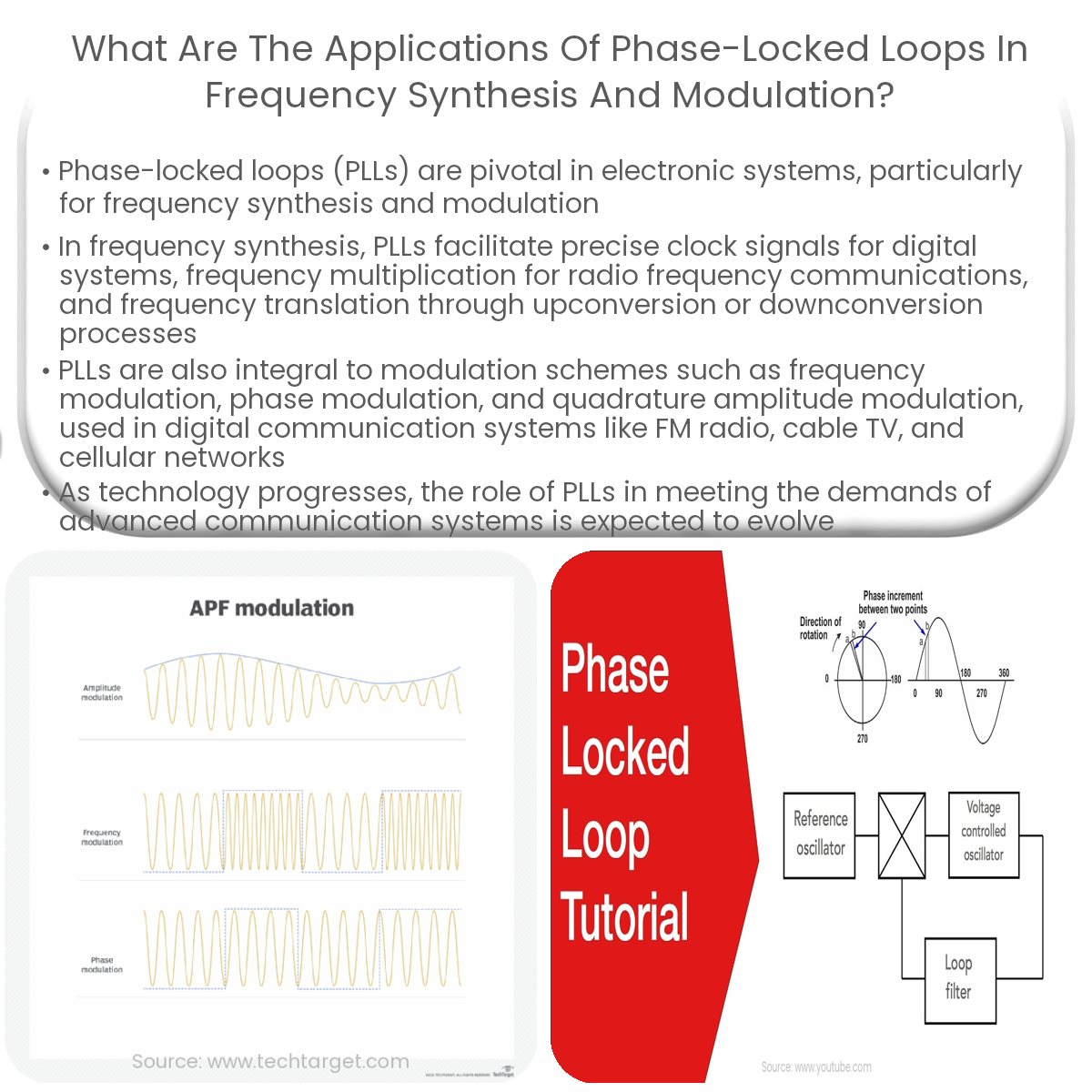
PLLs are used in frequency synthesis for clock generation, multiplication, and translation, as well as modulation techniques like FM, PM, and QAM.
Introduction
Phase-locked loops (PLLs) are widely used in electronic systems for various purposes, including frequency synthesis and modulation. This article highlights some of the key applications of PLLs in these areas.
Frequency Synthesis
PLLs play an essential role in frequency synthesis, which is the process of generating new frequencies from a reference frequency. Some common applications of frequency synthesis using PLLs include:
Clock generation: PLLs are used to create stable, precise clock signals for digital systems such as microprocessors and digital signal processors (DSPs). They can also multiply or divide the input frequency to generate different clock rates.
Frequency multiplication: PLLs can multiply an input frequency to generate higher frequencies required for various applications, such as radio frequency (RF) communications or radar systems.
Frequency translation: PLLs can be used to change the frequency of a signal by adding or subtracting another frequency, useful in RF communications for upconversion or downconversion processes.
Modulation
In addition to frequency synthesis, PLLs are also utilized in modulation schemes to transmit and receive data over various communication channels. Some notable modulation applications include:
Frequency modulation (FM): PLLs can be used to modulate an input signal’s frequency according to the amplitude of another signal. This method is widely used in FM radio broadcasting and wireless communication systems.
Phase modulation (PM): PLLs enable the modulation of a signal’s phase based on the amplitude of another signal, which is employed in digital modulation techniques such as phase-shift keying (PSK).
Quadrature amplitude modulation (QAM): PLLs can be used to combine amplitude and phase modulation to create a more spectrally efficient communication system, widely used in digital communication systems like cable TV and cellular networks.
Conclusion
Phase-locked loops are versatile components in electronic systems, with crucial applications in frequency synthesis and modulation. They play a significant role in generating stable clock signals, frequency multiplication, and frequency translation, as well as enabling various modulation techniques for efficient data communication. As technology advances, PLLs will continue to evolve, meeting the ever-increasing demands of modern communication systems.