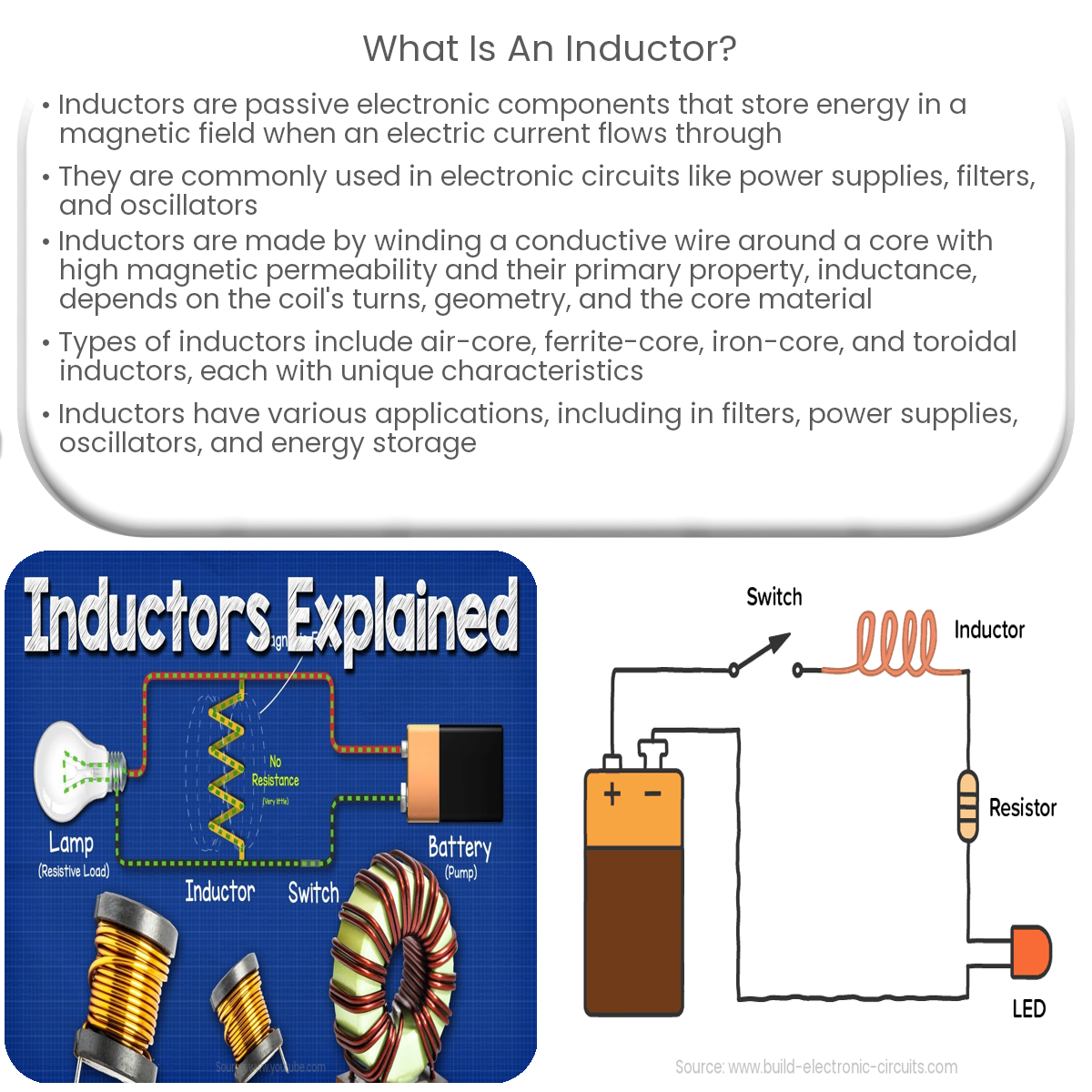
An inductor is a passive electronic component that stores energy in its magnetic field when current flows through it, commonly used in filters and power supplies.
Introduction to Inductors
An inductor is a passive electronic component that stores energy in its magnetic field when an electric current flows through it. Inductors are commonly found in various electronic circuits, such as power supplies, filters, and oscillators. This article will provide a brief overview of inductors, their operation, and applications.
Construction and Operation of Inductors
Inductors are typically constructed by winding a conducting wire, such as copper, around a core made of materials with high magnetic permeability, like iron, ferrite, or even air. The inductor’s primary property is its inductance (L), measured in henrys (H), which depends on the number of turns in the coil, the coil’s geometry, and the core material.
When an alternating current (AC) flows through an inductor, a magnetic field is generated around the coil. This magnetic field stores energy, which is then released back to the circuit when the current decreases. The inductor opposes any change in the current flowing through it, a phenomenon known as “inductive reactance.”
Inductive reactance (XL) can be calculated using the following formula:
XL = 2πfL
Where f is the frequency of the AC signal in hertz (Hz) and L is the inductance in henrys (H).
Types of Inductors
There are several types of inductors, categorized based on their construction and core material. Some common types include:
- Air-core inductors: These inductors have no magnetic core, resulting in low inductance values and reduced core losses.
- Ferrite-core inductors: They use a ferrite core to increase inductance and are widely used in high-frequency applications.
- Iron-core inductors: These inductors use an iron core to achieve higher inductance values but can have significant core losses at high frequencies.
- Toroidal inductors: They are wound on a toroidal-shaped core, offering high inductance and reduced magnetic interference.
Applications of Inductors
Inductors play a vital role in various electronic circuits and systems, including:
- Filters: Inductors are used in low-pass, high-pass, and band-pass filters to remove unwanted frequencies from a signal.
- Power supplies: Inductors are essential components in switch-mode power supplies, helping to stabilize output voltage and current.
- Oscillators: Inductors, along with capacitors, form LC oscillators that generate sinusoidal signals at specific frequencies.
- Energy storage: Inductors store energy in their magnetic field, which can be utilized in energy-harvesting applications.
Conclusion
Inductors are fundamental components in electronic circuits, storing energy in their magnetic field and opposing changes in current. They come in various types and have numerous applications, including filtering, power supplies, oscillators, and energy storage. Understanding the properties and behavior of inductors is essential for designing and analyzing electronic systems.