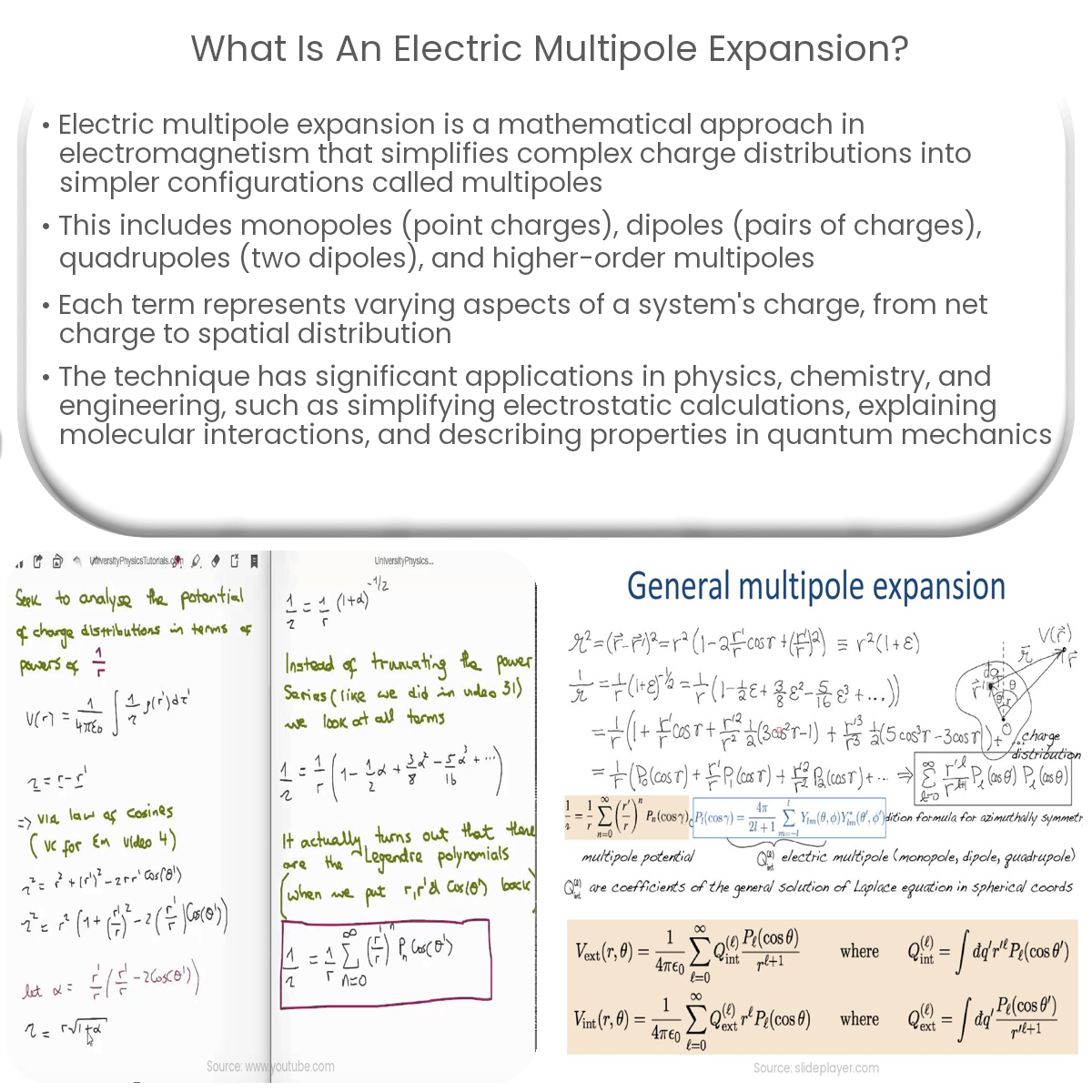
Electric multipole expansion is a technique that approximates complex charge distributions as combinations of simpler multipoles for easier analysis.
Introduction to Electric Multipole Expansion
Electric multipole expansion is a powerful mathematical technique used in electromagnetism to describe complex charge distributions and their interactions with electric fields. In this article, we will discuss the principles, components, and applications of electric multipole expansion.
Principles of Electric Multipole Expansion
Electric multipole expansion is based on the idea that any charge distribution can be approximated as a combination of simpler charge configurations, known as multipoles. The expansion involves a series of terms, each corresponding to a different type of multipole, such as monopoles (point charges), dipoles (pairs of equal and opposite charges), quadrupoles (two dipoles with zero net charge and dipole moment), and higher-order multipoles.
Components of Electric Multipole Expansion
The primary components of electric multipole expansion include:
- Monopole term: Represents the net charge of the system and describes the long-range interaction of the charge distribution with electric fields.
- Dipole term: Represents the net dipole moment of the system, which is the product of the charge and the distance between the positive and negative charges. It describes the first-order spatial variation of the electric field.
- Quadrupole term: Represents the spatial distribution of the charge in the system and its interaction with the electric field. Quadrupoles have zero net charge and dipole moment, making their interactions more complex than those of monopoles and dipoles.
- Higher-order multipoles: Represent more complex charge configurations and are needed to accurately describe the electric field near the charge distribution or in cases where the lower-order terms are insufficient.
Applications of Electric Multipole Expansion
Electric multipole expansion has a wide range of applications in physics, chemistry, and engineering, including:
- Electrostatics: The technique helps simplify the calculation of electric fields and potentials generated by complex charge distributions, providing insights into the behavior of charged particles and the design of electronic devices.
- Molecular interactions: Electric multipole expansion is used to describe the interactions between molecules, which can help explain phenomena such as van der Waals forces, molecular alignment in electric fields, and chemical bonding.
- Quantum mechanics: In quantum mechanics, electric multipole expansion is used to describe the properties of atomic nuclei and their interactions with external electric fields, with implications for nuclear spectroscopy and magnetic resonance imaging (MRI).
In conclusion, electric multipole expansion is a powerful technique used to approximate complex charge distributions as a combination of simpler multipoles, providing a deeper understanding of the interactions between charges and electric fields. The method has diverse applications in various fields, including electrostatics, molecular interactions, and quantum mechanics.