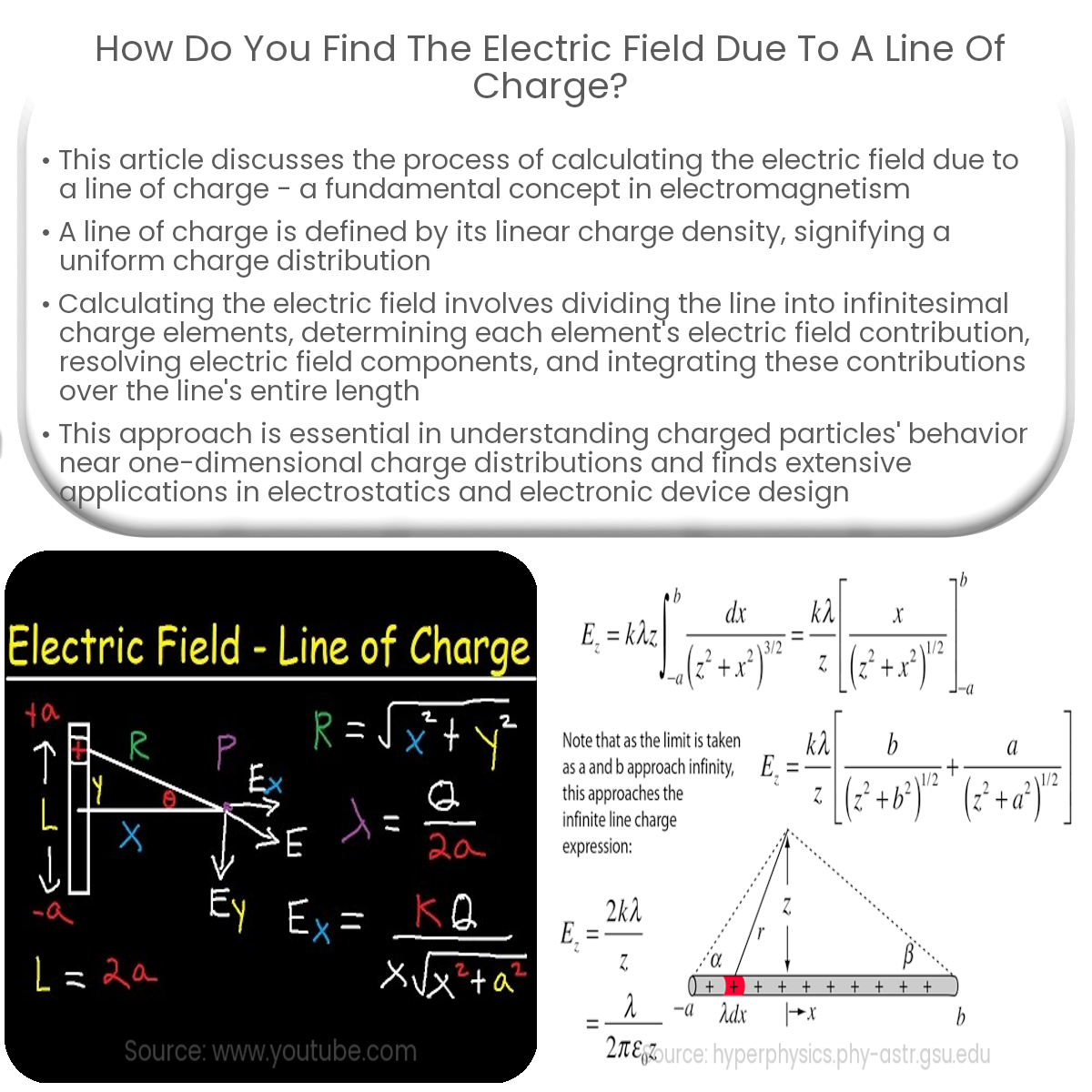
To find the electric field due to a line of charge, divide it into small charge elements, calculate their fields, and integrate the vertical components.
Introduction to the Electric Field Due to a Line of Charge
Calculating the electric field due to a line of charge is a fundamental concept in electromagnetism and essential for understanding the behavior of charged particles in various systems. In this article, we will discuss the process of finding the electric field generated by a uniformly charged line.
Characteristics of a Line of Charge
A line of charge is a one-dimensional charge distribution where the charge is uniformly distributed along its length. The line of charge is characterized by its linear charge density, λ (C/m), which represents the charge per unit length.
Calculating the Electric Field Due to a Line of Charge
To find the electric field due to a line of charge at a point P perpendicular to the line and a distance r away, follow these steps:
- Divide the line into infinitesimally small charge elements: Consider a small section of the line with charge dq and length dx. The infinitesimal charge dq is given by dq = λdx, where λ is the linear charge density.
- Calculate the electric field due to each charge element: The electric field contribution, dE, due to the infinitesimal charge dq is given by dE = (1/4πε0) * (dq / r2), where ε0 is the vacuum permittivity and r is the distance from the charge element to point P.
- Resolve the electric field components: Due to symmetry, the horizontal electric field components will cancel each other out, leaving only the vertical component. The vertical component of the electric field, dEvert, is given by dEvert = dE * cosθ, where θ is the angle between the electric field vector and the vertical direction.
- Integrate the electric field contributions: To find the total electric field at point P, integrate dEvert over the entire length of the charged line. The resulting expression for the electric field will depend on the linear charge density λ, the distance r, and the geometry of the line of charge.
Conclusion
In conclusion, finding the electric field due to a line of charge involves dividing the line into infinitesimal charge elements, calculating the electric field due to each element, resolving the electric field components, and integrating the contributions along the entire line. This approach is crucial for understanding the behavior of charged particles near one-dimensional charge distributions and has numerous applications in electrostatics and electronic device design.