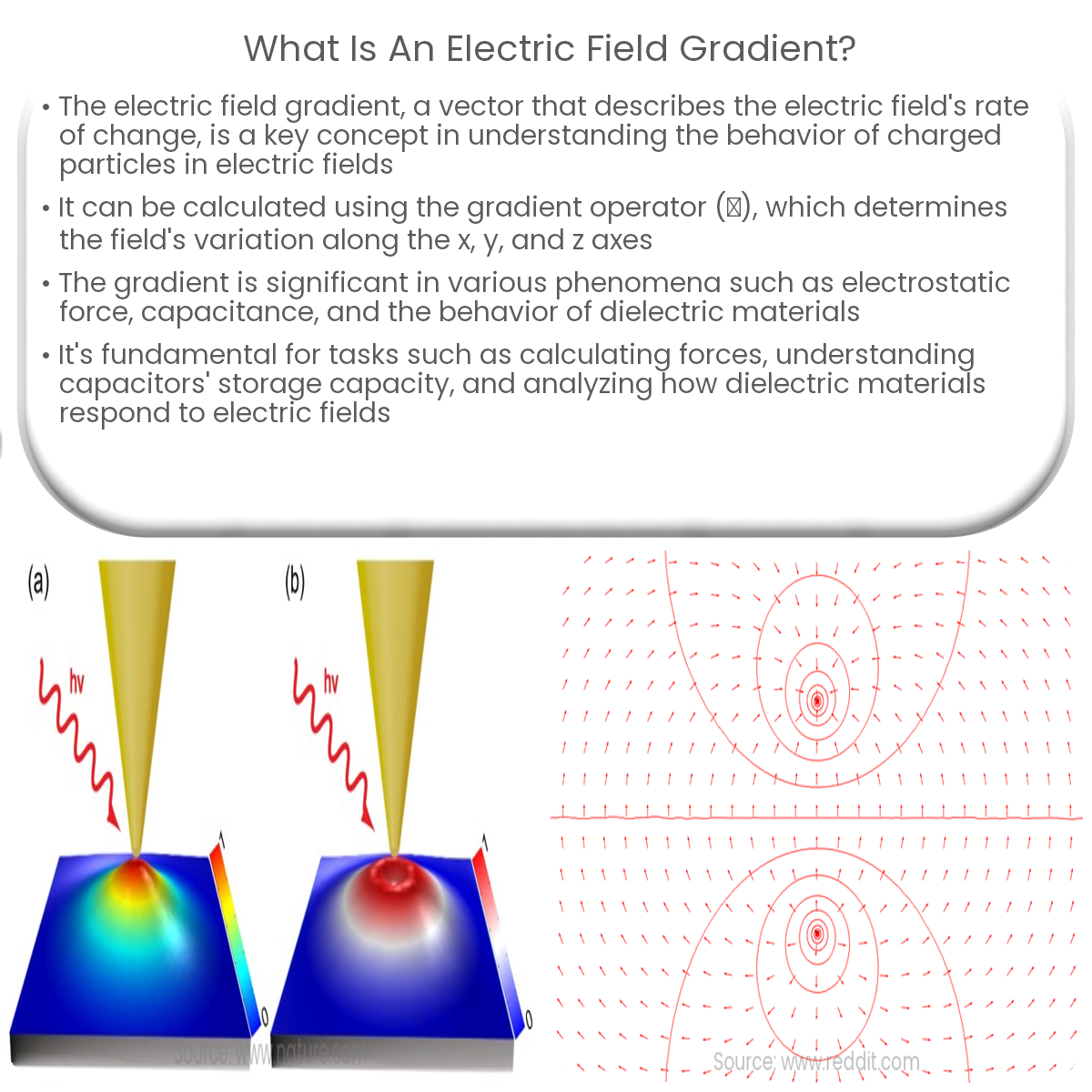
An electric field gradient measures how the electric field changes with respect to position and is crucial in understanding charged particles’ behavior.
Understanding the Electric Field Gradient
An electric field gradient is a measure of how the electric field changes with respect to position within a region of space. It is a vector quantity that describes the rate of change of the electric field in each direction. The electric field gradient is an essential concept in understanding the behavior of charged particles in the presence of electric fields and is particularly important in the analysis of phenomena such as electrostatic force, capacitance, and the behavior of dielectric materials.
Calculating the Electric Field Gradient
The electric field gradient can be determined mathematically using the gradient operator, which is denoted by the symbol ∇ (nabla). The gradient operator, when applied to the electric field vector E, yields the electric field gradient:
∇E = (∂Ex/∂x, ∂Ey/∂y, ∂Ez/∂z)
Here, ∂Ex/∂x, ∂Ey/∂y, and ∂Ez/∂z represent the partial derivatives of the electric field components with respect to the x, y, and z coordinates, respectively. These partial derivatives indicate how the electric field changes along each axis as one moves through the region of space.
Significance of the Electric Field Gradient
The electric field gradient is crucial in various applications and phenomena, such as:
- Electrostatic Force: The gradient of the electric field is directly related to the force experienced by a charged particle in the field. The force is given by F = qE, where q is the charge of the particle and E is the electric field strength. The electric field gradient determines how this force changes with position.
- Capacitance: In capacitors, the electric field gradient can be used to determine the capacitance, which is a measure of a capacitor’s ability to store electric charge. The capacitance is directly related to the electric field strength between the plates and inversely related to the distance between them.
- Dielectric Materials: The electric field gradient plays a significant role in the behavior of dielectric materials in electric fields. A dielectric material’s polarization, which is the separation of positive and negative charges within the material, is influenced by the electric field gradient, affecting the material’s permittivity and overall response to the applied electric field.
In summary, the electric field gradient is an essential concept for understanding the behavior of electric fields and charged particles within them. It has numerous applications in physics and engineering, ranging from electrostatic force calculations to the design and analysis of capacitors and dielectric materials.