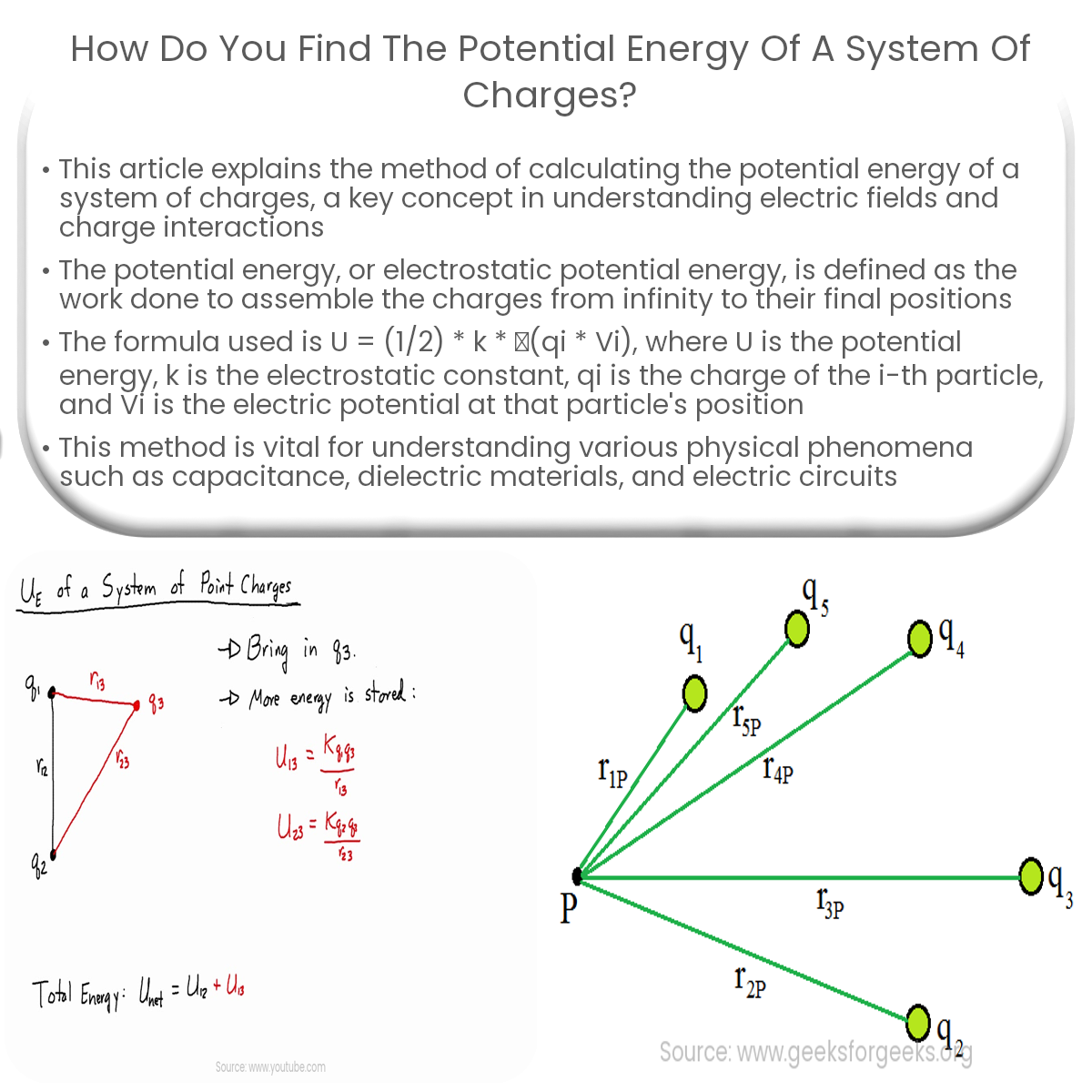
To find the potential energy of a system of charges, use the formula U = (1/2) * k * Σ(qi * Vi), where k is the electrostatic constant.
Finding the Potential Energy of a System of Charges
The potential energy of a system of charges is an essential concept in understanding the behavior of charged particles and their interaction with electric fields. This article explains the method to find the potential energy of a system of charges.
Electrostatic Potential Energy
Electrostatic potential energy is the energy stored in a system of charges due to the electrostatic interactions between the charges. It is defined as the work done to assemble the system of charges by bringing them from infinity to their final positions.
Formula for Potential Energy
To calculate the potential energy of a system of charges, we can use the following formula:
U = (1/2) * k * Σ(qi * Vi)
Where:
- U is the potential energy of the system
- k is the electrostatic constant (8.99 x 10⁹ Nm2/C2)
- qi is the charge of the i-th particle
- Vi is the electric potential at the position of the i-th particle
Procedure to Calculate Potential Energy
- Identify the charges and their positions in the system.
- Calculate the electric potential (Vi) at the position of each charge due to all other charges in the system.
- Multiply each charge (qi) by the electric potential (Vi) at its position.
- Sum up the products obtained in the previous step.
- Multiply the sum by the electrostatic constant (k) and divide by 2 to obtain the total potential energy (U) of the system.
By following these steps, one can calculate the potential energy of a system of charges. This concept is crucial in understanding various phenomena in physics, such as capacitance, dielectric materials, and electric circuits.