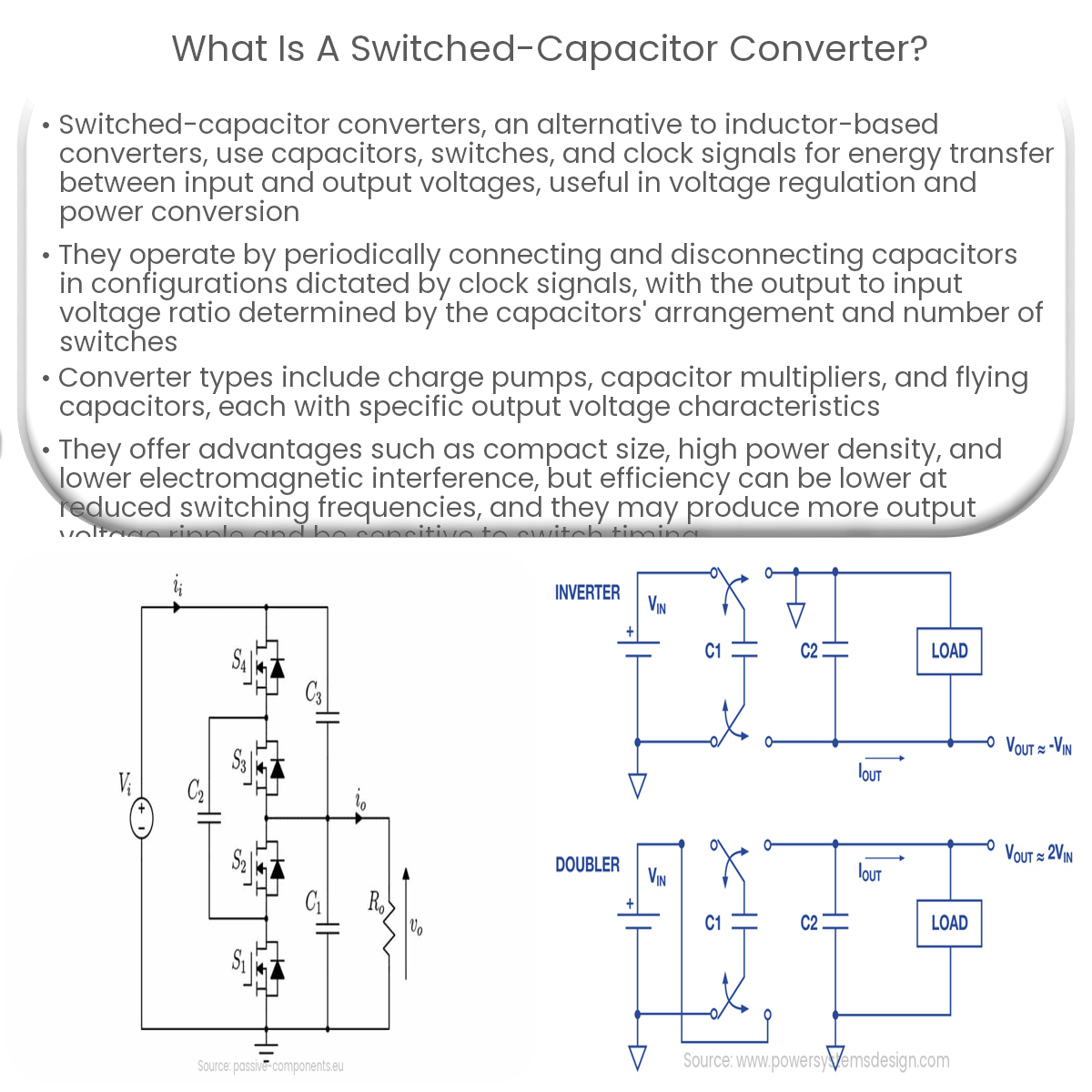
A switched-capacitor converter is an electronic circuit that transfers energy using capacitors, switches, and clock signals for voltage regulation.
Introduction to Switched-Capacitor Converters
A switched-capacitor converter is an electronic circuit that uses capacitors, switches, and clock signals to transfer energy between input and output voltages. They serve as alternatives to traditional inductor-based converters, such as buck, boost, and buck-boost converters. With their unique topology, switched-capacitor converters can provide efficient and compact solutions in various applications, including voltage regulation and power conversion.
Working Principle
Switched-capacitor converters operate by periodically connecting and disconnecting capacitors in specific configurations. The switches, typically MOSFETs, are controlled by clock signals with non-overlapping phases, ensuring no short circuits occur. During each clock cycle, capacitors store energy from the input voltage and then transfer it to the output. The ratio of output to input voltage is determined by the capacitors’ arrangement and the number of switches.
Types of Switched-Capacitor Converters
- Charge Pumps: These converters use a single capacitor and two switches to generate an output voltage that is either an integer multiple or a fractional part of the input voltage. They are commonly used in low-power applications like voltage regulation in microprocessors and memory devices.
- Capacitor Multiplier: This type of converter uses multiple capacitors and switches to generate output voltages that are linear combinations of the input voltage. Capacitor multipliers can provide a more versatile range of output voltages compared to charge pumps.
- Flying Capacitor: Flying capacitor converters use a series of capacitors connected in a ladder configuration to achieve a wide range of output voltages. They can provide high efficiency and low output voltage ripple.
Advantages of Switched-Capacitor Converters
Switched-capacitor converters offer several benefits over inductor-based converters, including:
- Compact size due to the absence of inductors.
- Higher power density and efficiency at high switching frequencies.
- Lower electromagnetic interference (EMI) because of the absence of magnetic components.
- Simple control strategy and easier design and integration into integrated circuits (ICs).
Limitations
Despite their advantages, switched-capacitor converters also have some limitations:
- They typically have a lower efficiency than inductor-based converters at lower switching frequencies.
- Switched-capacitor converters generate more output voltage ripple, which may require additional filtering.
- They are sensitive to switch timing and clock signal quality, which may impact performance and efficiency.
In conclusion, switched-capacitor converters offer an attractive solution for various power conversion applications, particularly where size, weight, and EMI reduction are critical factors. However, their performance is contingent on the specific application and design requirements.