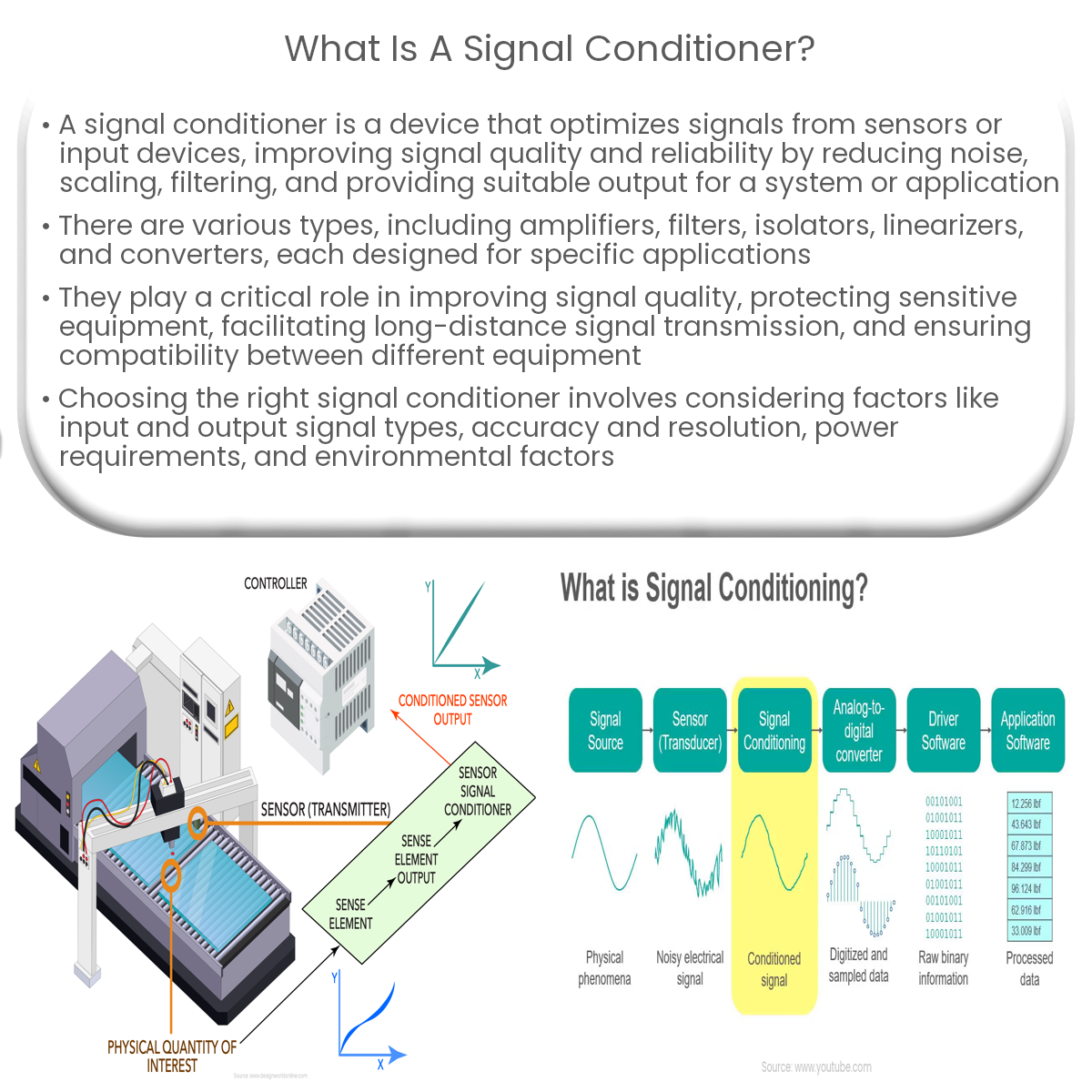
A signal conditioner processes and optimizes signals from sensors or input devices, improving signal quality and compatibility for target systems.
Introduction to Signal Conditioners
A signal conditioner is an electronic device that manipulates and optimizes signals from sensors, transducers, or other input devices, ensuring that the signal is suitable for processing or transmission. The primary goal of a signal conditioner is to improve the quality and reliability of the signal by reducing noise, scaling, or filtering, and providing a suitable output for the target system or application.
Types of Signal Conditioners
There are several types of signal conditioners, each designed for specific applications and signal types. Some common signal conditioners include:
Amplifiers: These devices increase the amplitude of weak signals, making them more detectable and less susceptible to noise.
Filters: Filters remove unwanted frequencies or noise from a signal, allowing only the desired frequency range to pass through.
Isolators: Isolators prevent electrical interference or ground loops by separating the input and output signals through optical or magnetic coupling.
Linearizers: These conditioners correct non-linearities in sensor outputs, ensuring that the output signal is proportional to the input.
Converters: Converters change a signal from one form to another, such as converting an analog signal to a digital one (ADC) or vice versa (DAC).
Why Use Signal Conditioners?
Signal conditioners play a vital role in various applications, particularly in industrial and scientific environments where signals may be weak or contaminated with noise. They are used to:
Improve signal quality and readability, ensuring accurate data acquisition and analysis.
Protect sensitive equipment from damage caused by electrical interference or ground loops.
Facilitate signal transmission over long distances without significant degradation or loss of quality.
Enable compatibility between different types of equipment, such as matching input and output impedance or converting signal types.
Choosing the Right Signal Conditioner
When selecting a signal conditioner for your project, consider the following factors:
Input and output signal types: Ensure compatibility with your specific sensors and data acquisition system.
Accuracy and resolution: Choose a conditioner with adequate performance to meet your application’s requirements.
Power requirements: Some conditioners require external power sources, while others can be powered through the input signal or data acquisition system.
Environmental factors: Consider the operating temperature range, humidity, and other environmental conditions your conditioner will be exposed to.