
How do signal conditioners work in a circuit?

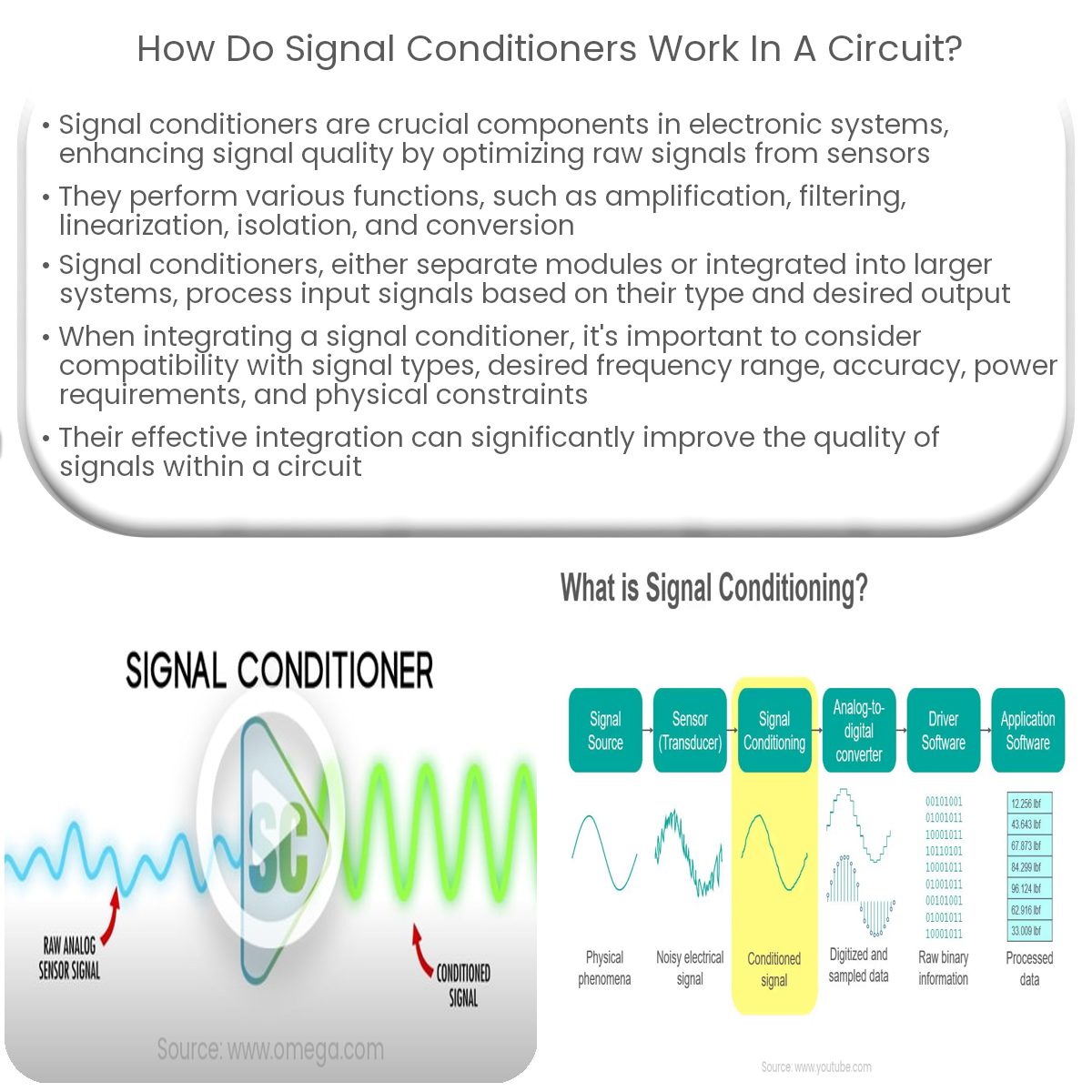
Signal conditioners process and optimize raw signals, performing functions like amplification, filtering, linearization, isolation, and conversion.

Introduction to Signal Conditioners

Signal conditioners are essential components in many electronic systems, particularly those that rely on accurate measurements from sensors. They work by processing and optimizing raw signals, ensuring they are compatible with the target systems and improving their quality.

Functions of Signal Conditioners

Signal conditioners can perform several functions, including:

  • Amplification: Increasing the amplitude of a weak signal to improve its readability and resolution.
  • Filtering: Removing unwanted noise or interference from the signal to improve its quality.
  • Linearization: Transforming a non-linear signal into a linear one for easier interpretation.
  • Isolation: Separating input and output signals to prevent interference or ground loops.
  • Conversion: Converting signals between different formats, such as analog to digital, or vice versa.
  • How Signal Conditioners Work in a Circuit

    Signal conditioners are typically designed as separate modules or integrated into a larger system. The input signal, usually from a sensor, is first received by the signal conditioner. Depending on the type of signal and the desired output, the conditioner will then perform one or more of the aforementioned functions.

    For example, an analog signal might first pass through a filter to remove high-frequency noise. Next, the filtered signal may be amplified to increase its amplitude. If necessary, a linearization process can then be applied to correct any non-linear behavior. Finally, the conditioned signal is output to the target system or converted to a digital format using an analog-to-digital converter (ADC).

    Signal Conditioner Integration

    When integrating a signal conditioner into a circuit, consider the following factors:

  • Input and output signal types: Ensure the signal conditioner is compatible with the input and output signal formats.
  • Bandwidth and frequency range: Choose a signal conditioner that supports the desired frequency range and has sufficient bandwidth.
  • Accuracy and resolution: Select a conditioner that offers the desired level of accuracy and resolution for your application.
  • Power requirements: Consider the power consumption of the conditioner and ensure your system can provide sufficient power.
  • Size and form factor: Select a signal conditioner that fits within the physical constraints of your design.
  • In conclusion, signal conditioners play a crucial role in improving the quality of signals within a circuit. By understanding their functions and considering key factors, you can integrate them effectively into your design.

    How do signal conditioners work in a circuit?

    header - logo

    The primary purpose of this project is to help the public to learn some exciting and important information about electricity and magnetism.

    Privacy Policy

    Our Website follows all legal requirements to protect your privacy. Visit our Privacy Policy page.

    The Cookies Statement is part of our Privacy Policy.

    Editorial note

    The information contained on this website is for general information purposes only. This website does not use any proprietary data. Visit our Editorial note.

    Copyright Notice

    It’s simple:

    1) You may use almost everything for non-commercial and educational use.

    2) You may not distribute or commercially exploit the content, especially on another website.