
What is a charge pump?

A charge pump is a DC-to-DC converter that uses capacitors to generate higher or lower output voltages from an input voltage in low-power applications.

Introduction to Charge Pumps

A charge pump is a type of DC-to-DC converter that uses capacitors as energy storage elements to generate higher or lower output voltages from a given input voltage. Charge pumps offer a simple, low-cost alternative to inductor-based converters, such as buck and boost converters, for applications requiring moderate output current and power levels.

Operation Principle of Charge Pumps

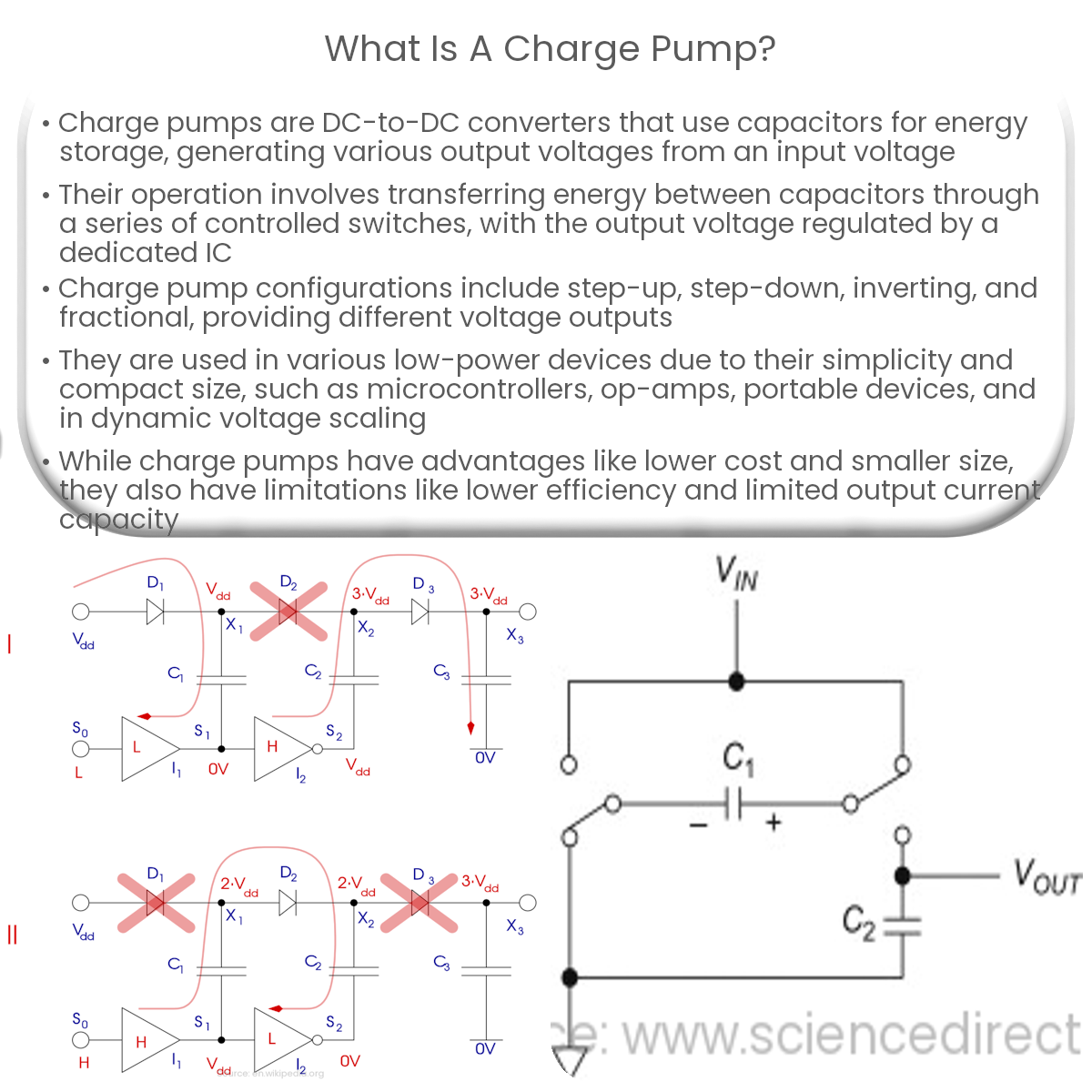
Charge pumps operate by transferring energy between capacitors through a series of controlled switches. The input voltage charges the capacitors, which then release energy to the output, creating a regulated voltage level. The switch control, typically performed by a dedicated integrated circuit (IC), determines the output voltage and regulates it according to the desired level.

Types of Charge Pumps

There are several types of charge pump configurations, depending on the desired output voltage:

  • Step-up (or voltage doubler): This configuration produces an output voltage that is approximately twice the input voltage.
  • Step-down (or voltage divider): This configuration produces an output voltage that is approximately half the input voltage.
  • Inverting: This configuration produces an output voltage that is the inverse of the input voltage.
  • Fractional: This configuration produces an output voltage that is a fraction of the input voltage, typically achieved by using a combination of step-up and step-down stages.
  • Applications of Charge Pumps

    Charge pumps find applications in various electronic devices and systems due to their simplicity, compact size, and low component count. Some common applications include:

  • Power supply voltage conversion for low-power devices, such as microcontrollers, sensors, and analog circuits.
  • Generating a negative supply voltage for op-amps and other analog components that require dual-rail power supplies.
  • Supplying power to white LED backlights in portable devices, such as smartphones and tablets.
  • Generating high voltages for programming non-volatile memory devices, such as EEPROMs and flash memories.
  • Adjusting the output voltage in dynamic voltage scaling applications to optimize power consumption and performance.
  • Advantages and Limitations

    Charge pumps offer several advantages over inductor-based converters, including simplicity, lower cost, smaller size, and lower electromagnetic interference (EMI). However, they also have limitations, such as lower efficiency, limited output current capacity, and higher output voltage ripple. These factors make charge pumps more suitable for low-power applications where the advantages outweigh the limitations.

    What is a charge pump?

    header - logo

    The primary purpose of this project is to help the public to learn some exciting and important information about electricity and magnetism.

    Privacy Policy

    Our Website follows all legal requirements to protect your privacy. Visit our Privacy Policy page.

    The Cookies Statement is part of our Privacy Policy.

    Editorial note

    The information contained on this website is for general information purposes only. This website does not use any proprietary data. Visit our Editorial note.

    Copyright Notice

    It’s simple:

    1) You may use almost everything for non-commercial and educational use.

    2) You may not distribute or commercially exploit the content, especially on another website.