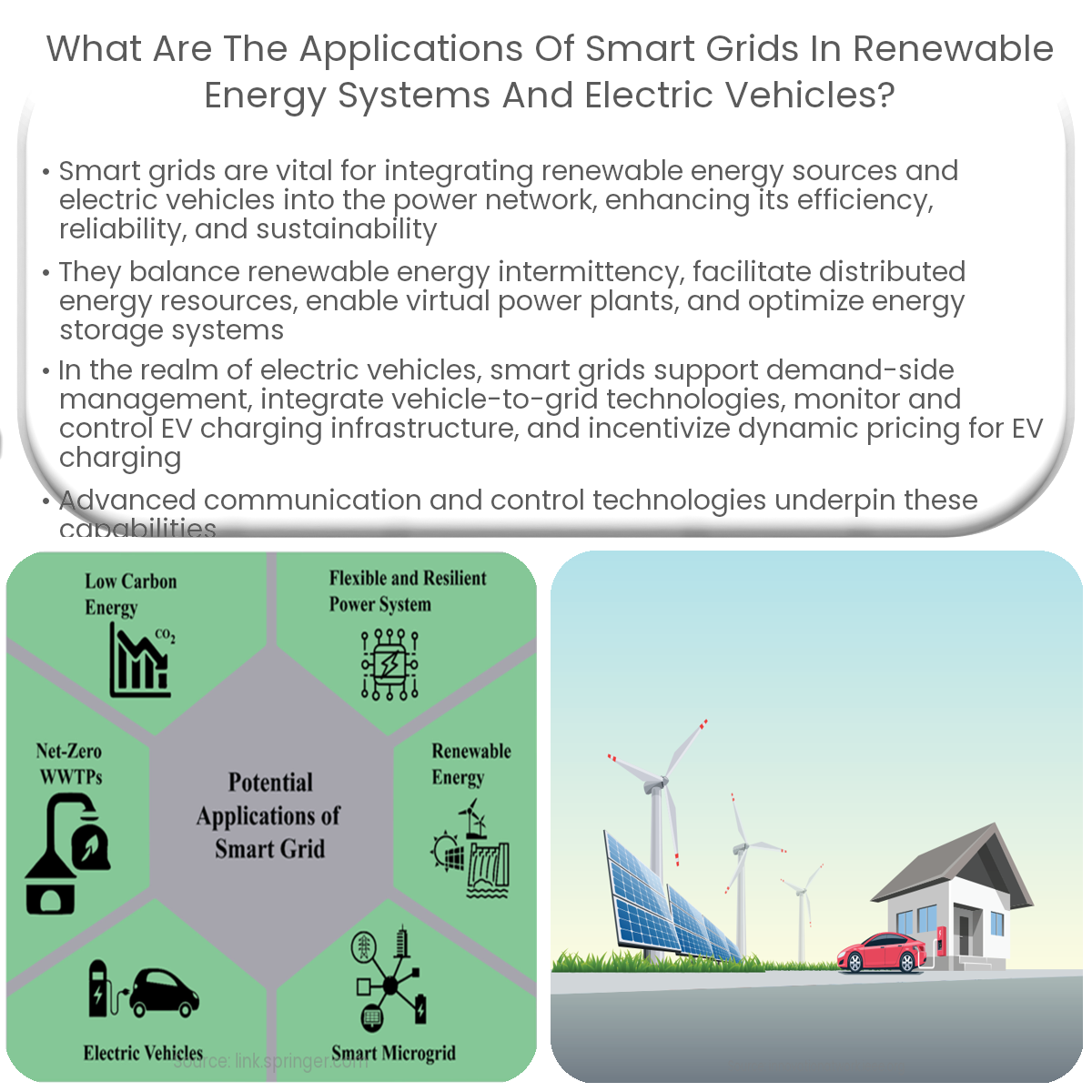
Smart grids integrate renewables, balance supply and demand, support EV charging, and enable vehicle-to-grid tech, enhancing efficiency and reliability.
Applications of Smart Grids in Renewable Energy Systems
Smart grids play a vital role in integrating renewable energy sources into the power network. With the help of advanced communication and control technologies, smart grids can:
- Balance the intermittent nature of renewable energy sources, such as solar and wind, by adjusting power supply and demand in real-time.
- Facilitate the connection of distributed energy resources (DERs), like rooftop solar panels and small-scale wind turbines, to the grid.
- Enable virtual power plants (VPPs) that aggregate and manage distributed energy resources to provide reliable, flexible, and efficient energy supply.
- Optimize the use of energy storage systems, such as batteries and pumped hydro storage, to store excess renewable energy and release it when needed.
Applications of Smart Grids in Electric Vehicles
As electric vehicles (EVs) continue to gain popularity, smart grids play a crucial role in managing their impact on the power system. Smart grids can:
- Support demand-side management by allowing EV owners to charge their vehicles during off-peak hours, when electricity prices are lower and grid stress is reduced.
- Integrate vehicle-to-grid (V2G) technologies, enabling EVs to act as mobile energy storage units that can feed energy back into the grid during peak demand periods.
- Facilitate real-time monitoring and control of EV charging infrastructure, ensuring efficient use of resources and preventing overloading of local distribution networks.
- Enable dynamic pricing and incentives for EV charging, encouraging users to adapt their charging behavior to grid conditions and available renewable energy.
In summary, smart grids play a significant role in integrating renewable energy systems and electric vehicles into the power network. By utilizing advanced communication and control technologies, smart grids can optimize energy generation, distribution, and consumption, resulting in increased efficiency, reliability, and sustainability of the power system.