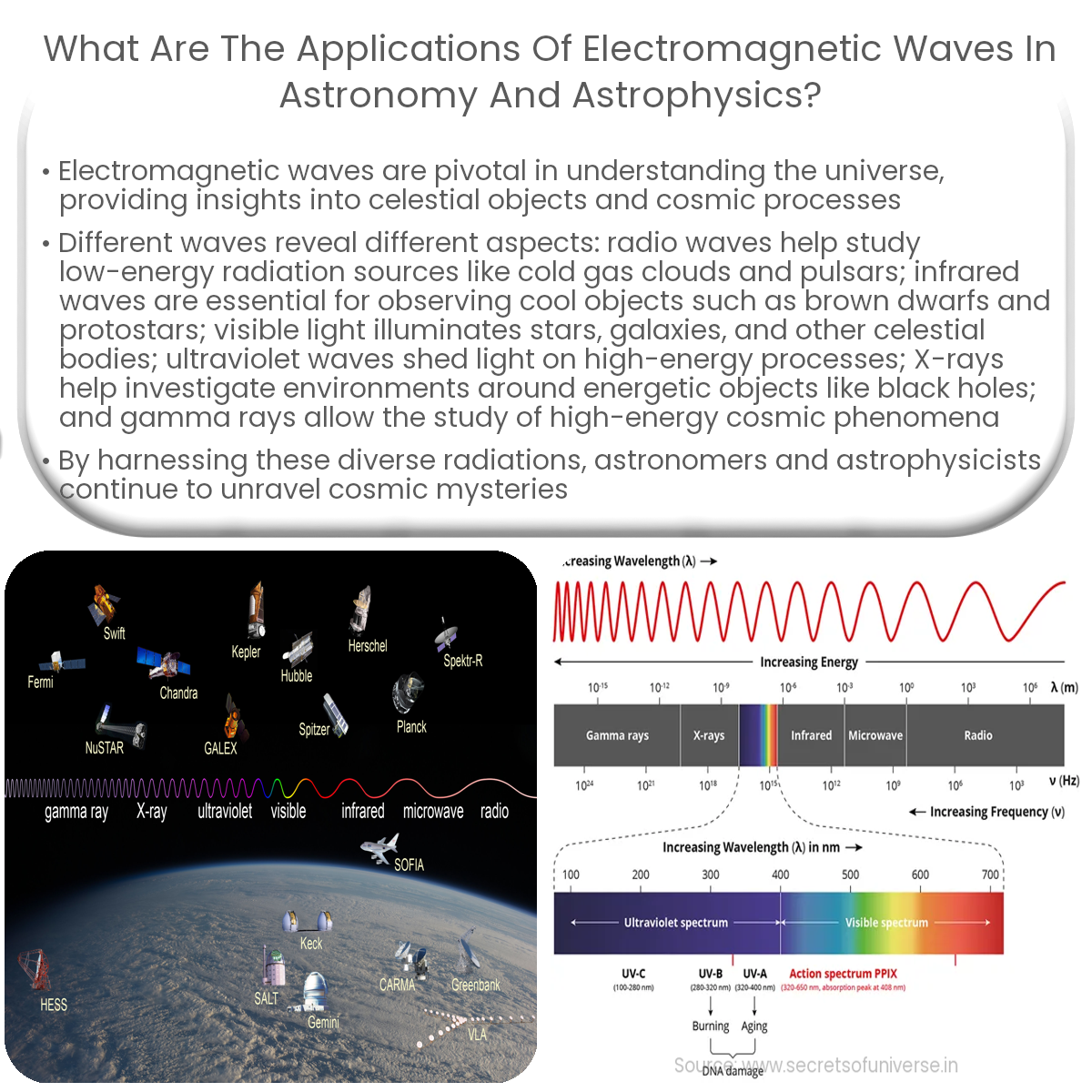
Electromagnetic waves aid in studying celestial objects, revealing their composition, temperature, and motion across various wavelengths.
Applications of Electromagnetic Waves in Astronomy and Astrophysics
Electromagnetic waves play a pivotal role in our understanding of the universe. In astronomy and astrophysics, these waves provide invaluable insights into the nature of celestial objects and the fundamental processes occurring in the cosmos. This article explores the key applications of electromagnetic waves in these scientific disciplines.
1. Radio Astronomy
- Radio waves, with wavelengths ranging from millimeters to tens of meters, enable astronomers to study celestial bodies that emit low-energy radiation, such as cold gas clouds and pulsars. Radio telescopes detect these signals, allowing scientists to map and analyze these objects.
2. Infrared Astronomy
- Infrared waves, which have wavelengths longer than visible light but shorter than radio waves, are crucial for studying cool objects like brown dwarfs and protostars. Infrared telescopes can penetrate interstellar dust clouds, offering glimpses of star-forming regions otherwise obscured in visible light.
3. Optical Astronomy
- Visible light, or optical waves, has been the backbone of astronomy for centuries. Optical telescopes capture images of stars, galaxies, and other celestial bodies, helping astronomers learn about their composition, temperature, and motion. The Hubble Space Telescope is a notable example of an optical observatory.
4. Ultraviolet Astronomy
- Ultraviolet (UV) waves, which are shorter in wavelength than visible light, are emitted by hot, young stars and active galactic nuclei. UV astronomy focuses on studying these high-energy processes, providing insights into the early universe and the formation of galaxies.
5. X-ray Astronomy
- X-rays, with even shorter wavelengths than UV light, are emitted by highly energetic objects like supernovae, neutron stars, and black holes. X-ray observatories, such as the Chandra X-ray Observatory, enable scientists to probe extreme environments and investigate the behavior of matter under intense gravitational forces.
6. Gamma-Ray Astronomy
- Gamma rays, the most energetic form of electromagnetic radiation, are produced by cosmic phenomena such as supernovae, gamma-ray bursts, and the decay of radioactive isotopes. Gamma-ray telescopes, like the Fermi Gamma-ray Space Telescope, help astronomers study these high-energy events and their implications for the cosmos.
In conclusion, electromagnetic waves encompass a wide range of wavelengths, each revealing unique aspects of the universe. By leveraging these different types of radiation, astronomers and astrophysicists continue to deepen our understanding of the cosmos and unravel the mysteries of celestial objects and phenomena.