Explore the theory, types, applications, and significance of Voltage-to-Current converters in modern electronic systems.
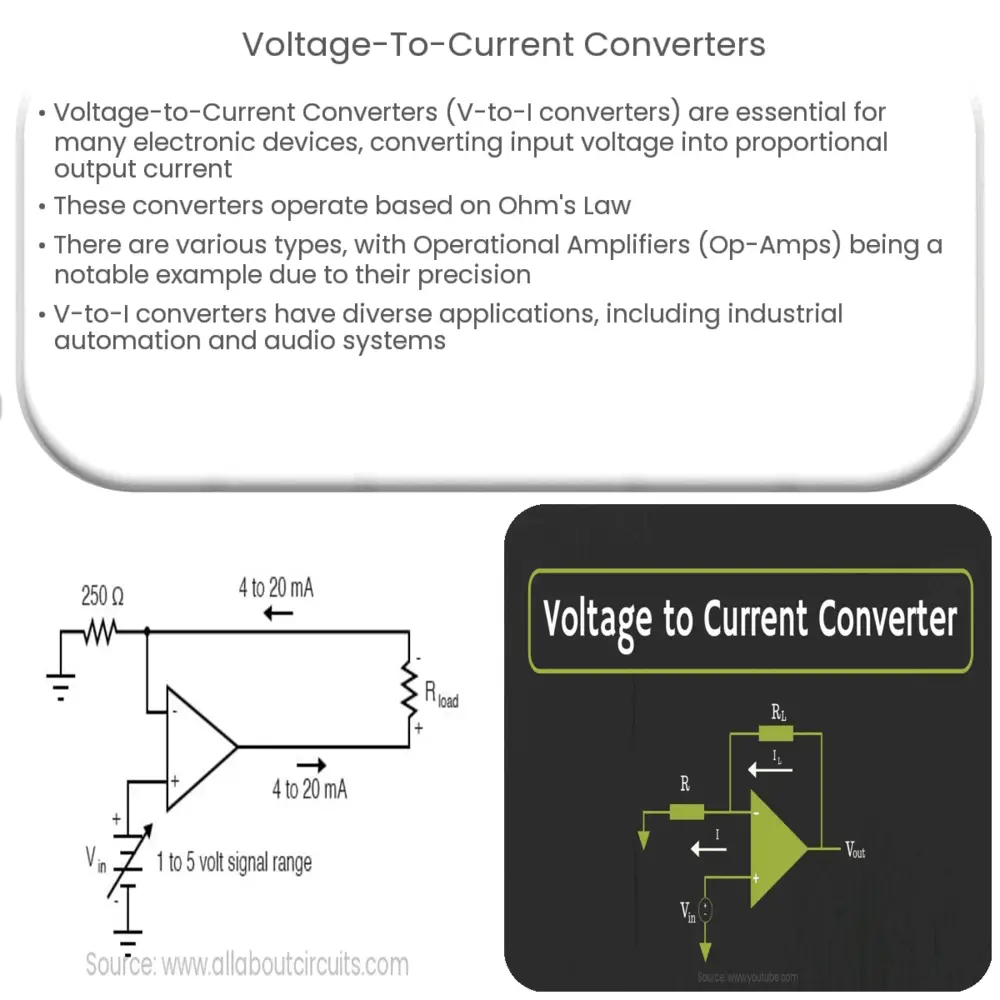
Understanding Voltage-to-Current Converters
Voltage-to-Current Converters, often abbreviated as V-to-I converters, are a crucial component in many electronic devices and systems. They perform the pivotal role of converting an input voltage into a proportional output current. This conversion allows devices to effectively communicate, control, and power different elements of a system.
The Theory Behind Voltage-to-Current Converters
At its core, a V-to-I converter operates based on Ohm’s Law, which states that the current through a conductor between two points is directly proportional to the voltage across the two points. The law is usually expressed in the equation form as I = V/R, where I represents current, V represents voltage, and R represents resistance. Thus, by controlling the resistance, the converter can effectively modulate the current in response to changes in voltage.
Types of Voltage-to-Current Converters
- Simple V-to-I Converters: The simplest form of a V-to-I converter uses a resistor to convert the voltage to current. However, the precision and efficiency of these converters are typically lower compared to more complex designs.
- Op-Amp V-to-I Converters: Operational Amplifiers (Op-Amps) are commonly used in V-to-I converters for their superior performance. They use feedback mechanisms to maintain an equilibrium, resulting in precise and consistent output currents.
Applications of Voltage-to-Current Converters
Voltage-to-Current converters find extensive use in diverse applications. Here are a few:
- Industrial Automation: In industrial automation systems, V-to-I converters are used to control various elements like valves, actuators, and sensors. These components often require current for operation, making V-to-I converters an indispensable part of the system.
- Audio Systems: Audio devices often employ V-to-I converters to amplify the signal before it reaches the speakers. The converters help ensure that the speakers receive a current that accurately represents the original audio signal.
This overview provides a basic understanding of voltage-to-current converters, their operation, types, and applications. In the next part, we will delve deeper into the detailed working principle of these converters and their significance in modern electronic systems.
Working Principle of Voltage-to-Current Converters
A voltage-to-current converter utilizes a resistor, transistor, or operational amplifier to convert an input voltage into a corresponding output current. The operational principle is based on Ohm’s law and the understanding that an increase in voltage across a fixed resistance leads to an increase in current.
For instance, consider an operational amplifier-based V-to-I converter. The op-amp is typically arranged in a configuration with a feedback resistor. The input voltage is applied to the non-inverting terminal, and the inverting terminal is grounded. According to the properties of an op-amp, both input terminals try to maintain the same voltage. Therefore, when a voltage is applied at the non-inverting terminal, a current flows through the feedback resistor proportional to the input voltage, thereby accomplishing the voltage-to-current conversion.
Significance of Voltage-to-Current Converters
Voltage-to-Current converters are indispensable in modern electronic systems, owing to their ability to facilitate precise control over various components. As electronic devices become more sophisticated, the demand for more accurate and efficient converters grows.
Moreover, these converters aid in mitigating the effects of load impedance variations in a system. By converting voltage signals to current, they ensure a consistent signal is delivered to the load, irrespective of its impedance. This makes V-to-I converters vital for the stability of many electronic systems.
Future Prospects
With the rapid advancements in electronics, the future of V-to-I converters looks promising. Their application in emerging technologies such as IoT (Internet of Things), autonomous vehicles, and advanced industrial automation underscores their relevance in the era of Industry 4.0 and beyond.
Conclusion
In summary, Voltage-to-Current converters play a significant role in electronic systems, from industrial automation to audio systems. They provide an efficient way to control various electronic components by converting voltage signals into a proportional current. Understanding the operation and importance of these converters is vital for anyone seeking a deeper understanding of electronics. As we continue to push the boundaries of electronic and digital technology, the role of these essential components is set to become even more pivotal.