
A video decoder is a hardware or software component that decodes compressed video data, enabling smooth playback and synchronized audio.
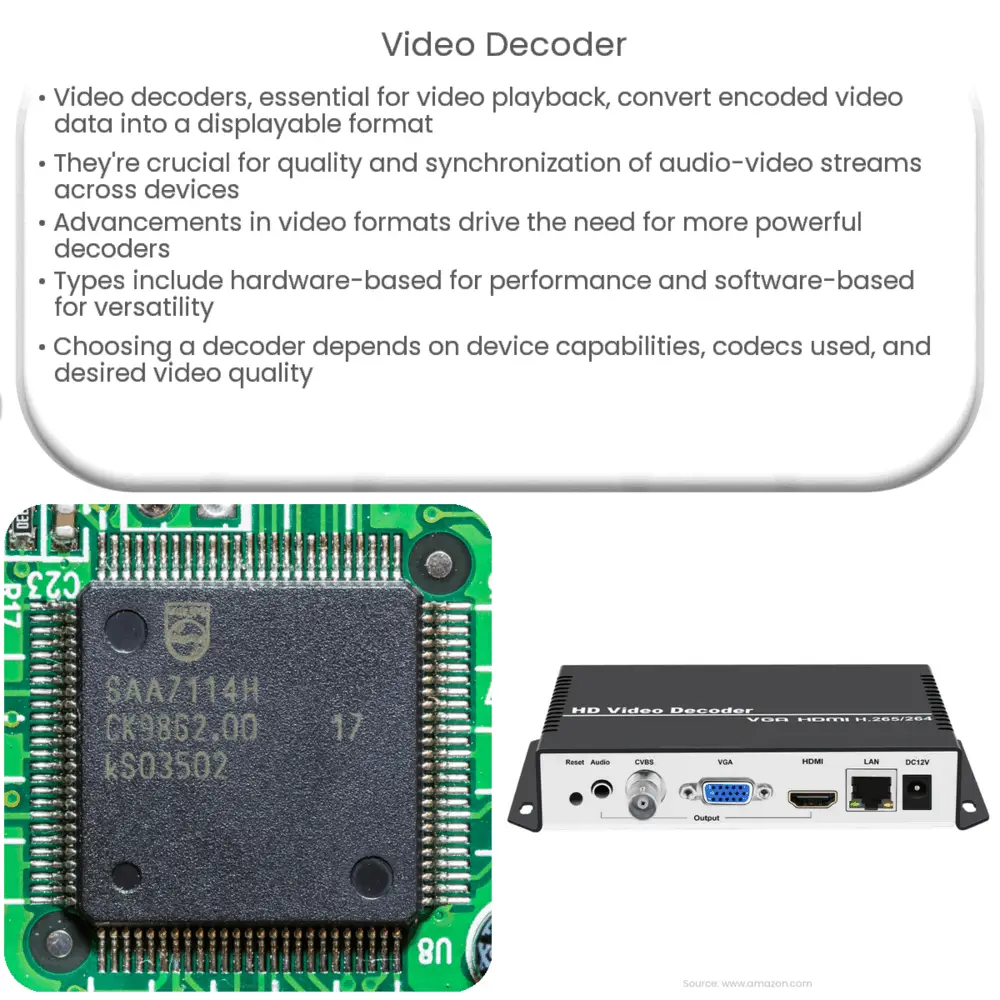
Understanding Video Decoders: An Essential Component for Video Playback
As digital technology continues to evolve, video decoders play an increasingly important role in our daily lives. From streaming platforms to social media, video content is everywhere, and the quality of the viewing experience relies heavily on the performance of video decoders. In this article, we will explore the basics of video decoders, their importance, and how they function in the context of video playback.
What is a Video Decoder?
A video decoder is a hardware or software component that translates encoded video data into a format that can be displayed on a screen. When video files are created, they are often compressed to save storage space and reduce the amount of data that needs to be transmitted for streaming. This compression is achieved through a process called encoding, which removes redundant information and efficiently organizes the data. A video decoder reverses this process by interpreting the encoded data and reconstructing the original video frames for playback.
Why are Video Decoders Important?
Video decoders are crucial for the smooth playback of video content on various devices, including smartphones, computers, and televisions. They ensure that the compressed video data is accurately and efficiently converted back to its original form, preserving the quality and integrity of the content. Additionally, video decoders are responsible for synchronizing the audio and video streams, ensuring that they play in harmony without any noticeable delays or inconsistencies.
As video resolutions and formats continue to advance, the demand for more powerful and efficient video decoders increases. Higher resolutions, such as 4K and 8K, require more data to be processed, and advanced codecs like H.265/HEVC and AV1 offer improved compression efficiency but require more processing power to decode. As a result, the development of video decoders plays a critical role in the growth and evolution of the digital video landscape.
How Do Video Decoders Work?
Video decoders work by interpreting the encoded video data and performing a series of complex mathematical operations to reconstruct the original video frames. The process typically involves several stages:
- Bitstream parsing: The decoder reads the encoded video data and identifies the various components, such as header information, frame types, and motion vectors.
- Inverse quantization: The decoder reverses the quantization process applied during encoding to restore the original pixel values.
- Inverse transformation: The decoder applies an inverse transformation, such as the Discrete Cosine Transform (DCT), to convert the pixel values back to their spatial domain representation.
- Motion compensation: The decoder uses motion vectors to reconstruct the original frames by predicting the movement of objects within the scene.
- Deblocking filtering: The decoder smooths out any block artifacts that may have been introduced during the encoding process.
Once the video frames have been reconstructed, they are combined with the synchronized audio stream and displayed on the screen for the viewer to enjoy.
Types of Video Decoders
There are two primary types of video decoders: hardware-based and software-based decoders. Each has its advantages and drawbacks, depending on the specific use case and device capabilities.
- Hardware-based decoders: These decoders are integrated into the device’s hardware, such as a graphics processing unit (GPU) or a dedicated video processing chip. Hardware-based decoders offer superior performance and lower power consumption, making them ideal for devices with limited resources, such as smartphones and tablets. However, they may not always support the latest codecs or features, as updates to the hardware can be more challenging and less frequent than software updates.
- Software-based decoders: These decoders rely on the device’s central processing unit (CPU) to perform the decoding process. Software-based decoders can be easily updated to support new codecs and features, making them more versatile and future-proof. However, they typically consume more system resources and may not perform as well as hardware-based decoders, particularly on devices with limited processing power.
Selecting the Right Video Decoder
Choosing the appropriate video decoder depends on several factors, such as the device’s capabilities, the codecs used, and the desired video quality. Here are some guidelines to help you make an informed decision:
- Consider the device’s hardware capabilities and whether it has built-in support for hardware-based decoding.
- Check if the device’s operating system and software support the required codecs and formats.
- Take into account the processing power of the device and whether it can handle the demands of the chosen video decoder, particularly for high-resolution content and advanced codecs.
- Assess the compatibility of the video decoder with other components of the video playback system, such as media players, streaming platforms, and content delivery networks.
Conclusion
Video decoders play a critical role in the video playback experience, ensuring that compressed video data is accurately and efficiently converted back to its original form. As digital video technology continues to advance, the importance of video decoders grows, making it essential for users and developers to understand their role and how they function. By considering the factors discussed in this article, you can select the right video decoder for your needs and enjoy a seamless, high-quality video experience.



