
Explore the world of Vertical Cavity Surface Emitting Lasers (VCSELs), their unique characteristics, applications, and future prospects.
Introduction to VCSEL
The technology landscape has seen remarkable innovations, with one such groundbreaking advancement being the Vertical Cavity Surface Emitting Laser (VCSEL). VCSELs have emerged as a central component in various modern applications due to their superior characteristics and performance.
Understanding the Concept of VCSEL
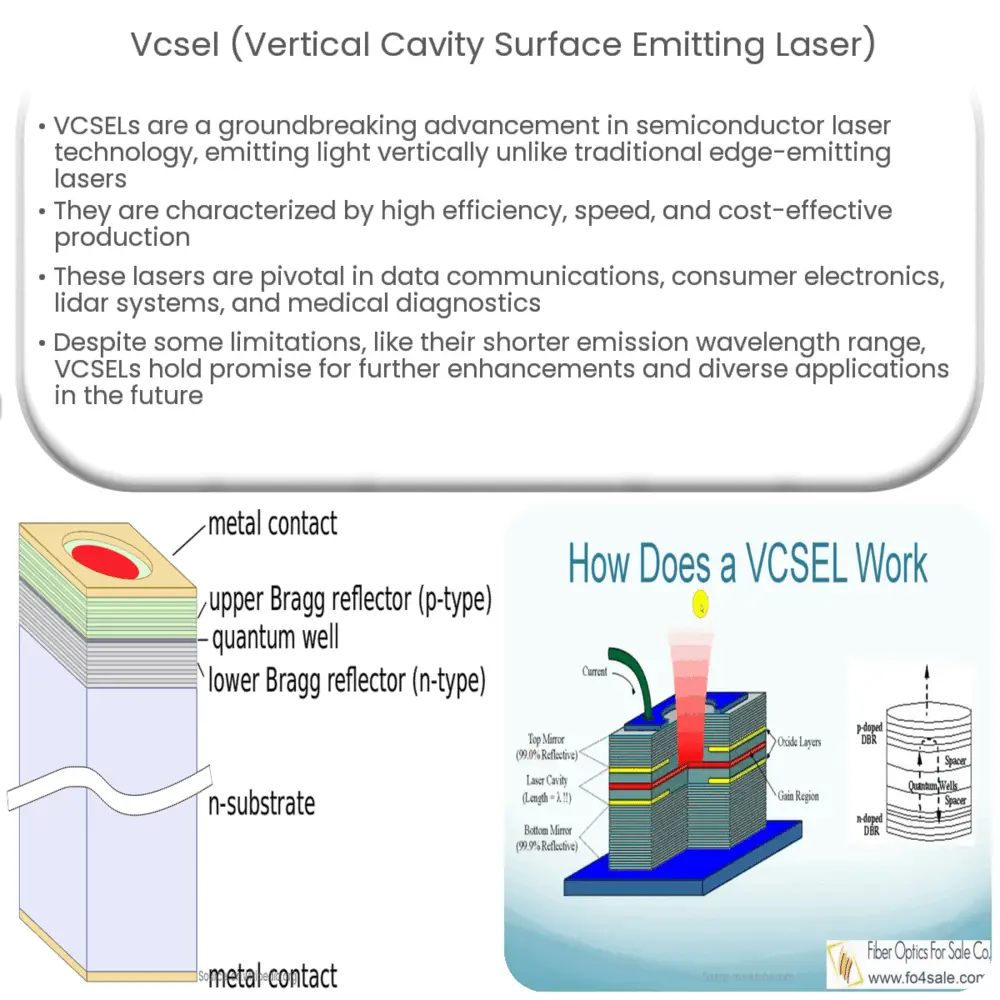
The VCSEL is a type of semiconductor laser diode, unique for its vertical emission. Unlike conventional edge-emitting lasers that emit light from a small facet on the side of the chip, VCSELs emit light perpendicular to the wafer surface. This design comes with numerous advantages, leading to a broad range of applications.
Key Characteristics of VCSEL
- High Efficiency: VCSELs are known for their high power conversion efficiency, leading to less energy waste and lower operating costs.
- Beam Properties: They produce a circular, low divergence beam which simplifies coupling to optical fibers and facilitates array formation.
- High Speed: VCSELs can modulate directly at very high frequencies, often exceeding several tens of GHz.
- Cost-Effective Production: VCSELs can be tested and characterized on-wafer before they are cleaved into individual chips, reducing production costs.
Working Principle of VCSEL
The VCSEL comprises numerous thin layers of different semiconductor materials, stacked on top of each other. These layers form a pair of mirrors with an active layer, or quantum well, in between where light is generated. The light reflects back and forth between the mirrors, amplifying in intensity with each pass through the quantum well until it is emitted out of the top of the device.
Applications of VCSEL
VCSELs have found their way into various applications due to their unique properties. Here are some key areas:
- Data Communications: They are extensively used in short to medium reach (1–300 meters) data communications typically found in data centers and high-performance computing clusters.
- Consumer Electronics: VCSELs are now a fundamental part of modern smartphones and other consumer electronics, providing functionality for 3D sensing and facial recognition.
Further Applications of VCSEL
- Lidar Systems: VCSEL technology is increasingly being employed in lidar systems for autonomous vehicles, drones, and other robotics, benefiting from the high power and beam quality VCSELs can offer.
- Industrial Sensing: Their unique characteristics make VCSELs ideal for a range of industrial sensing applications, including distance sensing and 3D imaging.
- Medical Diagnostics: The use of VCSELs is also expanding into medical diagnostic equipment and therapeutic applications, such as optical coherence tomography (OCT).
Future Prospects of VCSEL Technology
Given the rapid pace of technological development, the demand for VCSELs is expected to continue to rise. This is particularly true as more devices and systems require high-speed, efficient, and compact light sources. VCSELs’ potential to be manufactured in high volumes at low costs makes them a promising technology for future optical communication systems and various sensing applications.
Challenges and Limitations
Despite their many advantages, VCSELs are not without challenges. One of the primary limitations is their relatively short emission wavelength range. Most VCSELs operate in the near-infrared region, limiting their use in applications requiring different wavelengths. Additionally, while VCSELs are more energy-efficient than traditional lasers, their power output is generally lower. Researchers are addressing these challenges, and we can expect further improvements in VCSEL technology.
Conclusion
In conclusion, VCSELs represent a significant advancement in semiconductor laser technology, offering numerous advantages over traditional edge-emitting lasers. Their high efficiency, high speed, excellent beam properties, and cost-effective production have made them an integral part of various applications, from data communications and consumer electronics to lidar systems and medical diagnostics. Despite certain limitations, ongoing research and advancements hold the promise of expanding the application range and improving the performance of VCSELs. As we navigate our way into an increasingly digital future, VCSEL technology will undoubtedly continue to play a critical role in shaping the technological landscape.



