Semiconductors
In general, semiconductors are inorganic or organic materials that can control their conduction depending on chemical structure, temperature, illumination, and the presence of dopants. The name semiconductor comes from the fact that these materials have electrical conductivity between a metal, like copper, gold, etc., and an insulator, like glass. They have an energy gap of less than 4eV (about 1eV). In solid-state physics, this energy gap or band gap is an energy range between the valence band and conduction band where electron states are forbidden. In contrast to conductors, semiconductors’ electrons must obtain energy (e.g., from ionizing radiation) to cross the band gap and reach the conduction band. The properties of semiconductors are determined by the energy gap between valence and conduction bands.
Types of Semiconductors
Semiconductors can be classified into two basic types based on their electronic properties:
- Intrinsic Semiconductors: These are pure semiconductors that are made up of a single element (e.g., Silicon, Germanium) and have no intentional doping with impurities. Intrinsic semiconductors have a specific number of electrons in their valence band and conduction band. They conduct electricity when they are heated, and some electrons gain sufficient energy to break free from their bonds and become free electrons in the conduction band.
- Extrinsic Semiconductors: These are impure semiconductors that are intentionally doped with impurities to change their electronic properties. Extrinsic semiconductors can be further classified into two types:
- p-type semiconductors: In p-type semiconductors, impurity atoms such as boron are introduced into the semiconductor material. These impurities have fewer valence electrons than the semiconductor material, which results in “holes” (absence of electrons) being created in the valence band. These holes can conduct current like positive charge carriers, which gives the material its p-type designation.
- n-type semiconductors: In n-type semiconductors, impurity atoms such as phosphorus are introduced into the semiconductor material. These impurities have more valence electrons than the semiconductor material, which creates excess electrons in the conduction band. These excess electrons can conduct current like negative charge carriers, which gives the material its n-type designation.
Here is a table with 3 intrinsic semiconductors and 2 p-type and n-type semiconductors, along with 4 key properties:
| Semiconductor | Type | Band Gap (eV) | Electron Mobility (cm²/Vs) | Hole Mobility (cm²/Vs) | Thermal Conductivity (W/mK) |
|---|---|---|---|---|---|
| Silicon (Si) | Intrinsic | 1.12 | 1500 | 450 | 150 |
| Germanium (Ge) | Intrinsic | 0.67 | 3900 | 1900 | 60 |
| Gallium Arsenide (GaAs) | Intrinsic | 1.43 | 8500 | 400 | 46 |
| Boron-doped Silicon (p-Si) | p-type | 1.12 | 1500 | 1800 | 150 |
| Phosphorus-doped Silicon (n-Si) | n-type | 1.12 | 1500 | 4500 | 150 |
| Aluminum-doped Gallium Arsenide (p-GaAs) | p-type | 1.43 | 8500 | 200 | 46 |
| Silicon-doped Gallium Arsenide (n-GaAs) | n-type | 1.43 | 8500 | 800 | 46 |
Semiconductor Materials
There are many types of semiconductors in nature and others synthesized in laboratories; however, the best known are silicon (Si) and germanium (Ge).
Types of semiconductors:
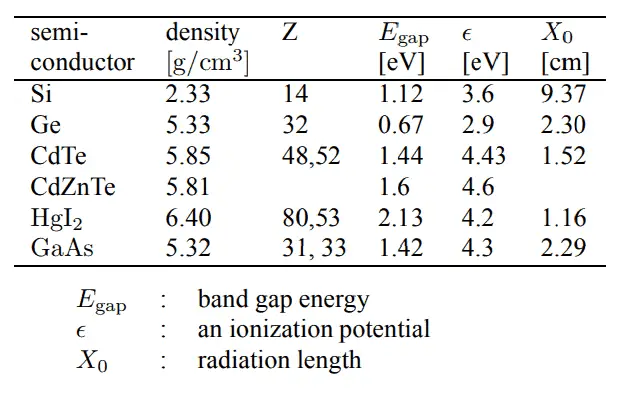
- Silicon. Silicon is a chemical element with the atomic number 14, meaning there are 14 protons and 14 electrons in the atomic structure. The chemical symbol for Silicon is Si. Silicon is a hard and brittle crystalline solid with a blue-grey metallic luster, and it is a tetravalent metalloid and semiconductor. Silicon is mainly used for charged particle detectors (especially for tracking charged particles) and soft X-ray detectors. The large band-gap energy (Egap= 1.12 eV) allows us to operate the detector at room temperature, but cooling is preferred to reduce noise. Silicon-based detectors are very important in high-energy physics. Since silicon-based detectors are very good for tracking charged particles, they constitute a substantial part of the detection system at the LHC in CERN.
- Germanium. Germanium is a chemical element with the atomic number 32, which means there are 32 protons and 32 electrons in the atomic structure. The chemical symbol for Germanium is Ge. Germanium is a lustrous, hard, grayish-white metalloid in the carbon group, chemically similar to its group neighbors, tin and silicon. Pure germanium is a semiconductor with an appearance similar to elemental silicon. Germanium is widely used for gamma-ray spectroscopy. In gamma spectroscopy, germanium is preferred due to its atomic number being much higher than silicon, increasing the probability of gamma-ray interaction. Germanium is more used than silicon for radiation detection because the average energy necessary to create an electron-hole pair is 3.6 eV for silicon and 2.9 eV for germanium, which provides the latter a better resolution in energy. On the other hand, germanium has a small band gap energy (Egap = 0.67 eV), which requires operating the detector at cryogenic temperatures.
- Diamond. Diamond is a solid form of the element carbon with its atoms arranged in a crystal structure called diamond cubic. Diamonds are also very good electrical insulators, which are both useful and problematic for electrical devices. Diamond is a wide-bandgap semiconductor (Egap= 5.47 eV) with high potential as an electronic device material in many devices. Diamond detectors have many similarities with silicon detectors but are expected to offer significant advantages, particularly high radiation hardness and very low drift currents.
- CdTe and CdZnTe. Cadmium telluride (CdTe) and cadmium zinc telluride (CdZnTe) are promising semiconductor materials for hard X-ray and gamma-ray detection. These materials’ high atomic number and density mean they can effectively attenuate X-rays and gamma rays with energies greater than 20 keV that traditional silicon-based sensors cannot detect. This significantly increases their quantum efficiency in comparison with silicon-based. The large band-gap energy (Egap= 1.44 eV) allows us to operate the detector at room temperature. On the other hand, a considerable amount of charge loss in these detectors produces a reduced energy resolution.