
Explore the importance of timers in daily life and technology, from managing daily tasks to orchestrating complex computing systems.
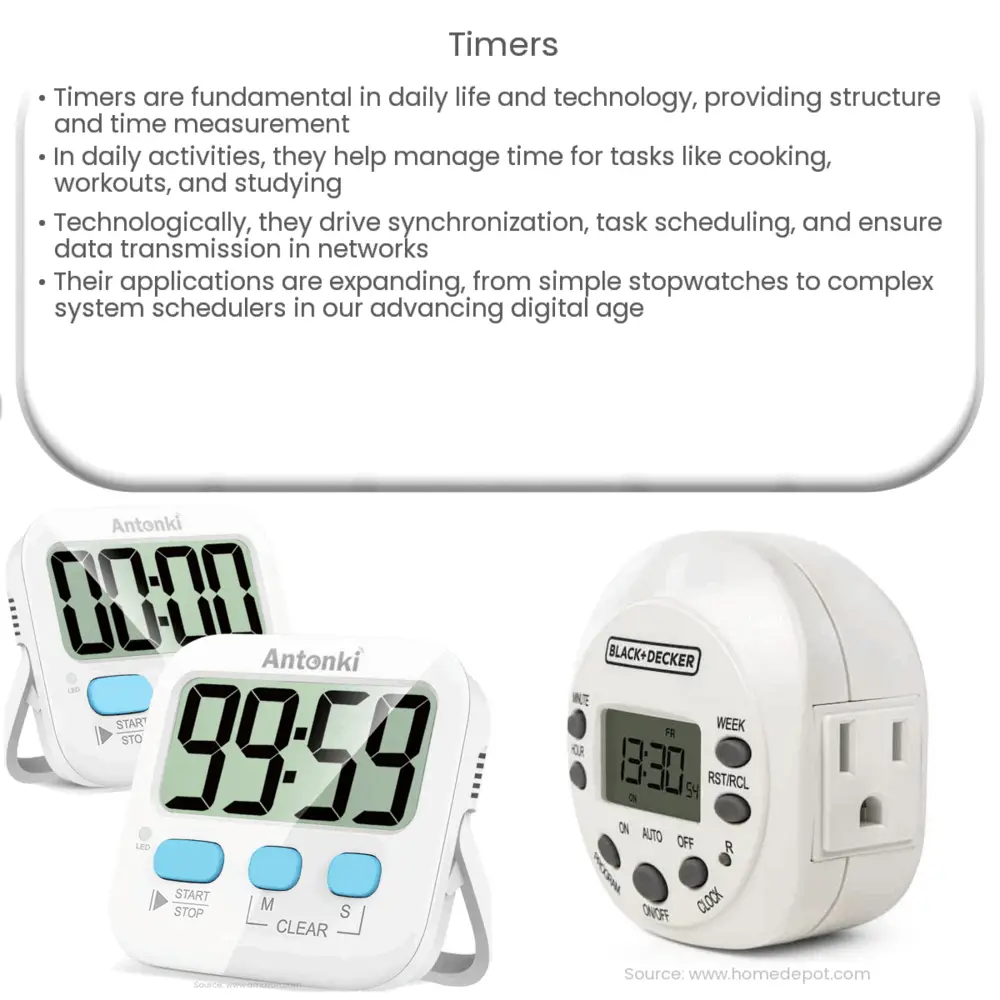
Understanding Timers
Timers are a fundamental concept in every aspect of life, from our daily routines to the intricate operations of our computer systems. They provide structure and allow us to measure the progress of time in a systematic manner. A timer can be as simple as a stopwatch or as complex as a system-wide scheduler in an operating system.
The Role of Timers in Everyday Life
Timers serve numerous functions in our day-to-day activities. We use them to manage our time effectively, set alarms for waking up, and measure intervals for cooking, exercising, studying, or other tasks. They allow us to manage our resources, particularly time, efficiently and effectively.
- Cooking Timers: Many kitchen appliances come with built-in timers. For example, when baking, a timer ensures the food is not over or undercooked by providing a notification when the set time has elapsed.
- Workout Timers: Fitness enthusiasts often rely on timers for interval training. They help to segment workouts into high-intensity periods and rest periods for effective training.
- Study Timers: The “Pomodoro Technique” is a popular study method where timers are used to divide study sessions into focused intervals, typically 25 minutes long, separated by short breaks.
The Role of Timers in Technology
In the realm of technology, timers assume an even more significant role. They are an integral part of computing systems, networks, and applications, driving synchronization, scheduling tasks, measuring performance, and creating delays where necessary.
- Operating System Schedulers: In computing, an operating system uses timers to allocate CPU time to various processes. This time-sharing allows multiple processes to execute ‘simultaneously’ on a single-core CPU.
- Network Timers: In network protocols like TCP, timers ensure data sent over a network reaches its destination, resending it if an acknowledgment isn’t received within a set time.
- Application Timers: Many software applications use timers for tasks like auto-saving work, user session management, and more.
Understanding the nature and utility of timers not only enables us to use them effectively in our daily lives but also provides insights into the complex mechanisms that govern the operation of our digital devices.
Timers in Programming
In the world of programming, timers are also essential tools. They are used to control the execution of programs, manage resources, and offer functionality like countdowns, timeouts, and intervals.
- Timeouts: In programming, a timeout is a specified period of time that a program will wait for a certain event to occur. If the event does not occur within that time, the program will execute a certain piece of code, typically to handle the ‘timeout’ error.
- Intervals: Intervals allow programmers to execute a block of code repeatedly at a specified time interval. This is useful for tasks that need to be run continuously at regular intervals, like updating a user interface or polling a server for data.
The Future of Timers
As we move further into the digital age, timers are becoming increasingly sophisticated and integrated into our lives. From smart home devices that automate household tasks to the implementation of real-time systems in industries such as healthcare and aviation, the applications of timers are continually expanding.
Conclusion
In conclusion, timers, from simple stopwatch apps to intricate system schedulers, play an indispensable role in our everyday life and in the realm of technology. They provide structure, enable efficiency, and allow for the precise measurement and allocation of time. As we continue to advance technologically, it’s clear that the significance of timers will only continue to grow. Whether it’s managing our daily activities or orchestrating the operation of complex computer systems, timers indeed make the world ‘tick’.



