
Explore the role and types of switches in daily life, digital electronics, and network systems, and discover their integral contribution to technological advancement.
Understanding the Importance of Switches
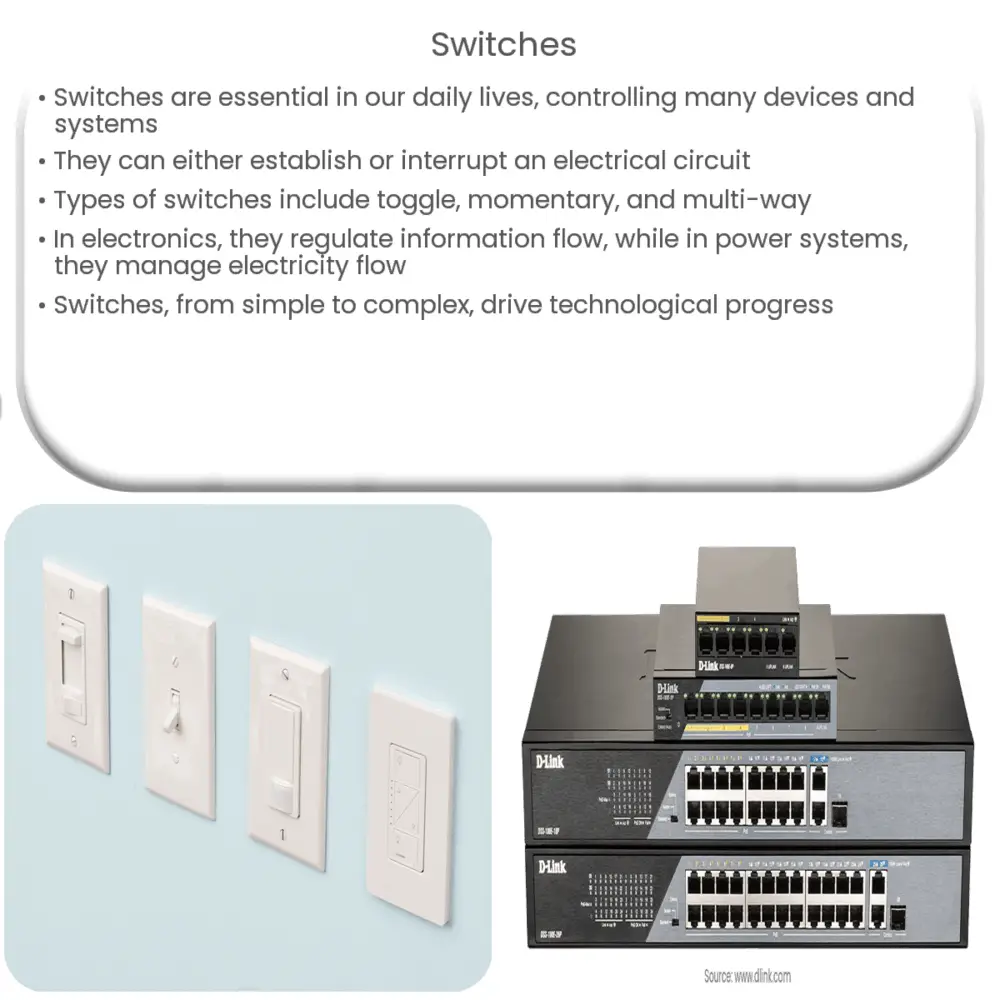
Switches are an integral part of our everyday lives, whether we realize it or not. Their primary function is to establish or interrupt an electrical circuit, allowing or preventing the flow of current. A seemingly simple device, the switch’s intricate functionality provides us with the capacity to control many devices and systems in our homes, workplaces, and virtually any technology-driven space.
The Fundamentals of Switches
At the most basic level, a switch is a device that can either break (open) or complete (close) an electrical circuit. This action enables the control of electrical devices, which could range from a simple light bulb to complex machinery. In essence, flipping a switch either allows electrical current to flow, turning the device ‘on’, or prevents the flow of current, turning the device ‘off’. This binary ‘on-off’ functionality is a core aspect of digital electronics and computer systems.
Types of Switches
- Toggle Switches: These are some of the most common types of switches. They maintain their state until flipped, making them ideal for applications where continuous power is required.
- Momentary Switches: As the name suggests, these switches only maintain their state while being actuated. Once released, they return to their original position. Common examples include a computer keyboard or a doorbell.
- Multi-way Switches: These are more complex, designed for controlling a single device from two or more locations. A common use is in a house, where you can turn on or off a light from different points.
The Role of Switches in Electronics
Switches are a cornerstone of electronic systems. In digital circuits, they are used to control the logical flow of information, a critical function in all types of digital electronics, from computers and smartphones to digital watches and calculators. These switches are usually not physically manipulated; instead, they are controlled by electronic signals. The presence or absence of these signals (representing ‘1’ and ‘0’, respectively) determines whether the switch is ‘on’ or ‘off’.
Importance in Telecommunications
In telecommunications, the term ‘switch’ refers to a device that connects and directs data packets between different network devices or network segments. These switches form a significant part of our internet infrastructure, providing reliable and efficient data transfer.
Switches in Networking
In the context of network infrastructure, switches play a crucial role in ensuring efficient communication between different network devices. Switches connect various devices on a network, including servers, workstations, and other hardware, and manage the flow of data packets. They perform a crucial function in reducing congestion, ensuring data packets are directed only to the devices they are intended for, thus optimizing network performance.
Switches in Power Systems
In power systems, switches are used to control the flow of electricity. These range from circuit breakers that protect an electrical circuit from damage caused by excess current, to light switches that provide a convenient way to control lighting. These switches ensure safety and offer a means to control the usage of electricity in an efficient manner.
Types of Switching Methods
- Circuit Switching: Traditionally used in telephone networks, this switching method establishes a dedicated communication path between the source and the destination.
- Packet Switching: Used in digital networks, this switching method divides the data into packets and sends them separately to the destination, where they are reassembled.
- Message Switching: An older switching method, where the entire message is routed from one machine to another until it reaches its destination.
Microscopic Switches – Transistors
On a microscopic level, switches exist as transistors in digital circuits. A transistor is essentially a tiny switch controlled by an electrical signal. These transistors, numbering in the billions in modern-day processors, serve as the building blocks of digital electronics, enabling the development and advancement of modern-day computing technology.
Conclusion
In conclusion, switches, in their various forms and functions, are fundamental to our technology-driven world. They play crucial roles in various fields, from simple household appliances to complex digital networks and power systems. The switch’s ability to control and regulate the flow of electricity and data is a testament to its importance in our day-to-day lives and its contribution to technological advancement. Whether it is a simple light switch or a complex network switch, these devices continue to be the unseen heroes of our technological progress.



