
Spot infrared thermometers provide quick, accurate, non-contact temperature measurements for various industries and applications.
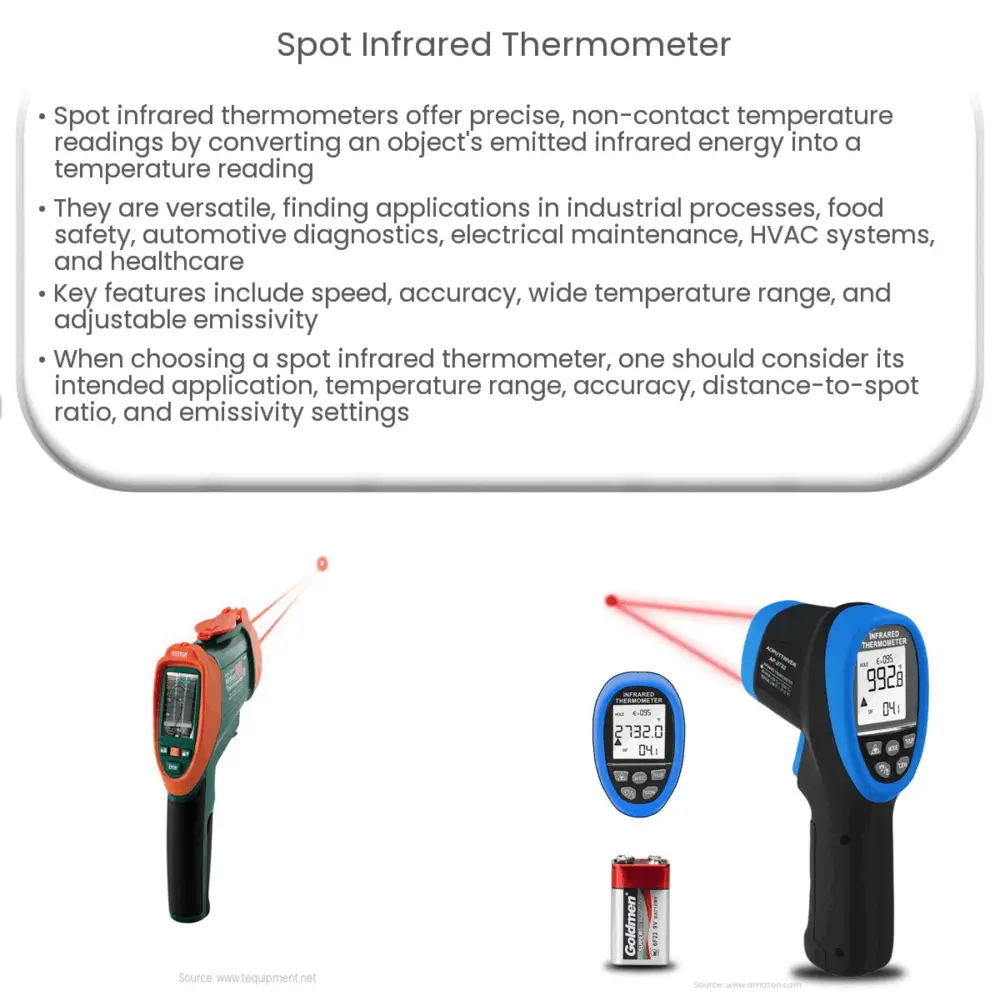
Spot Infrared Thermometers: A Comprehensive Guide
Introduction
In today’s fast-paced world, ensuring accurate temperature measurements is crucial for a variety of applications across industries. One such device that provides rapid and precise temperature readings is the spot infrared thermometer. In this article, we will delve into the science behind these devices, their uses, and how they can benefit your operations.
Understanding Infrared Thermometers
Infrared thermometers, also known as IR thermometers or pyrometers, are non-contact temperature measuring devices that utilize infrared radiation to determine the temperature of an object’s surface. These devices operate by detecting the infrared energy emitted by an object and converting it into an electrical signal. This signal is then processed by the device’s electronics and displayed as a temperature reading.
How Do Spot Infrared Thermometers Work?
Spot infrared thermometers consist of an infrared sensor, an optical system, and a processing unit. The sensor is responsible for detecting the infrared energy emitted by the object being measured. The optical system, typically a lens, focuses the energy onto the sensor. Finally, the processing unit converts the electrical signal generated by the sensor into a temperature reading. This reading is then displayed on the device’s screen.
These thermometers have a distance-to-spot (D:S) ratio that determines the size of the area being measured at a specific distance. For example, a D:S ratio of 12:1 means that the thermometer measures a 1-inch diameter spot at a 12-inch distance from the object. A higher D:S ratio indicates a more focused measurement, which is beneficial for measuring smaller areas or objects from a distance.
Applications and Uses
Spot infrared thermometers offer a wide range of applications across various industries due to their non-contact, rapid, and accurate temperature measurement capabilities. Some common uses include:
- Industrial processes: Monitoring the temperature of equipment and machinery, such as motors, bearings, and conveyor belts, to prevent overheating and ensure optimal performance.
- Food safety: Ensuring proper cooking, cooling, and storage temperatures to prevent foodborne illnesses and maintain product quality.
- Automotive diagnostics: Identifying hot spots or temperature discrepancies in engines, radiators, and brakes to address potential issues.
- Electrical maintenance: Detecting overheating components in electrical panels and circuits to prevent damage and ensure safety.
- HVAC systems: Inspecting heating, ventilation, and air conditioning systems for temperature imbalances and inefficiencies.
- Healthcare: Quickly screening individuals for elevated body temperatures, such as during fever checks in pandemic scenarios.
As we have seen, spot infrared thermometers play a vital role in various industries and applications. In the next part of this article, we will explore the benefits and features of these devices, as well as tips for selecting the best spot infrared thermometer for your needs.
Benefits and Features of Spot Infrared Thermometers
Spot infrared thermometers offer numerous advantages over traditional contact thermometers. Some key benefits and features include:
- Non-contact measurement: By eliminating the need for direct contact with the object being measured, spot infrared thermometers reduce the risk of contamination and damage to surfaces. This is particularly useful in food safety, healthcare, and sensitive electronic applications.
- Speed: These devices provide nearly instantaneous temperature readings, allowing users to quickly and efficiently gather data from multiple points or scan large areas.
- Accuracy: Spot infrared thermometers are known for their high accuracy, with some models offering a margin of error as low as ±1% or even better.
- Wide temperature range: These devices can measure a broad range of temperatures, from extremely low to very high, making them suitable for diverse applications.
- Adjustable emissivity: Many spot infrared thermometers have adjustable emissivity settings, which allow users to account for the object’s surface material and obtain more accurate readings.
Choosing the Right Spot Infrared Thermometer
Selecting the best spot infrared thermometer for your needs involves considering several factors. Here are some tips to help you make an informed decision:
- Identify your application: Determine the primary use for the thermometer, as this will dictate the specific features and specifications you require, such as temperature range, accuracy, and D:S ratio.
- Consider the temperature range: Ensure the device can measure the temperature range needed for your application. Some models may not be suitable for extreme temperatures.
- Evaluate accuracy: Choose a thermometer with an accuracy level that meets your requirements. Higher accuracy often comes at a higher cost, so balance the need for precision with your budget.
- Check the D:S ratio: Select a thermometer with a suitable D:S ratio for your needs. A higher ratio is better for measuring small areas or objects from a distance, while a lower ratio may suffice for less demanding applications.
- Adjustable emissivity: If your application involves measuring a variety of surface materials, consider a device with adjustable emissivity to improve accuracy.
- Additional features: Some spot infrared thermometers offer added features, such as data logging, alarms, and connectivity options. Determine if any of these features will be beneficial for your specific application.
Conclusion
Spot infrared thermometers are versatile, non-contact temperature measuring devices that have become essential tools in various industries. By understanding the science behind these devices, their applications, and how to choose the right one, you can ensure accurate temperature readings and improve the efficiency and safety of your operations.