
Explore the role and significance of signal analyzers in electronics and telecommunications, their types, functions, advancements, and future prospects.
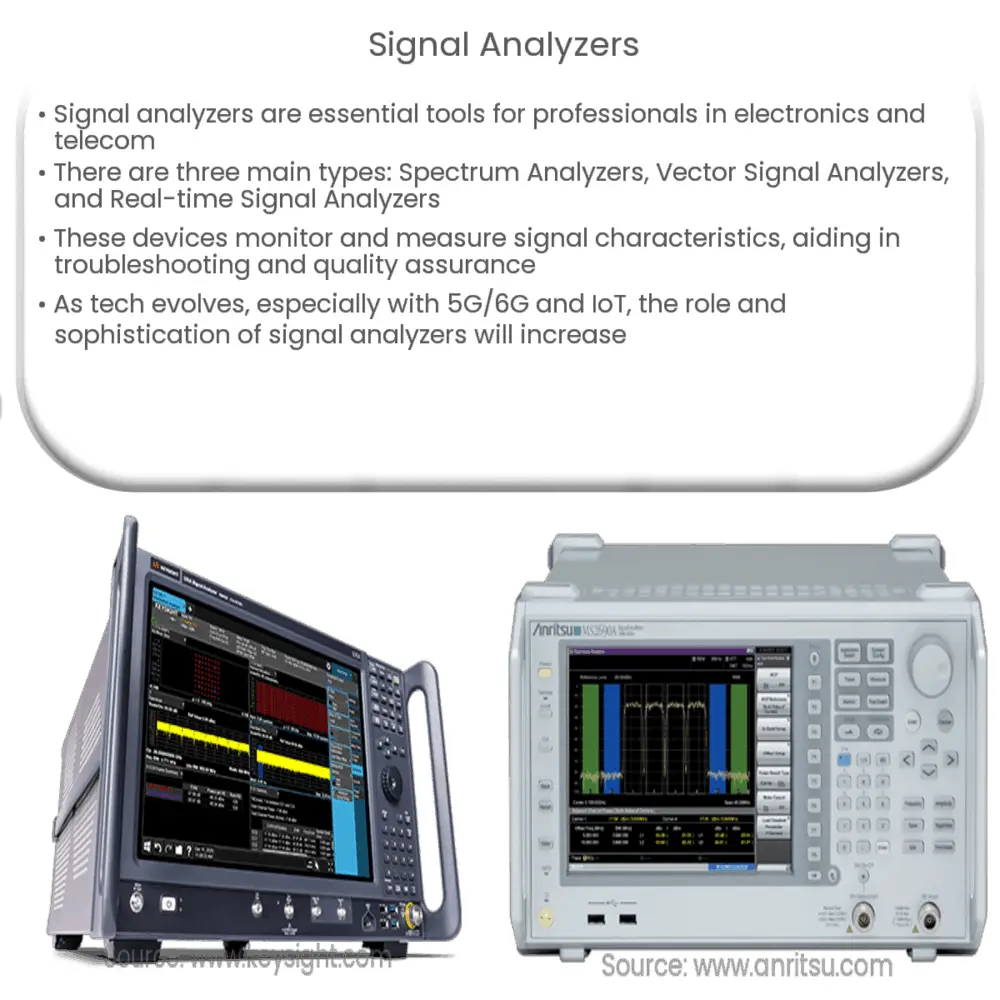
Introduction to Signal Analyzers
A Signal Analyzer is an indispensable instrument for professionals working in the field of electronics, telecommunications, and signal processing. This device, often used in the design, test, troubleshoot, and repair of electronic devices, is a powerful tool for understanding and optimizing the performance of these systems.
Types of Signal Analyzers
There are primarily three types of signal analyzers:
- Spectrum Analyzers: These are used to measure the magnitude of an input signal versus frequency within the full frequency range of the instrument.
- Vector Signal Analyzers: They are capable of providing magnitude and phase information about the input signal, offering a more comprehensive analysis.
- Real-time Signal Analyzers: These offer the ability to view both frequency and time domain simultaneously, which is especially useful in identifying and diagnosing transient, intermittent, and complex signals.
Key Functions of Signal Analyzers
Signal analyzers are fundamentally used for two primary functions:
- Signal Monitoring: This includes tracking and recording the characteristics of a signal over time. This is often used to ensure the signal is operating within defined parameters, to identify anomalies, and to support troubleshooting.
- Signal Measurement: The analyzer measures specific characteristics of the signal, such as its amplitude, frequency, phase, and bandwidth. These measurements can support a range of analyses, including understanding the quality of the signal and identifying sources of interference or distortion.
Signal Analyzers in the Real World
Signal analyzers have wide-ranging applications, including but not limited to, wireless communication, radar, audio, medical equipment, and electronic warfare. For instance, in wireless communication, signal analyzers help in understanding and improving the performance of the communication system by identifying potential issues like signal interference or weak signal strength.
Considerations in Selecting a Signal Analyzer
Choosing the right signal analyzer depends on various factors such as the frequency range, modulation type, and analysis bandwidth. The device’s sensitivity, which determines its ability to measure small signals, is another critical consideration. Finally, the level of detail required in the analysis—whether it’s a simple spectrum view or a more detailed phase and amplitude analysis—will also guide the selection.
Advancements in Signal Analyzers
With the rapid pace of technological advancement, signal analyzers have evolved significantly. Modern signal analyzers are not only more sensitive and accurate but also offer greater versatility. For instance, some devices now provide advanced digital signal processing (DSP) capabilities and can analyze signals in the time, frequency, and even the modulation domain.
Furthermore, today’s signal analyzers often come with user-friendly interfaces and advanced software that simplify the process of analyzing complex signals. This software may include features for automated testing, data logging, and even machine learning algorithms for predictive maintenance and anomaly detection.
Signal Analyzers and the Future
The future of signal analyzers looks promising, particularly in the realm of wireless communication and internet of things (IoT) devices. As these technologies continue to grow and evolve, the need for effective and efficient signal analysis tools will only increase. This could spur further innovation in the field, leading to the development of even more powerful and sophisticated signal analyzers.
Moreover, the rise of 5G and potentially 6G technologies, along with increasing demands for high data rates and low latency, will likely necessitate new types of signal analyzers. These devices will need to be capable of handling higher frequencies, wider bandwidths, and more complex modulation schemes.
Conclusion
In conclusion, signal analyzers are a critical tool in the design, testing, and maintenance of electronic and telecommunication systems. They offer invaluable insights into signal characteristics, aiding in the detection and resolution of issues that could affect the performance and reliability of these systems. As technology continues to advance, particularly in wireless communication and IoT, the importance and capabilities of signal analyzers are set to grow. Therefore, staying abreast of the latest developments in signal analysis technology will be essential for professionals in these fields.



