
Explore the world of semiconductor lasers, their structure, functioning, unique advantages, and crucial role in future technologies.
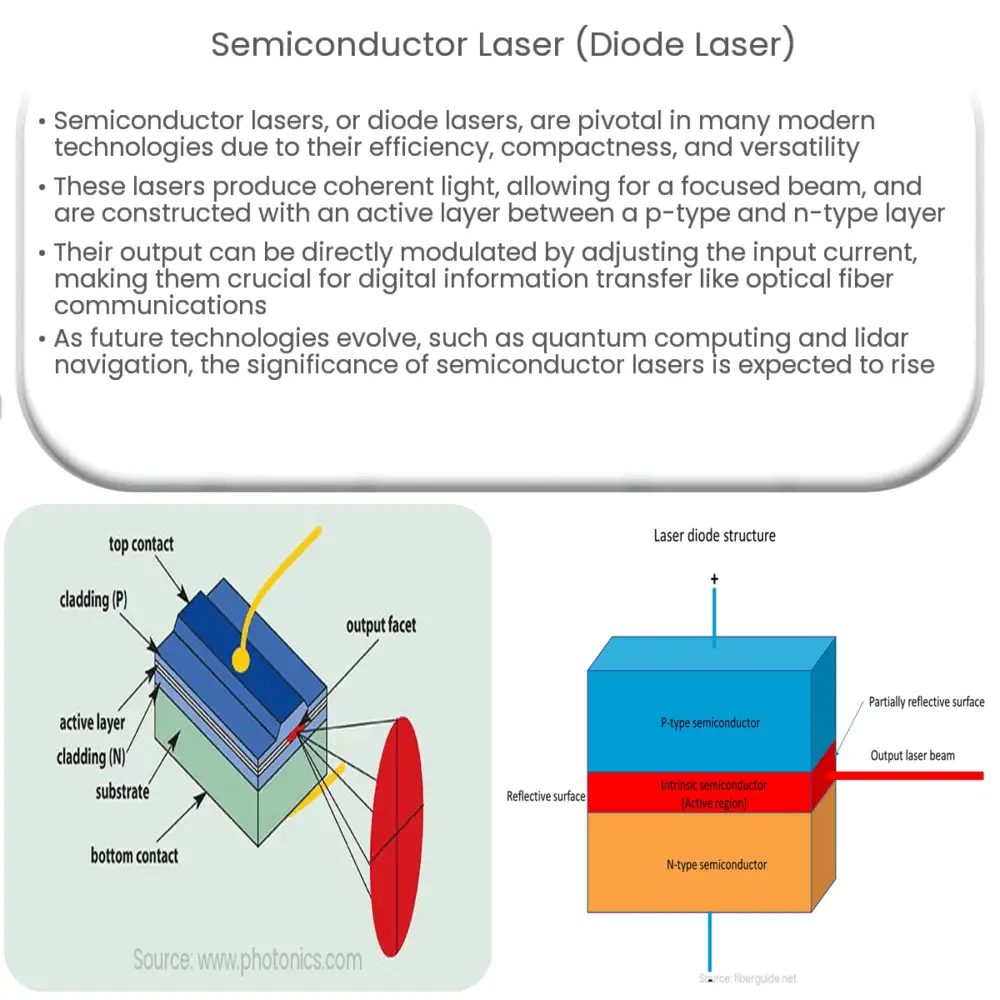
Semiconductor Laser: The Pinnacle of Light Amplification Technology
At the very core of numerous modern-day technologies, from barcode scanners to telecommunications, lies a rather unassuming, yet incredibly powerful device: the semiconductor laser, also known as the diode laser. With a unique blend of efficiency, compactness, and versatility, semiconductor lasers have become an indispensable component in various fields.
Understanding the Basics
The term “laser” is an acronym for Light Amplification by Stimulated Emission of Radiation. Unlike conventional light sources, which emit a broad spectrum of light in various directions, lasers emit coherent light—light waves that have the same frequency and are in phase with each other. This allows for the generation of a highly focused beam of light.
- Structure of a Semiconductor Laser
A semiconductor laser, typically made from gallium arsenide (GaAs), indium phosphide (InP), or similar materials, consists of three primary layers: an active layer sandwiched between a p-type layer and an n-type layer. The p-type and n-type layers are doped with specific impurities to create an abundance of positive and negative charge carriers, respectively.
- Functioning of a Diode Laser
When an electric current is passed through the laser diode, it causes the electrons in the n-type layer to move to the active layer, where they recombine with the holes from the p-type layer. This recombination process results in the emission of photons, a phenomenon known as spontaneous emission.
The Principle of Stimulated Emission
For the laser to generate a coherent and concentrated beam of light, however, a more complex process, known as stimulated emission, needs to occur. In stimulated emission, an incoming photon of the same frequency can stimulate an excited electron in the active layer to drop to a lower energy level, emitting a second photon in the process. Importantly, this emitted photon will have the same frequency, phase, and direction as the incoming photon, thereby contributing to the coherent nature of the laser light.
Unique Advantages of Semiconductor Lasers
Semiconductor lasers bring a number of unique advantages over other types of lasers. Due to their small size and high efficiency, they are ideal for applications where space and power are at a premium. Additionally, the ability to directly modulate the output of a semiconductor laser by varying the input current makes them highly suitable for digital information transfer, such as in optical fiber communications.
- Compactness and Efficiency
One of the primary reasons semiconductor lasers are so prevalent is their compactness. These lasers can be as small as a few millimeters, making them perfect for integration into small electronic devices. Additionally, they are highly efficient, converting a large portion of the input electrical energy directly into light.
- Direct Modulation and Versatility
The output power of a semiconductor laser can be directly controlled by adjusting the input current, a feature known as direct modulation. This unique property is especially useful in telecommunications, where the laser’s light output is modulated to carry digital information. Furthermore, by altering the composition of the semiconductor materials, the wavelength of the emitted light can be precisely controlled, making these lasers highly versatile.
Future Outlook
As we look toward the future, the importance of semiconductor lasers is set to grow even more. They have a crucial role to play in emerging technologies like quantum computing and lidar-based autonomous navigation systems. Also, as the demand for high-speed data transmission continues to increase, the role of these lasers in optical communications is expected to expand.
Conclusion
In conclusion, semiconductor lasers, with their unique blend of compactness, efficiency, and versatility, have become an indispensable component of modern technology. As we continue to push the boundaries of what’s possible in fields like telecommunications, data processing, and sensing, the semiconductor laser stands as a testament to the power of harnessing light’s potential at the microscopic level. Whether in a supermarket barcode scanner or a high-speed internet cable, these tiny devices will continue to illuminate our path forward.



