
Resistive force sensors detect changes in electrical resistance due to applied force, offering simplicity, cost-effectiveness, and high sensitivity in various applications.
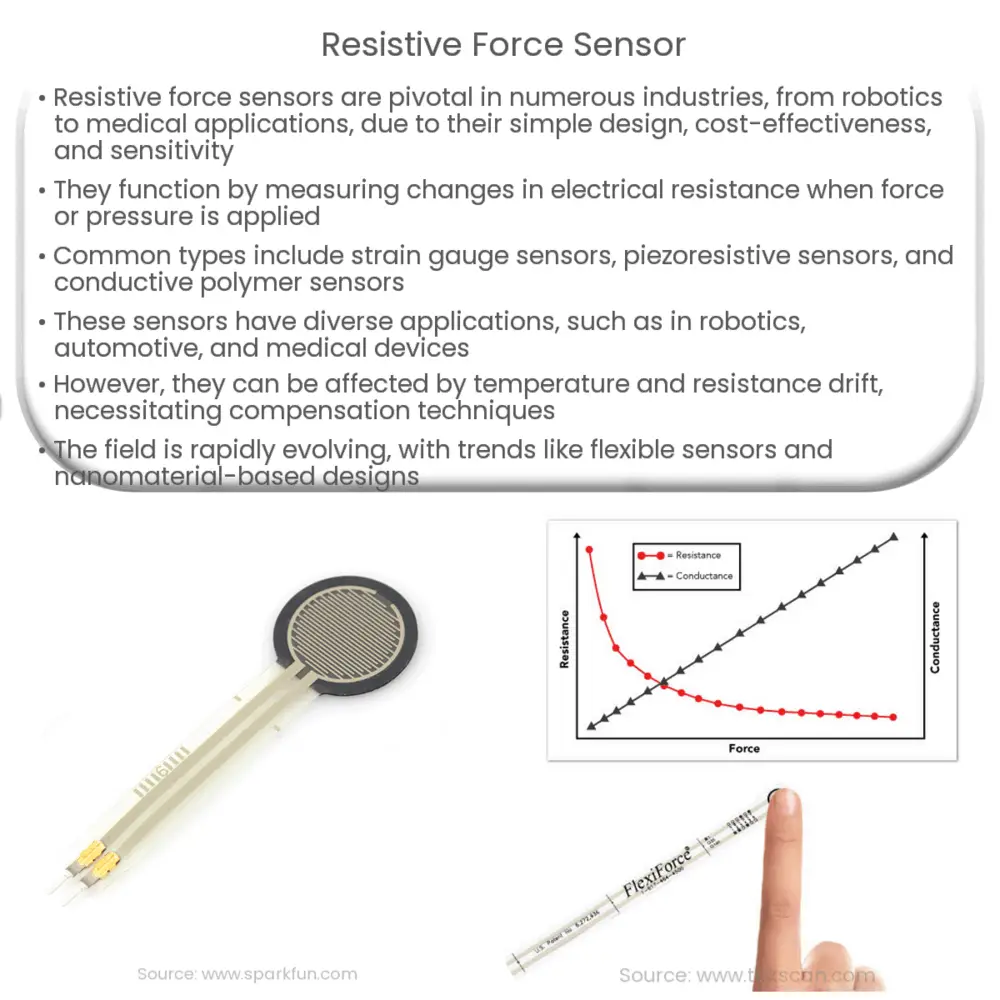
Resistive Force Sensor: An Introduction
The resistive force sensor is a versatile technology that has made a significant impact in various industries, ranging from robotics to medical applications. In this article, we will explore the basics of resistive force sensors, including their working principle, types, and applications. This comprehensive guide will help you understand the importance of this technology and its potential in various domains.
Working Principle of Resistive Force Sensors
Resistive force sensors work on the principle of changing electrical resistance due to applied force or pressure. These sensors typically consist of a conductive material, such as a thin metal or polymer film, sandwiched between two flexible, insulating layers. When a force is applied to the sensor, it causes a deformation in the conductive material, resulting in a change in its electrical resistance. This change in resistance is then measured and converted into a corresponding force or pressure value.
The primary advantage of resistive force sensors is their simple, low-cost design and ease of integration into various systems. They are also highly sensitive, with the ability to detect minute changes in applied force, making them ideal for applications that require high precision and accuracy.
Types of Resistive Force Sensors
There are several types of resistive force sensors, each with its unique characteristics and applications. Some of the most common types include:
1. Strain Gauge Sensors
Strain gauge sensors are one of the most widely used resistive force sensors. They consist of a thin, conductive metal foil that is bonded to a flexible substrate. When force is applied to the sensor, it causes the metal foil to elongate or compress, resulting in a change in its electrical resistance. Strain gauges are used in a variety of applications, such as structural monitoring, load cells, and torque sensors.
2. Piezoresistive Sensors
Piezoresistive sensors utilize semiconductor materials, such as silicon, that exhibit a change in resistance when subjected to mechanical stress. These sensors are commonly used in pressure and force sensing applications due to their high sensitivity and ability to operate at low power levels. They are widely used in automotive, industrial, and medical applications.
3. Conductive Polymer Sensors
Conductive polymer sensors employ a conductive polymer as the sensing element. These sensors offer many advantages, including flexibility, low cost, and ease of fabrication. They are ideal for wearable technology and soft robotics applications, where flexibility and conformability are essential.
Applications of Resistive Force Sensors
Resistive force sensors have been employed in a wide range of industries and applications, some of which include:
- Robotics: Force sensing in robotic grippers and tactile sensors for robotic limbs.
- Automotive: Tire pressure monitoring systems and suspension load sensing.
- Medical: Blood pressure monitoring, prosthetic limb force sensing, and smart surgical tools.
- Wearable technology: Pressure-sensitive insoles for gait analysis and posture monitoring.
- Industrial: Load cells for weighing systems and force sensing in assembly lines.
Advantages and Limitations of Resistive Force Sensors
Resistive force sensors offer several advantages over other sensing technologies, such as:
- Simplicity: They have a simple design and working principle, making them easy to understand and implement in various applications.
- Cost-effectiveness: Resistive force sensors are generally inexpensive to manufacture, making them a viable option for cost-sensitive applications.
- Versatility: They can be tailored to different form factors and sizes, making them suitable for a wide range of applications.
- High sensitivity: These sensors can detect minute changes in force or pressure, allowing for high-precision measurements.
However, resistive force sensors also have some limitations:
- Temperature sensitivity: Changes in ambient temperature can affect the sensor’s electrical resistance, potentially leading to inaccurate readings. Compensation techniques are often required to account for this effect.
- Drift: Long-term exposure to force or pressure can cause the sensor’s resistance to drift over time, affecting its accuracy. This issue can be mitigated by periodic calibration and the use of stable materials.
- Non-linearity: Some resistive force sensors may exhibit non-linear behavior, making it challenging to accurately convert the resistance change into a force or pressure value. Advanced signal processing techniques may be needed to address this issue.
Future Developments and Trends
The field of resistive force sensors is continuously evolving, driven by advancements in materials science, electronics, and manufacturing techniques. Some of the emerging trends and developments in this area include:
- Flexible and stretchable sensors: The development of flexible and stretchable conductive materials is enabling the creation of new form factors and applications, particularly in wearable technology and soft robotics.
- Nanomaterial-based sensors: The use of nanomaterials, such as carbon nanotubes and graphene, is opening new possibilities in terms of sensor performance, sensitivity, and miniaturization.
- Self-powered sensors: Research is underway to develop self-powered resistive force sensors that harvest energy from the environment, such as piezoelectric or triboelectric materials, eliminating the need for external power sources.
- Integrated sensing and actuation: The integration of sensing and actuation capabilities within a single device is an emerging trend, offering potential advantages in terms of device compactness, efficiency, and functionality.
Conclusion
Resistive force sensors are an essential technology in a wide range of industries and applications, offering simplicity, cost-effectiveness, and high sensitivity. As the technology continues to advance, we can expect to see new and exciting developments in materials, form factors, and applications that will further expand the possibilities of resistive force sensing. By understanding the principles, types, and applications of resistive force sensors, we can harness their full potential to drive innovation and improve the quality of life in various domains.



