
KTN is a versatile ferroelectric material with applications in electronics, photonics, and energy storage, offering unique properties and advantages.
Potassium Tantalate Niobate (KTN) as Ferroelectric Material
Introduction
Ferroelectric materials have garnered significant attention in recent years due to their wide range of applications in electronic devices and systems, such as sensors, actuators, and memory devices. One such promising material is potassium tantalate niobate (KTN), which exhibits excellent ferroelectric properties and has been the subject of extensive research in recent years. This article provides an overview of KTN as a ferroelectric material, its properties, and its potential applications.
Structure and Properties of KTN
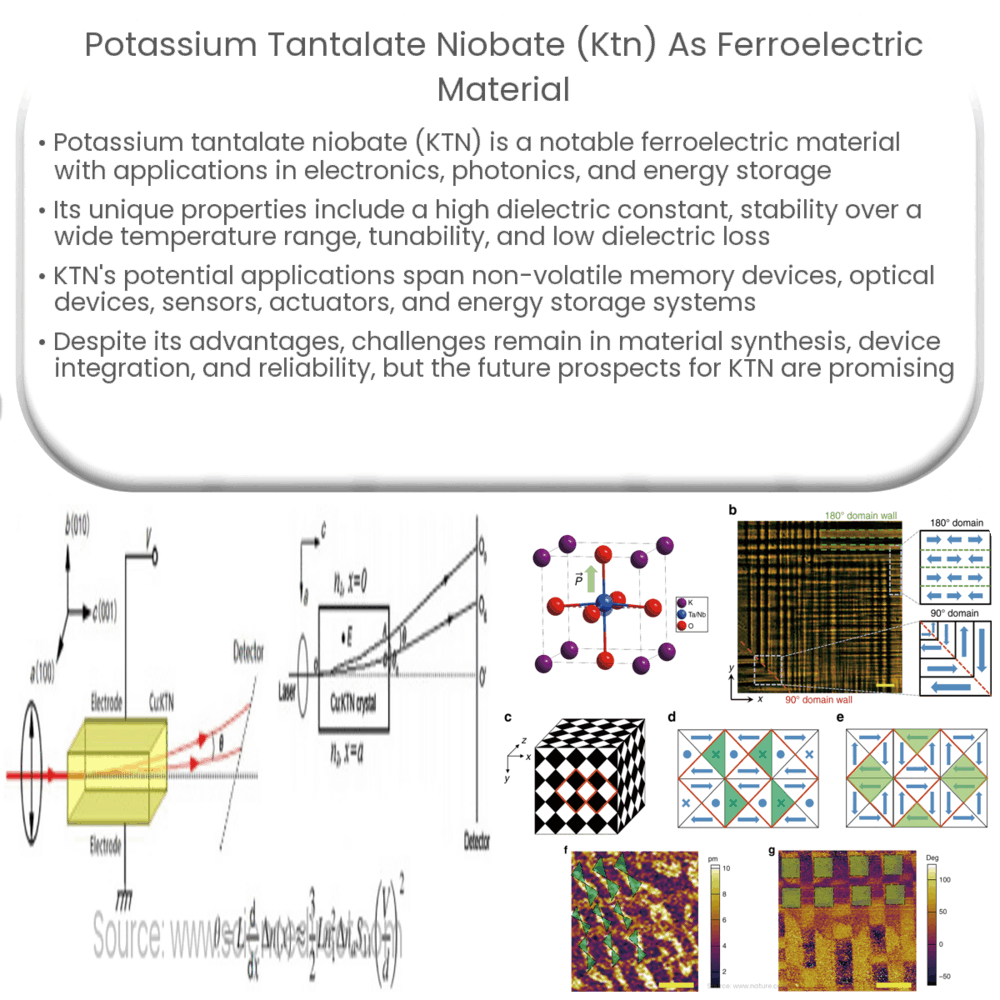
Potassium tantalate niobate (KTN) is a perovskite-type compound with the general formula KTa1-xNbxO3, where x represents the niobium content. The KTN structure is characterized by a cubic perovskite unit cell, with potassium ions (K+) occupying the A-site and a mix of tantalum (Ta5+) and niobium (Nb5+) ions on the B-site, surrounded by oxygen octahedra. The electrical and ferroelectric properties of KTN are highly dependent on the niobium concentration, as it influences the Curie temperature (Tc) and the dielectric constant.
As a ferroelectric material, KTN exhibits spontaneous polarization, which is the result of a displacement of the electrically charged ions within the crystal lattice. This property allows KTN to exhibit a hysteresis loop, where the polarization can be reversed by applying an external electric field. The ferroelectric properties of KTN can be tailored by adjusting the niobium concentration, making it a versatile material for a wide range of applications.
Advantages of KTN over Other Ferroelectric Materials
Compared to other ferroelectric materials, KTN boasts several advantages that make it an attractive choice for researchers and engineers. Some of these benefits include:
- High Dielectric Constant: KTN possesses a high dielectric constant, which makes it suitable for high-capacity energy storage applications and miniaturization of electronic devices.
- Wide Temperature Range: KTN’s ferroelectric properties are stable over a broad temperature range, making it suitable for use in diverse environments and applications.
- Tunability: The ferroelectric properties of KTN can be easily tuned by adjusting the niobium concentration, allowing for the development of customized materials with tailored properties.
- Low Dielectric Loss: KTN exhibits low dielectric loss, which is crucial for reducing energy dissipation and improving the efficiency of electronic devices.
Potential Applications of KTN
Due to its unique properties and advantages, KTN has been considered for various applications in the fields of electronics, photonics, and energy storage. Some of these potential applications include:
- Non-Volatile Memory Devices: KTN’s ferroelectric properties can be utilized in the development of non-volatile memory devices, such as ferroelectric random-access memory (FeRAM), which can retain information even in the absence of power.
- Optical Devices: KTN’s high
refractive index and electro-optic coefficients make it a promising candidate for use in optical devices, such as modulators, switches, and waveguides. - Sensors and Actuators: KTN’s piezoelectric properties, which result from its ferroelectric nature, make it suitable for use in sensors and actuators that convert mechanical stress or strain into electrical signals and vice versa.
- Energy Storage: The high dielectric constant of KTN can be harnessed in energy storage applications, such as capacitors and supercapacitors, to achieve high energy density and rapid charge-discharge capabilities.
Challenges and Future Prospects
Despite its numerous advantages and potential applications, there are still several challenges associated with the use of KTN as a ferroelectric material. These challenges include:
- Material Synthesis: The synthesis of high-quality KTN crystals with controlled composition and properties remains a challenge. Improved synthesis techniques and better understanding of the structure-property relationships are crucial for the development of KTN-based devices.
- Device Integration: The integration of KTN with other materials and device structures can be difficult due to potential compatibility issues and processing challenges. Further research is needed to develop methods for integrating KTN into practical devices and systems.
- Reliability: The long-term stability and reliability of KTN-based devices must be thoroughly investigated and optimized to ensure their successful commercialization and adoption in various applications.
Despite these challenges, the future prospects for KTN as a ferroelectric material are promising. Ongoing research and development efforts are likely to address the current limitations and expand the range of possible applications for KTN. As our understanding of KTN’s properties and behavior improves, so too will our ability to harness its unique features for use in next-generation electronic devices and systems.
Conclusion
Potassium tantalate niobate (KTN) is a versatile and promising ferroelectric material with numerous potential applications in the fields of electronics, photonics, and energy storage. Its unique properties and advantages over other ferroelectric materials make it an attractive choice for researchers and engineers working to develop innovative solutions for a wide range of challenges. While there are still obstacles to overcome, the future of KTN as a ferroelectric material appears bright, and its potential impact on the world of electronic devices is significant.



