
Explore the fascinating world of organic redox supercapacitors, their workings, benefits, challenges, and future potential in energy storage.
Introduction to Organic Redox Supercapacitors
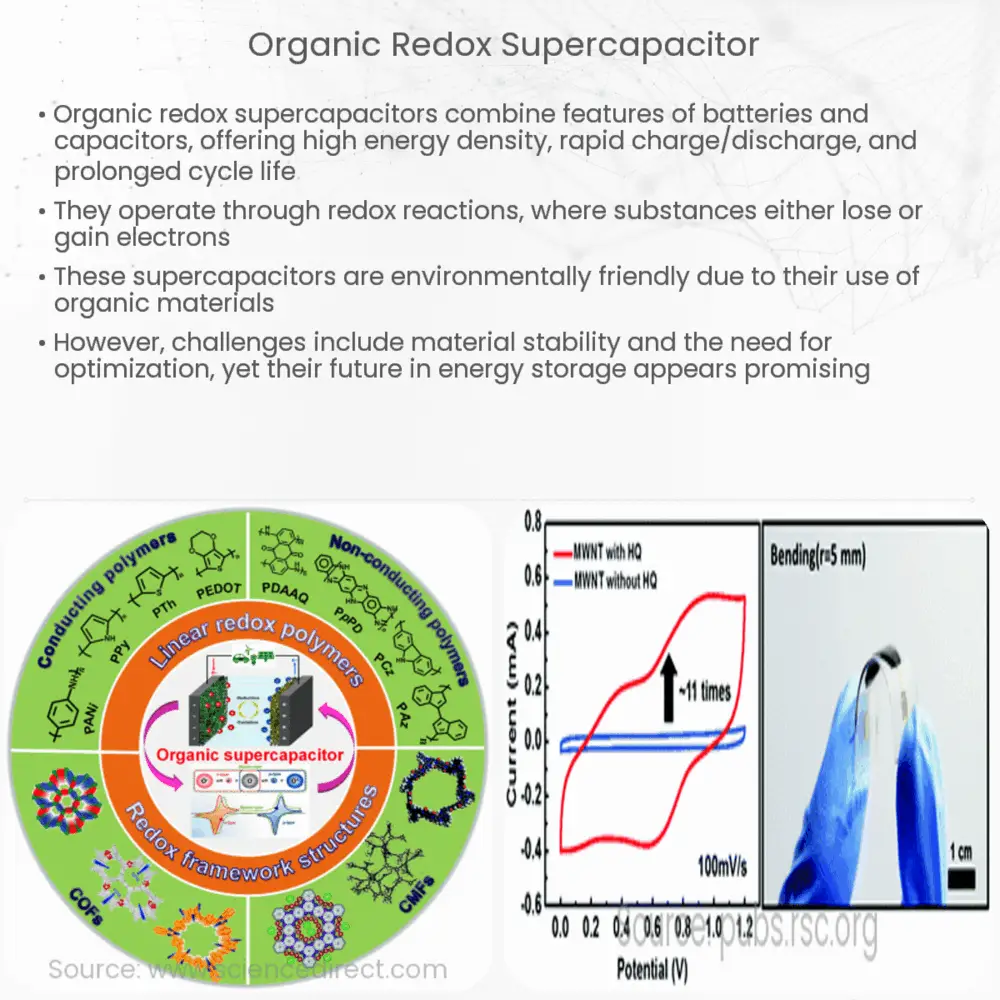
Organic redox supercapacitors are a novel class of energy storage devices that have recently captured the attention of researchers worldwide. These supercapacitors harness the principles of both traditional capacitors and batteries, offering a unique blend of high energy density, rapid charge/discharge rates, and long cycle life.
Understanding Redox Reactions
At the heart of an organic redox supercapacitor lies the concept of redox reactions. Redox is an abbreviation for reduction-oxidation reactions, which involve the transfer of electrons between two substances. The substance that loses electrons is oxidized, while the one that gains electrons is reduced. These reactions power many of the chemical processes in our world, from rusting iron to powering our bodies.
-
Oxidation: This is the process in which a substance loses electrons. In the context of an organic redox supercapacitor, the oxidized substance is often an organic compound.
-
Reduction: This is the process in which a substance gains electrons. In an organic redox supercapacitor, the reduced substance is typically another organic compound or the electrolyte.
Working Principle of Organic Redox Supercapacitors
Organic redox supercapacitors exploit these redox reactions to store and release electrical energy. They consist of two electrodes, an anode and a cathode, soaked in an electrolyte solution. The electrodes are usually made from conductive materials like carbon nanotubes or graphene, and are coated with organic redox-active materials.
When the supercapacitor is charging, oxidation occurs at the anode, causing it to lose electrons. These electrons then flow through an external circuit to the cathode, where reduction occurs. This flow of electrons creates a current that can be used to power devices. When the supercapacitor is discharging, the process is reversed, and the stored energy is released.
Advantages of Organic Redox Supercapacitors
-
High Energy Density: Organic redox supercapacitors possess higher energy densities than traditional supercapacitors. This is due to the additional energy stored in the redox reactions.
-
Fast Charge/Discharge Rates: Like traditional supercapacitors, organic redox supercapacitors can charge and discharge rapidly. This makes them ideal for applications that require quick bursts of power.
Advantages of Organic Redox Supercapacitors Continued
-
Long Cycle Life: Thanks to the reversibility of the redox reactions, organic redox supercapacitors have a longer life cycle compared to traditional batteries. They can withstand thousands, if not hundreds of thousands, of charge-discharge cycles without significant loss of performance.
-
Environmentally Friendly: The use of organic materials in redox supercapacitors makes them more environmentally friendly compared to conventional batteries that often contain toxic and heavy metals.
Challenges and Future Perspectives
Despite these impressive advantages, organic redox supercapacitors are not without their challenges. The stability of the organic redox-active materials can be a concern, as they may degrade over time. Additionally, finding the optimal combination of materials for the electrodes, electrolyte, and redox-active compounds requires further research.
Nevertheless, the future of organic redox supercapacitors looks promising. With ongoing research and technological advancements, these challenges can be addressed. Potential applications range from powering electric vehicles to providing energy storage solutions for renewable energy systems.
Conclusion
In conclusion, organic redox supercapacitors represent a significant advancement in the field of energy storage. They combine the best features of batteries and capacitors, offering high energy density, fast charge/discharge rates, and long cycle life. Moreover, the use of organic materials makes them a more sustainable alternative to traditional energy storage devices.
Although challenges remain in improving their stability and optimizing their material components, the potential of organic redox supercapacitors is vast. As research progresses, we can anticipate seeing these innovative devices playing a key role in various applications, contributing to a more sustainable energy future.



