
Optical hygrometers measure humidity levels using optics, offering high accuracy, fast response time, and long-term stability for diverse applications.
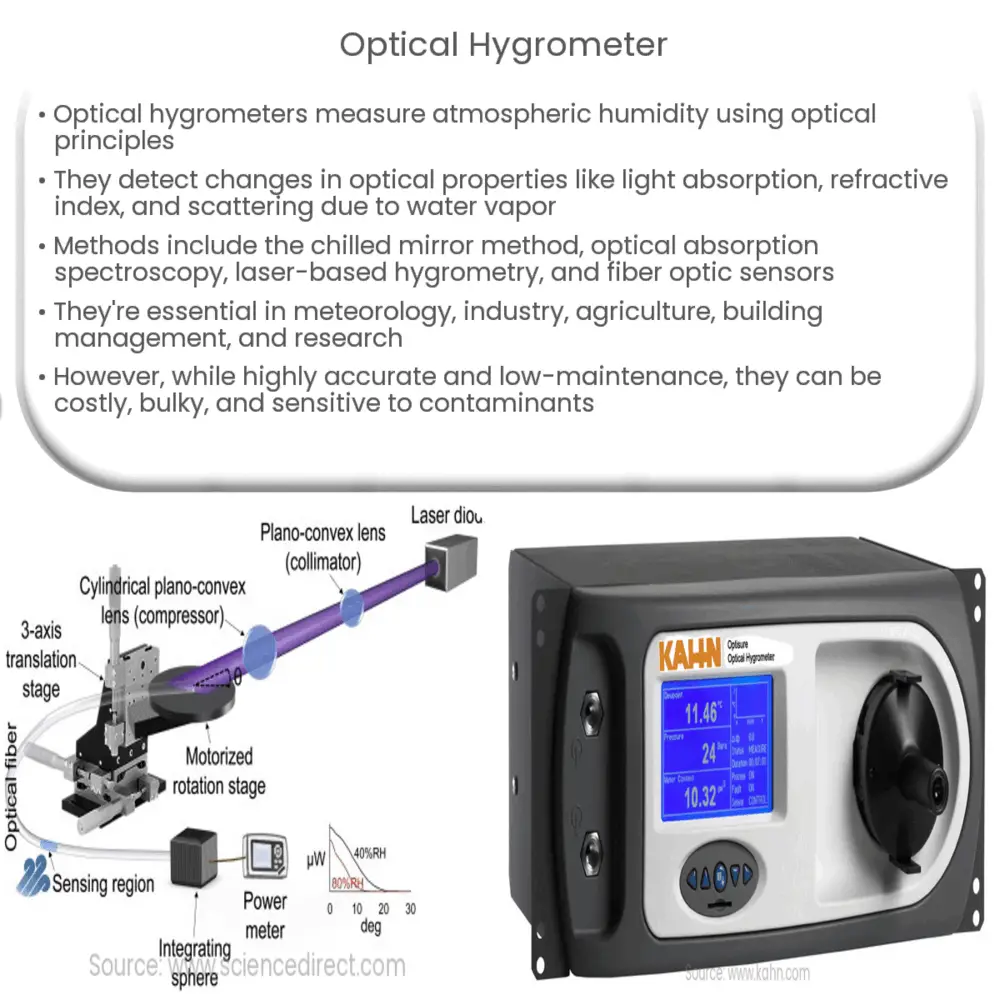
Optical Hygrometer: A Comprehensive Overview
Introduction
An optical hygrometer is an instrument that measures humidity in the atmosphere by utilizing the principles of optics. Humidity, the amount of water vapor present in the air, plays a significant role in various fields such as meteorology, agriculture, and industrial applications. Accurate and reliable measurements of humidity are essential for maintaining optimal environmental conditions and ensuring the efficiency of numerous processes. In this article, we will explore the working principle, types, and applications of optical hygrometers, as well as their advantages and limitations.
Working Principle of Optical Hygrometers
Optical hygrometers function by measuring the changes in specific optical properties of the air caused by the presence of water vapor. These properties include light absorption, refractive index, and scattering. By analyzing these changes, optical hygrometers can provide a precise measurement of humidity levels.
There are several methods employed by optical hygrometers to measure humidity, such as:
- Chilled mirror method
- Optical absorption spectroscopy
- Laser-based hygrometry
- Fiber optic sensors
Each of these methods has its advantages and disadvantages, which will be discussed further in the next section.
Types of Optical Hygrometers
Optical hygrometers can be broadly classified into four types based on their working principle:
1. Chilled Mirror Hygrometer
A chilled mirror hygrometer measures humidity by cooling a mirror to the dew point, which is the temperature at which water vapor condenses on the mirror’s surface. The device utilizes a temperature sensor and a light source to monitor the condensation process. The mirror’s temperature is adjusted until the light intensity reflected from the mirror’s surface remains constant. At this point, the temperature of the mirror is equal to the dew point, and the humidity level can be determined.
2. Optical Absorption Spectroscopy
This method relies on the absorption of specific wavelengths of light by water vapor molecules in the air. The hygrometer uses a light source, usually a tunable diode laser, to emit light through the air sample. As the light passes through the sample, water vapor molecules absorb specific wavelengths, which can be detected by a photodetector. By analyzing the absorption pattern, the concentration of water vapor and, subsequently, the humidity level can be calculated.
3. Laser-based Hygrometry
Laser-based hygrometers employ a laser beam to measure humidity by detecting changes in the refractive index of the air due to the presence of water vapor. The device comprises a laser source, a beam splitter, and a detector. The laser beam is split into two beams, one of which passes through the air sample while the other serves as a reference. The difference in the refractive index caused by the presence of water vapor results in a phase shift between the two beams, which can be detected and used to determine the humidity level.
4. Fiber Optic Sensors
Fiber optic hygrometers utilize optical fibers as humidity sensors. These devices typically employ specific materials, such as polymer coatings or porous glass, that exhibit changes in their optical properties when exposed to water vapor. The optical fiber is coated with this material, and the changes in the material’s properties, such as absorption or fluorescence, are measured using a light source and a detector. This information is then used to determine the humidity level in the surrounding environment.
Applications of Optical Hygrometers
Optical hygrometers find use in a wide range of applications, including:
- Meteorology: Accurate humidity measurements are crucial for weather forecasting and climate monitoring.
- Industrial processes: Humidity control is essential in various industries, such as food and beverage, pharmaceuticals, and electronics, to ensure product quality and efficient processes.
- Agriculture: Proper humidity levels are vital for plant growth and crop yield optimization, as well as for preventing the spread of diseases and pests.
- Building management: Maintaining appropriate humidity levels in buildings can enhance occupant comfort, prevent mold growth, and reduce energy consumption.
- Research: Optical hygrometers are used in numerous scientific studies that require precise humidity measurements, including atmospheric research, material sciences, and biology.
Advantages and Limitations of Optical Hygrometers
Optical hygrometers offer several advantages over other types of hygrometers:
- High accuracy and precision: Optical methods can provide highly accurate and precise humidity measurements.
- Fast response time: These devices typically exhibit a rapid response to changes in humidity levels, enabling real-time monitoring.
- Low maintenance: Optical hygrometers usually require minimal maintenance, as they do not have mechanical parts or wetted surfaces that can wear out or corrode.
- Long-term stability: The performance of optical hygrometers is generally stable over time, ensuring consistent and reliable measurements.
Despite these advantages, optical hygrometers also have some limitations:
- Cost: These devices can be more expensive than other types of hygrometers due to their sophisticated optical components and electronics.
- Size and complexity: Optical hygrometers can be larger and more complex than other hygrometers, which might be a drawback in certain applications where portability and simplicity are required.
- Sensitivity to contaminants: Some optical hygrometers may be sensitive to the presence of contaminants, such as dust, which can affect the accuracy of their measurements.
Conclusion
Optical hygrometers are valuable tools for measuring humidity levels in various applications. Their high accuracy, precision, and long-term stability make them a preferred choice in many fields. However, their cost, size, and sensitivity to contaminants can be limiting factors in certain situations. Understanding the working principles, types, and advantages of optical hygrometers can help users select the appropriate device for their specific needs.



