
Explore the vital role of motor rotors in converting electrical energy to mechanical motion, their types, maintenance, and future prospects.
Understanding Motor Rotors
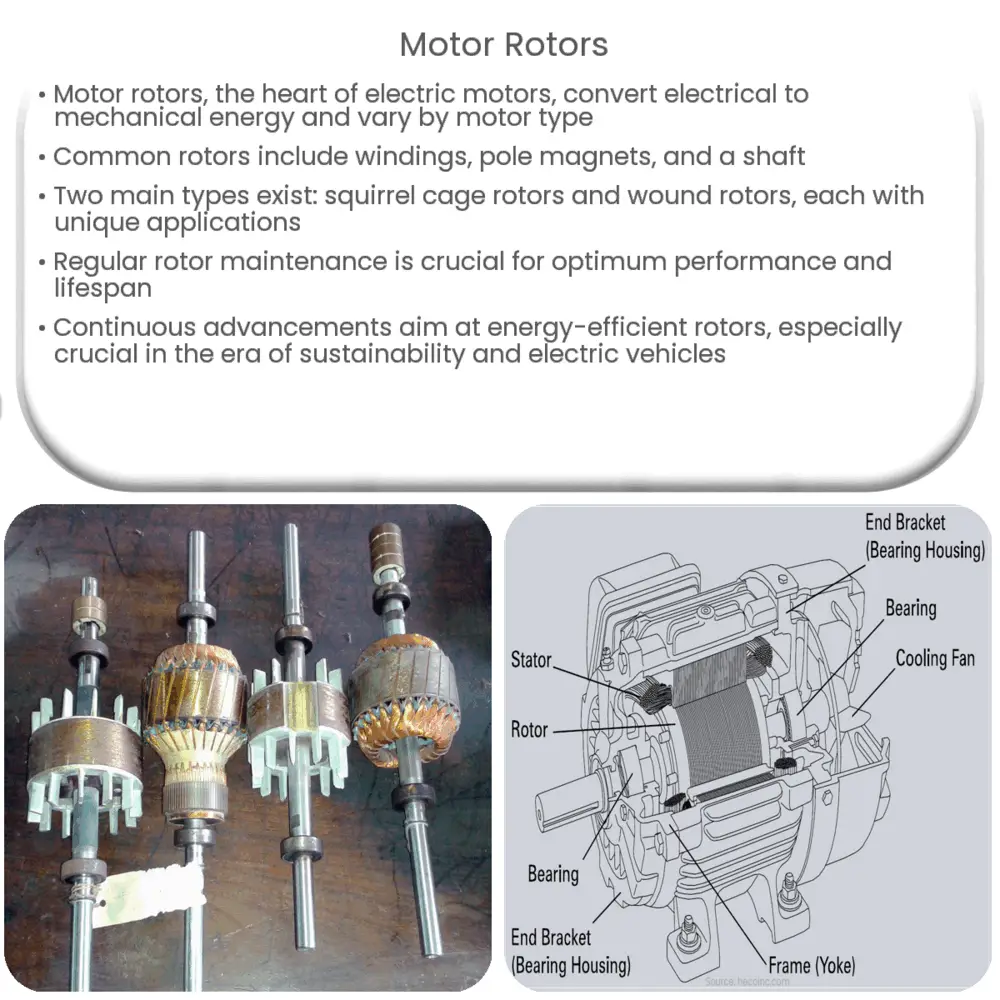
In the heart of every motor lies a vital component known as the rotor. It plays a significant role in converting electrical energy into mechanical energy. Understanding motor rotors in depth provides invaluable insights into the workings of numerous devices that power our everyday lives. Let’s delve deeper into this topic.
Composition of Motor Rotors
The basic construction of a motor rotor varies depending on the type of motor. Generally, a rotor consists of conductive windings or pole magnets, and a shaft.
- Windings: These are conductive wires coiled around a core. In AC motors like induction motors, the rotor winding is usually composed of bars of aluminum or copper.
- Pole Magnets: In some types of motors, such as permanent magnet DC motors, the rotor consists of permanent magnets rather than windings.
- Shaft: This central part of the rotor is attached to the mechanical load. As the rotor turns, the shaft also rotates, thereby driving the connected load.
Working Principle of Motor Rotors
The operation of a motor rotor relies on the fundamental principles of electromagnetism. When an electric current passes through the windings, a magnetic field is generated. This magnetic field interacts with the magnetic field of the stator (the stationary part of the motor), producing a torque that causes the rotor to spin.
Types of Motor Rotors
Motor rotors can be broadly classified into two categories based on their design: squirrel cage rotors and wound rotors.
- Squirrel Cage Rotors: Named after its appearance, which resembles a hamster wheel, this rotor type is commonly found in induction motors. It consists of conductive bars arranged in a pattern similar to a squirrel cage.
- Wound Rotors: Wound rotors are equipped with 3-phase windings, identical to the stator. This type of rotor is typically used in motors that require speed control.
Motor rotors are crucial for the operation of many machines, from small appliances in homes to large industrial equipment. Their construction, operation, and type play a key role in the performance of a motor.
Maintenance of Motor Rotors
Maintenance of motor rotors is an essential aspect of motor upkeep. This ensures optimum performance and increases the lifespan of the motor. In general, rotor maintenance involves regular inspection for signs of wear and tear, damage, or uneven wear patterns. Any abnormalities should be addressed promptly to avoid major complications or motor failure.
Advancements in Motor Rotor Design
Technological advancements have led to innovations in motor rotor design. High-efficiency rotors are now available that reduce energy consumption and operating costs. Such developments are particularly important in an era of growing environmental consciousness and the drive towards energy efficiency.
Future of Motor Rotors
The future of motor rotors is likely to witness further innovations and improvements. With the push towards more sustainable and energy-efficient technologies, we can expect the emergence of motor rotors designed for specific applications and environments. The rise of electric vehicles, for example, is driving the development of high-performance rotors suitable for electric drivetrains.
Conclusion
In conclusion, motor rotors serve as the heart of electric motors, effectively transforming electrical energy into mechanical motion. While they might seem simple in design, their operation relies on complex principles of electromagnetism. The different types of motor rotors, their maintenance, and the continuous advancements in their design play a pivotal role in powering the various machines that form the backbone of modern civilization. With emerging technologies and the push towards sustainability, the future of motor rotors holds exciting prospects. Understanding these essential components helps us better appreciate the intricate beauty of the mechanical world we have built around us.