
Miniature load cells are compact, highly accurate force sensors ideal for space-limited applications in medical, robotics, aerospace, automotive, and consumer electronics industries.
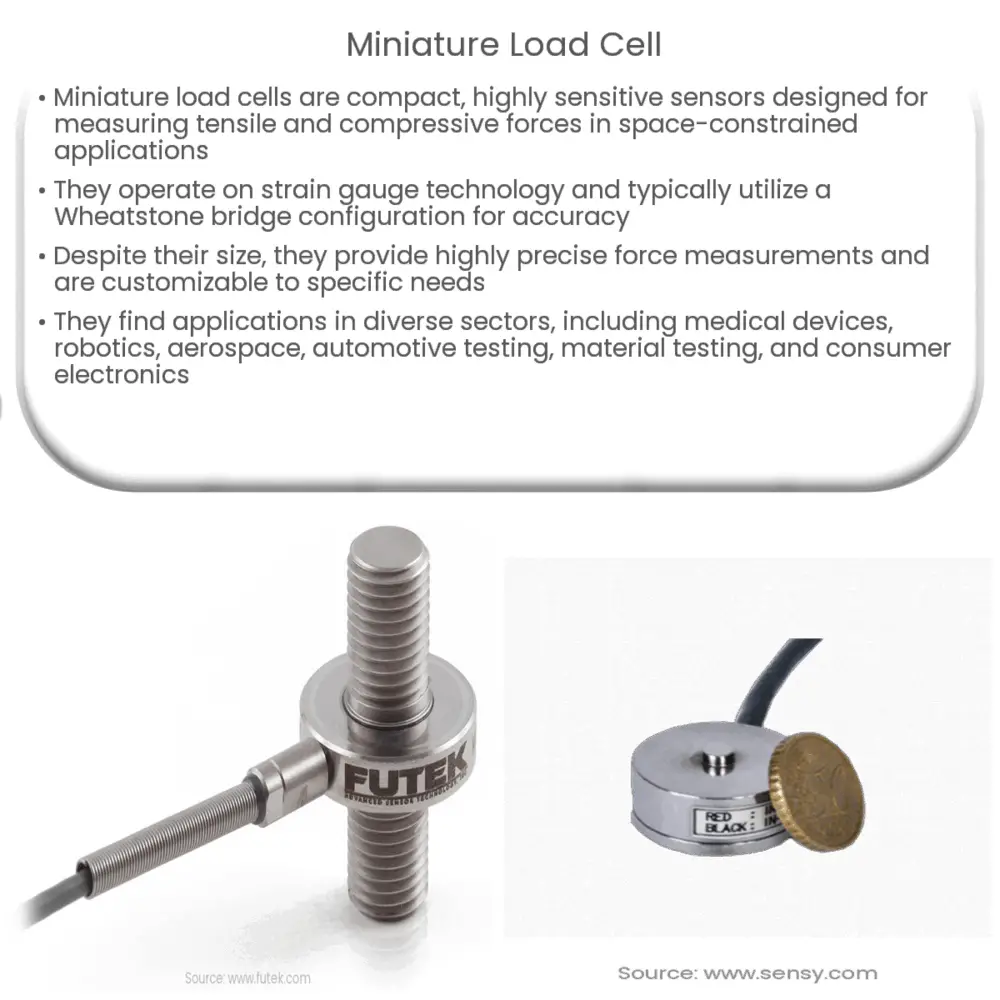
Miniature Load Cells: The Tiny Titans of Force Measurement
Load cells are a crucial component in the world of force measurement, providing the means to measure tensile and compressive forces with high accuracy. As technology continues to advance, there has been an increasing demand for more compact and precise force measurement solutions. Enter miniature load cells, the tiny titans of force measurement that are revolutionizing various industries. In this article, we’ll explore what miniature load cells are, how they work, and the numerous applications they serve.
What are Miniature Load Cells?
Miniature load cells are small, lightweight, and highly sensitive force sensors designed to measure tensile and compressive forces in limited space applications. They are engineered to provide the same level of accuracy and reliability as their larger counterparts, while occupying a smaller footprint. These compact sensors come in various shapes and sizes, including button, beam, and S-type configurations, to suit different applications and installation requirements.
How Do Miniature Load Cells Work?
Like all load cells, miniature load cells operate on the principle of strain gauge technology. A strain gauge is a thin, flexible electrical conductor that changes its electrical resistance when subjected to mechanical deformation (strain). When a load is applied to the load cell, the strain gauges convert the mechanical force into an electrical signal that is proportional to the applied force.
Miniature load cells typically use four strain gauges arranged in a Wheatstone bridge configuration, which provides a highly sensitive and accurate output signal. The Wheatstone bridge is an electrical circuit used to measure unknown electrical resistance by balancing two legs of a bridge circuit, one leg of which includes the unknown component. This configuration allows the load cell to precisely measure both tension and compression forces, while minimizing the effects of temperature and other external factors.
Key Advantages of Miniature Load Cells
Miniature load cells offer numerous benefits over their larger counterparts, making them a popular choice for various industries and applications. Some key advantages include:
- Compact size: The small form factor of miniature load cells makes them ideal for applications with limited space or where weight is a critical factor. They can be easily integrated into existing systems without significant modifications.
- High accuracy: Despite their small size, miniature load cells are designed to provide highly accurate and reliable force measurements. They often feature low non-linearity, hysteresis, and non-repeatability, ensuring consistent performance over time.
- Customizability: Miniature load cells can be tailored to specific application requirements, with options for custom shapes, mounting configurations, and force ranges. This flexibility allows them to be used in a wide variety of applications across different industries.
Applications of Miniature Load Cells
Miniature load cells are used in a diverse range of industries and applications, including:
- Medical devices
- Robotics and automation
- Aerospace and defense
- Automotive testing
- Material testing
- Consumer electronics
Medical Devices
In the medical industry, miniature load cells play a vital role in various devices, such as infusion pumps, surgical instruments, and rehabilitation equipment. They ensure accurate force measurements in applications where precision is critical for patient safety and treatment efficacy. For example, miniature load cells are used in robotic surgical systems to measure the force applied by the robotic arms during delicate procedures, providing real-time feedback to the surgeon for optimal control.
Robotics and Automation
Miniature load cells are essential components in robotic and automation systems, where they provide force feedback and ensure precise control during tasks such as assembly, gripping, and material handling. In collaborative robots (cobots), miniature load cells help monitor the force exerted by the robot, ensuring safe interaction with human operators and preventing accidents.
Aerospace and Defense
The aerospace and defense sectors utilize miniature load cells for various applications, including structural testing, vibration monitoring, and load monitoring in aircraft and spacecraft. Due to their compact size and high accuracy, miniature load cells are ideal for use in weight-sensitive and space-constrained environments, such as satellites and unmanned aerial vehicles (UAVs).
Automotive Testing
In the automotive industry, miniature load cells are used for testing and quality control purposes. They help measure forces applied during crash tests, suspension testing, and component fatigue testing, ensuring that vehicles meet safety standards and perform optimally under various conditions. Miniature load cells are also used in advanced driver assistance systems (ADAS) to measure the force exerted on the brake pedal, providing feedback to the system for better control and safety.
Material Testing
Miniature load cells are an essential tool in material testing laboratories, where they measure the mechanical properties of materials such as tensile strength, compressive strength, and fatigue under controlled conditions. Their high accuracy and sensitivity make them suitable for testing a wide range of materials, including metals, polymers, and composites.
Consumer Electronics
As consumer electronics become smaller and more advanced, miniature load cells are increasingly being used to measure force inputs in devices such as smartphones, tablets, and wearables. They enable features such as pressure-sensitive touchscreens and haptic feedback, enhancing user experience and providing more intuitive control.
Conclusion
Miniature load cells are an indispensable tool in the force measurement industry, offering high accuracy and reliability in a compact form factor. Their versatility and customizability make them suitable for a wide range of applications across various sectors, including medical, robotics, aerospace, automotive, material testing, and consumer electronics. As technology continues to advance and the demand for more compact and precise force measurement solutions grows, we can expect to see miniature load cells becoming even more prevalent in the years to come.



