
Canister load cell is a high-precision sensor used to measure force or weight in industrial settings. It features a cylindrical shape and a strain gauge inside, which detects deformation and converts it into an electrical signal. Canister load cells are cost-effective, easy to install, and can withstand high loads.
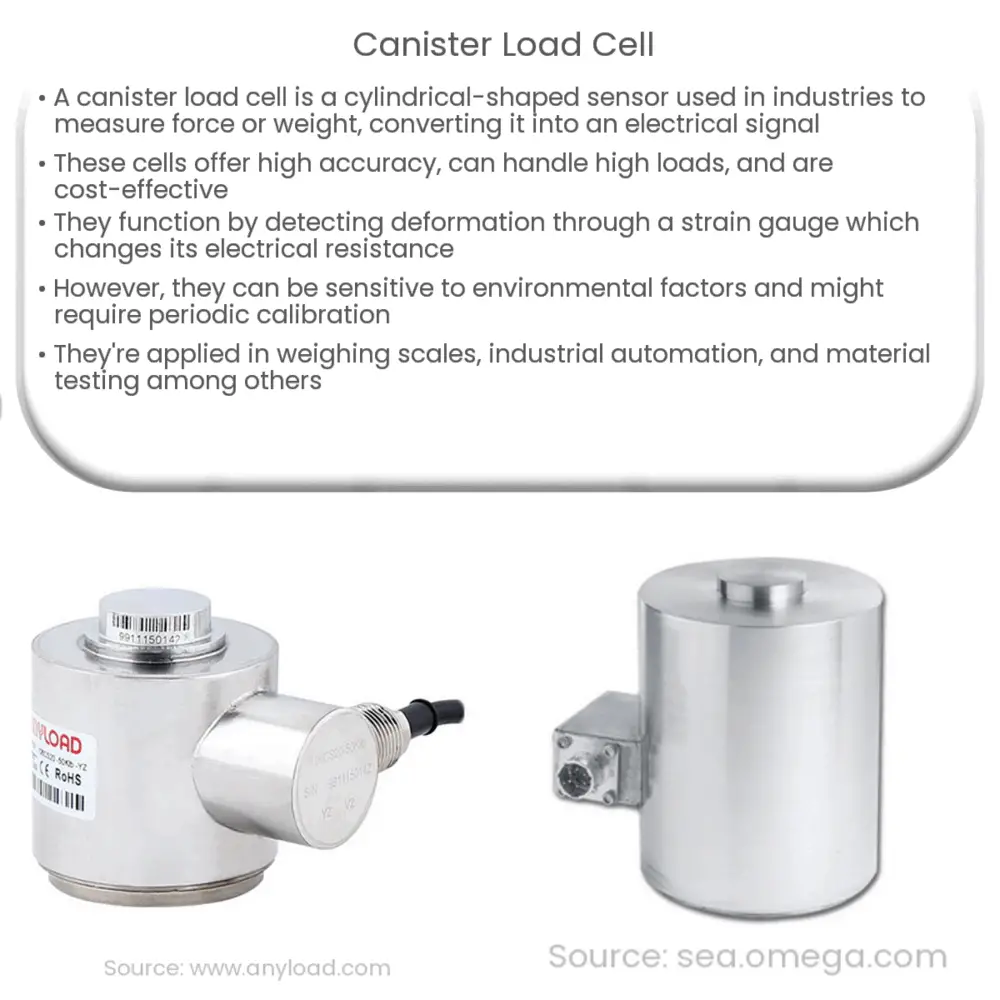
Canister Load Cell: What Is It and How Does It Work?
A canister load cell is a type of sensor that is commonly used in industrial settings to measure force or weight. It is named after its cylindrical shape, which resembles that of a canister. The load cell is designed to measure the force or weight exerted on it and convert it into an electrical signal that can be interpreted by a computer or other device.
Canister load cells are used in a variety of applications, including weighing scales, industrial automation, and testing equipment. They are often preferred over other types of load cells because of their high accuracy and ability to withstand high loads. Additionally, canister load cells are typically less expensive than other types of load cells, making them a cost-effective option for many industrial applications.
How Does a Canister Load Cell Work?
A canister load cell consists of a cylindrical body with two threaded holes on either end. The body is typically made of high-strength metal or alloy, such as stainless steel, to withstand the forces and loads it is designed to measure. Inside the body, there is a strain gauge, which is a small device that changes its electrical resistance when it is stretched or compressed. The strain gauge is connected to an electrical circuit that measures the resistance and converts it into a voltage signal. This signal is then transmitted to a computer or other device, which interprets it and displays the weight or force being measured.
To use a canister load cell, it must be mounted between the object being measured and a fixed point, such as a frame or support. When a force or weight is applied to the object, it is transferred through the load cell and causes it to deform slightly. This deformation is detected by the strain gauge, which changes its electrical resistance. The change in resistance is measured and converted into a voltage signal, which is then used to calculate the weight or force being applied.
Canister load cells are available in a variety of sizes and weight capacities, ranging from a few pounds to several tons. They can also be customized to fit specific applications, such as extreme temperature or humidity environments. In general, canister load cells are an excellent choice for applications where high accuracy, durability, and cost-effectiveness are important considerations.
In the next part of this article, we will explore some of the key advantages and disadvantages of canister load cells, as well as some of their most common applications in industry.
Advantages and Disadvantages of Canister Load Cells
As with any type of technology, canister load cells have both advantages and disadvantages. Some of the key advantages of canister load cells include:
- High accuracy and precision
- Ability to withstand high loads
- Relatively low cost compared to other load cell types
- Wide range of sizes and weight capacities available
- Easy to install and maintain
However, there are also some potential disadvantages to using canister load cells. Some of these include:
- Sensitivity to temperature changes and other environmental factors
- May require calibration to maintain accuracy over time
- May not be suitable for certain types of applications, such as those with high shock loads or vibration
Applications of Canister Load Cells
Canister load cells are used in a wide variety of industrial applications, including:
- Weighing scales and balances
- Industrial automation and control systems
- Material testing and analysis equipment
- Hydraulic and pneumatic systems
- Force and stress analysis in structural engineering and construction
Additionally, canister load cells are often used in research and development settings, such as in product testing and prototype development. They are also commonly used in quality control and assurance processes, to ensure that products and materials meet certain weight or force specifications.
Conclusion
Canister load cells are a reliable and cost-effective solution for measuring force and weight in a variety of industrial applications. They offer high accuracy, durability, and flexibility, and are widely used in industries ranging from construction and engineering to manufacturing and testing. While they do have some potential limitations, canister load cells remain a popular choice for many industries due to their excellent performance and value.



