
Explore the membrane force sensor, a groundbreaking tool for measuring mechanical forces in living systems, with applications in cell biology and biomechanics.
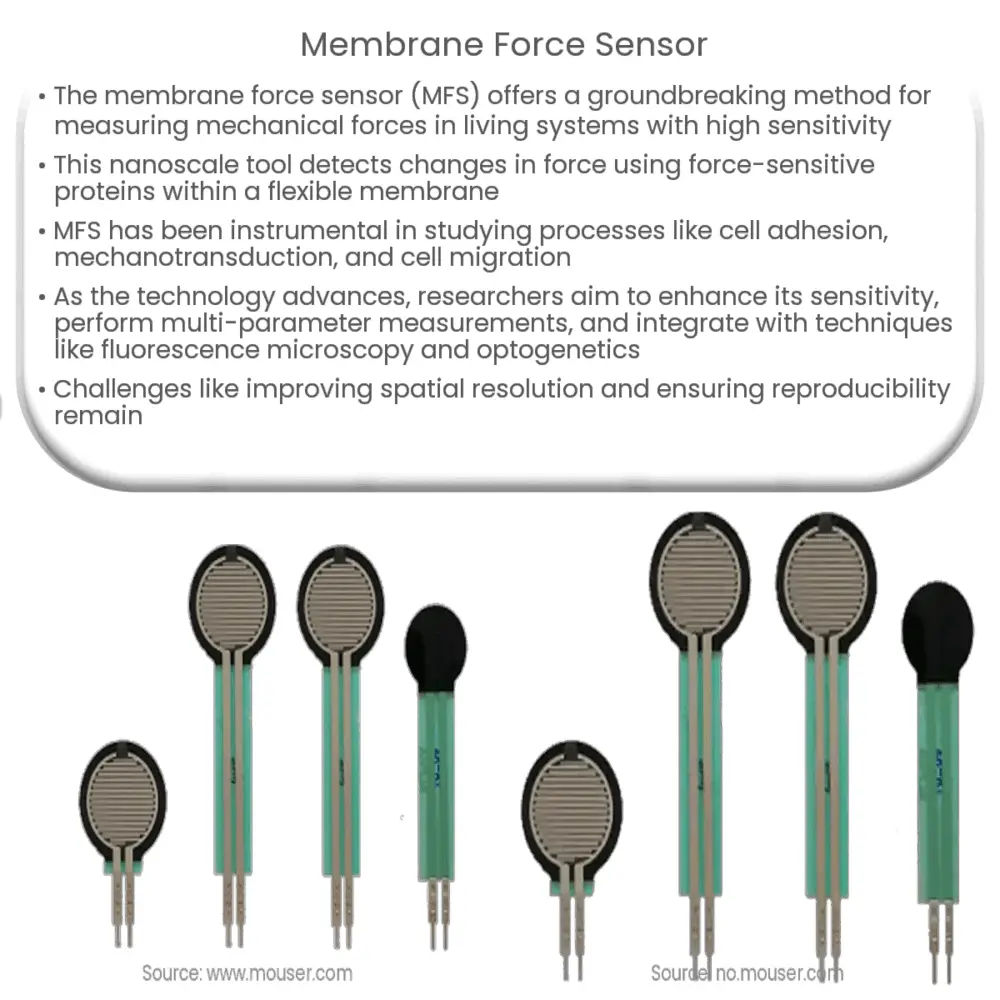
Exploring the Membrane Force Sensor: A Revolutionary Tool for Measuring Mechanical Forces
From cellular processes to the mechanical forces acting on organisms, understanding the interplay between biological systems and their environment has always been a central focus of scientific research. In recent years, a groundbreaking technology known as the membrane force sensor (MFS) has emerged, offering new possibilities for measuring mechanical forces in living systems. This article provides an overview of the MFS, its applications, and potential future advancements in the field.
Understanding the Membrane Force Sensor
The membrane force sensor is a revolutionary tool that enables scientists to measure mechanical forces in living cells with unprecedented sensitivity and precision. This nanoscale device is composed of a flexible, thin membrane embedded with force-sensitive proteins, which can detect changes in force acting on the membrane. By monitoring the activity of these proteins in response to external forces, researchers can determine the magnitude and direction of the forces at play in real time.
Applications of Membrane Force Sensors in Biological Research
Membrane force sensors have been utilized in a wide range of applications, from studying cellular processes to investigating biomechanical forces in multicellular organisms. Some notable examples include:
- Cell adhesion: MFS technology has been used to investigate the forces involved in cell adhesion, a crucial process in the development, maintenance, and function of tissues. By attaching MFS to cells, researchers can measure the forces exerted by cells as they adhere to different surfaces, shedding light on the mechanisms behind cell adhesion.
- Mechanotransduction: Mechanotransduction refers to the conversion of mechanical forces into biochemical signals within cells. MFSs have proven invaluable in studying this process, as they allow researchers to directly measure the forces experienced by cells in response to mechanical stimuli, such as stretching or compression.
- Cell migration: The ability to measure forces in living cells has enabled scientists to study cell migration, a vital process in development, wound healing, and cancer metastasis. With MFS, researchers can quantify the forces exerted by cells as they move, providing insights into the molecular mechanisms driving cell migration.
Advancements in MFS Technology
As the field of MFS technology continues to evolve, researchers are making significant strides in improving the performance and versatility of these devices. Some notable advancements include:
- Enhanced sensitivity: By refining the design of the force-sensitive proteins and optimizing the membrane’s material properties, researchers have increased the sensitivity of MFS devices, enabling them to detect even minute changes in force.
- Simultaneous multi-parameter measurements: Innovations in MFS technology now allow researchers to measure multiple force parameters simultaneously, such as force direction and magnitude, which can provide more comprehensive insights into the forces at play in biological systems.
Integration with Other Technologies
One of the most exciting aspects of MFS technology is its potential for integration with other scientific tools and techniques. Combining MFS with established methods can lead to novel insights and a deeper understanding of complex biological processes. Some promising integrations include:
- Fluorescence microscopy: By combining MFS with fluorescence microscopy, researchers can simultaneously observe cellular structures and measure the forces acting upon them. This integration provides a powerful tool for investigating the mechanical forces involved in various cellular processes and their effects on cell behavior.
- Optogenetics: Optogenetics is a technique that allows scientists to control cellular activity using light. By integrating MFS with optogenetics, researchers can precisely manipulate cellular forces and study their effects on cell behavior and function in real time.
- Biomaterials research: MFS can be used to study the mechanical properties of biomaterials, such as hydrogels and scaffolds, which are often used in tissue engineering and regenerative medicine. By measuring the forces exerted by cells on these materials, researchers can optimize their design and functionality for specific applications.
Future Perspectives and Challenges
Despite the significant advancements in MFS technology, several challenges remain to be addressed. Some of the key challenges include:
- Improving spatial resolution: To study forces at the subcellular level, it is essential to further improve the spatial resolution of MFS devices. This will enable researchers to investigate the forces acting on individual cellular structures and organelles, providing a more detailed understanding of cellular mechanics.
- Standardization and reproducibility: As MFS technology continues to evolve, it is crucial to establish standardized protocols and guidelines for its use. This will ensure the reproducibility of results across different research groups and facilitate the comparison of data between studies.
In conclusion, the membrane force sensor is a powerful tool that has greatly expanded our understanding of the mechanical forces in living systems. As MFS technology continues to advance, it holds the potential to revolutionize numerous fields of biological research, from cellular and molecular biology to biomechanics and tissue engineering. By addressing the existing challenges and exploring new integrations with complementary technologies, the future of MFS promises to unlock even more insights into the complex interplay between mechanical forces and living systems.



