
Magnetic shape memory alloy actuators enable high energy efficiency, large strains, and fast response times for robotics, aerospace, and biomedical applications.
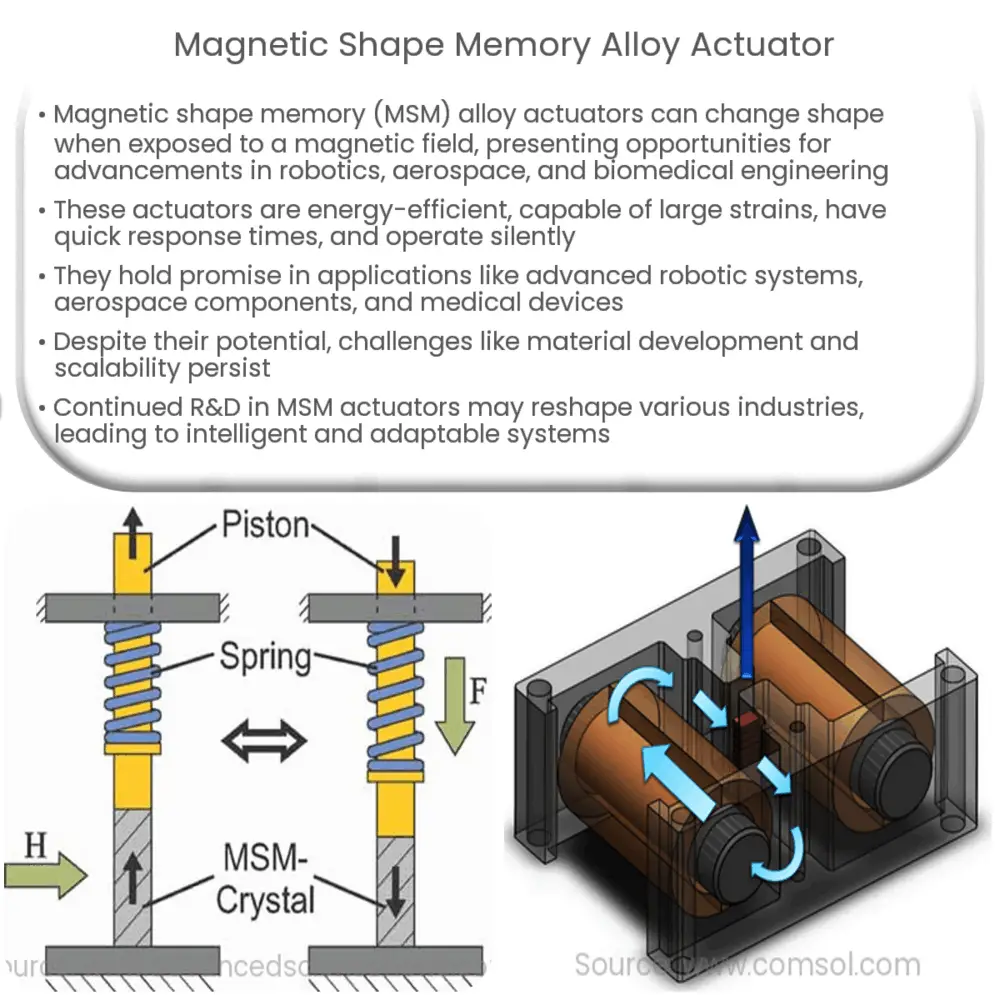
Magnetic Shape Memory Alloy Actuators: Revolutionizing the Future of Robotics and Beyond
Introduction to Magnetic Shape Memory Alloys
Magnetic shape memory (MSM) alloys are a unique class of smart materials that possess the ability to change their shape when exposed to a magnetic field. This property, known as the magnetic shape memory effect, has opened up a world of possibilities for creating advanced actuators in various fields such as robotics, aerospace, and biomedical engineering. In this article, we will discuss the fundamentals of MSM alloys, their applications, and how they are revolutionizing the future of technology.
Working Principle of MSM Actuators
MSM alloys are made up of ferromagnetic materials, which can undergo reversible changes in their crystal structure due to the application of a magnetic field. These changes result in a significant deformation of the alloy, which can be used to generate motion in actuators. The most widely studied MSM alloy is the Ni-Mn-Ga system, with its unique combination of properties making it a promising candidate for various applications.
The working principle of MSM actuators relies on the magnetic field-induced martensitic phase transformation of the alloy. This transformation results in a reorientation of the crystal structure, causing the material to change its shape in response to the magnetic field. The key advantage of MSM actuators is their ability to generate large strains (up to 10%) at relatively low magnetic field strengths, making them highly efficient and energy-saving devices.
Advantages of MSM Actuators over Conventional Actuators
MSM actuators offer several advantages over traditional actuators, such as electromagnetic, piezoelectric, and electrostatic actuators. Some of the key benefits of MSM actuators include:
- High energy efficiency: Due to their direct coupling between the magnetic field and the mechanical deformation, MSM actuators exhibit high energy conversion efficiency, which can reach up to 70%.
- Large actuation strains: MSM actuators can achieve large deformation strains, with some materials showing up to 10% strain, significantly higher than other smart materials, such as piezoelectric and electrostrictive materials.
- Fast response times: MSM actuators can generate quick, reversible actuation, with response times typically in the range of microseconds to milliseconds.
- Low noise and minimal wear: The solid-state nature of MSM actuators results in silent operation and minimal wear, making them ideal for applications where noise and durability are important factors.
Applications of MSM Actuators
Due to their unique properties, MSM actuators have a wide range of potential applications in various industries. Some of these applications include:
- Robotics: MSM actuators can be used in robotic systems for precise motion control, enabling the development of advanced robotic arms, legs, and grippers with improved efficiency and performance.
- Aerospace: The high energy efficiency and compact design of MSM actuators make them suitable for aerospace applications, such as adaptive wings, flaps, and landing gear systems.
- Biomedical engineering: MSM actuators can be employed in medical devices for minimally invasive surgery, drug delivery systems, and implantable devices, offering precise and reliable control of movement.
Challenges and Limitations of MSM Actuators
Despite their numerous advantages, MSM actuators also face several challenges and limitations that need to be addressed for their widespread adoption:
- Material development: The performance of MSM actuators strongly depends on the material properties, such as the magnetocrystalline anisotropy and phase transition temperatures. Further research and development are needed to optimize these properties for specific applications and operating conditions.
- Scalability: Scaling up the size of MSM actuators while maintaining their performance is a challenging task, as the magnetic field strength required for actuation increases with size. Innovative solutions, such as the use of composite materials or segmented designs, need to be explored to overcome this limitation.
- Control systems: Developing robust and precise control systems for MSM actuators is crucial for their successful integration into various applications. Advanced control algorithms and feedback mechanisms must be designed to ensure accurate and stable operation.
Future Outlook and Potential Impact
As research and development in the field of MSM actuators continue to progress, we can expect significant advancements in the performance, scalability, and control of these devices. By addressing the current challenges and limitations, MSM actuators have the potential to revolutionize a wide range of industries and applications, providing numerous benefits over traditional actuator technologies.
Moreover, the integration of MSM actuators with other smart materials and systems, such as sensors, energy harvesting devices, and artificial intelligence, will pave the way for the development of intelligent, adaptive, and autonomous systems. These systems have the potential to greatly impact various sectors, including manufacturing, transportation, healthcare, and defense.
Conclusion
Magnetic shape memory alloy actuators offer a promising alternative to conventional actuator technologies, thanks to their unique properties and advantages. While there are still challenges to overcome, ongoing research and development efforts in this field are expected to lead to significant advancements in the coming years. As a result, MSM actuators are poised to play a crucial role in shaping the future of robotics, aerospace, biomedical engineering, and many other industries, ushering in a new era of smart, efficient, and adaptable systems.