
Explore the world of Magnetic Proximity Sensors, their working principle, types, applications, and future trends in this comprehensive guide.
Magnetic Proximity Sensors: An Introduction
Magnetic Proximity Sensors are an important tool in the arsenal of any technologist dealing with physical measurements. They serve as key components in a broad array of industries and applications, from automotive to robotics, allowing machines to make precise detections without any physical contact.
What Are Magnetic Proximity Sensors?
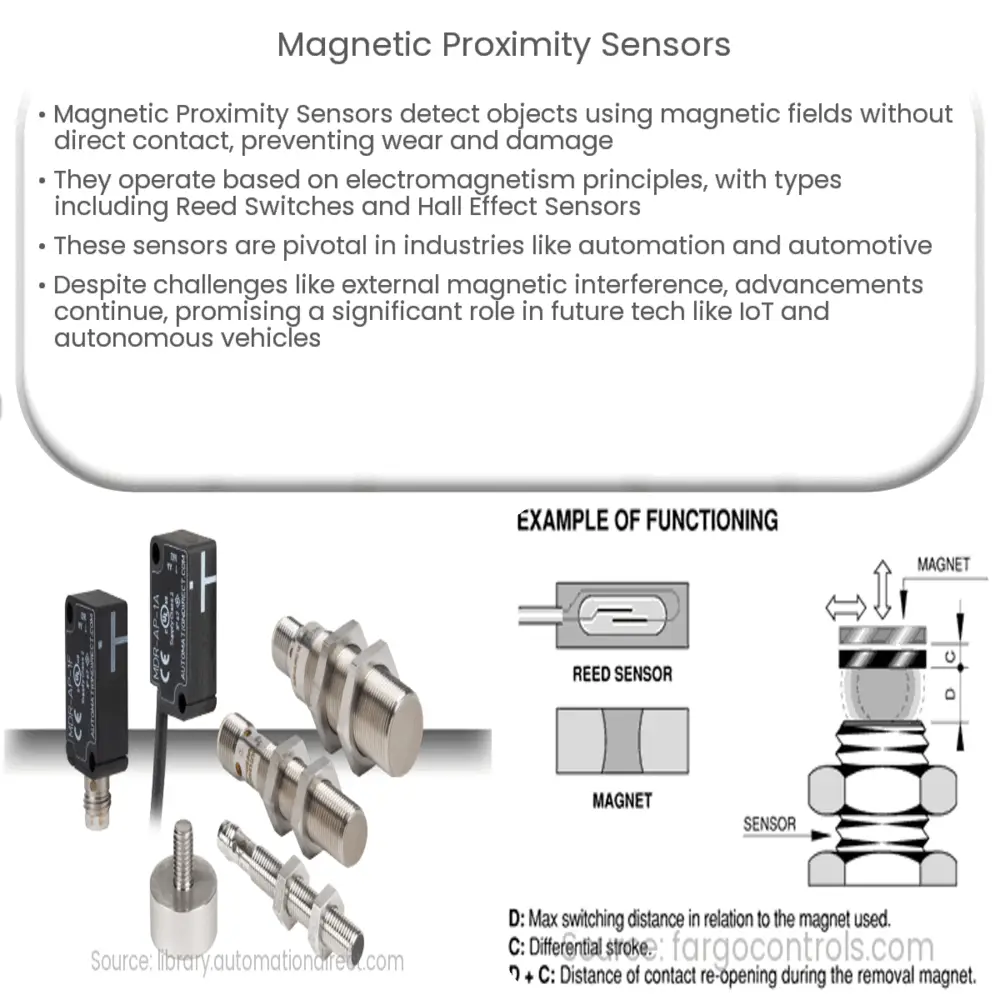
Magnetic Proximity Sensors are devices that sense the presence or absence of objects using magnetic fields. They are characterized by their ability to detect magnetic objects (usually ferrous materials) without the need for direct contact. This contact-free detection helps avoid damage due to wear and tear or excessive force, enabling extended operational life and reliability.
Operating Principle
The operation of Magnetic Proximity Sensors revolves around the basic principles of electromagnetism. A magnetic field is created by an internal magnet or electric current. When a magnetic material comes close, it alters this field, and this change is detected and translated into an electrical signal.
Types of Magnetic Proximity Sensors
- Reed Switches: These are simple sensors that contain a pair of flexible magnetic contacts sealed in a glass tube. When exposed to a magnetic field, the contacts draw together and close the circuit.
- Hall Effect Sensors: These sensors use the Hall effect, a phenomenon where a voltage difference is created across an electrical conductor, transverse to an electric current in the conductor and a magnetic field perpendicular to the current. Hall Effect sensors are very versatile, as they can sense both the presence and the absence of a magnetic field.
Applications
Magnetic Proximity Sensors are utilized in various industries and applications, thanks to their robust, reliable, and non-contact nature.
- Industrial Automation: Proximity sensors are used extensively in automated production processes for object detection, position tracking, and quality control.
- Automotive: They are used in anti-lock braking systems, fluid level detection, and engine management.
Magnetic Proximity Sensors have been a boon to countless industries, improving both safety and efficiency. Their importance in the modern technological landscape cannot be understated. As technology continues to advance, the role of these sensors is only expected to grow.
Challenges and Innovations
Despite their numerous advantages, Magnetic Proximity Sensors also come with certain challenges. For instance, they can be influenced by external magnetic fields or changes in ambient temperature. As a result, it’s necessary to design these sensors with measures to mitigate such effects.
Innovation in the field of Magnetic Proximity Sensors continues at a rapid pace. Sensor designs are getting smaller, more efficient, and increasingly sophisticated. With advancements in microfabrication and nanotechnology, we’re seeing the development of miniaturized sensors that offer improved sensitivity and reduced power consumption.
Future of Magnetic Proximity Sensors
Looking ahead, the future of Magnetic Proximity Sensors appears bright. The demand for these sensors is projected to grow significantly in the coming years, driven by the increasing adoption of automation across different sectors. The Internet of Things (IoT) revolution is expected to provide further impetus to this growth, given the role of proximity sensors in facilitating smart, connected devices.
Emerging technologies such as autonomous vehicles, robotics, and smart manufacturing are likely to make extensive use of Magnetic Proximity Sensors. In these applications, the sensors’ ability to detect objects without physical contact will be crucial in ensuring operational efficiency and safety.
Conclusion
In conclusion, Magnetic Proximity Sensors are indispensable tools in a vast range of applications. Their non-contact nature, reliability, and versatility have made them integral components in various fields, including industrial automation, automotive, and more. As technology continues to evolve, it’s clear that these sensors will play a pivotal role in driving progress. From enhancing safety in our vehicles to increasing efficiency in our factories, Magnetic Proximity Sensors are set to remain a cornerstone of modern technology for years to come.



