
A linear current sensor is an electronic device that accurately measures electrical current in circuits, utilizing the Hall effect for applications like motor control and power supplies.
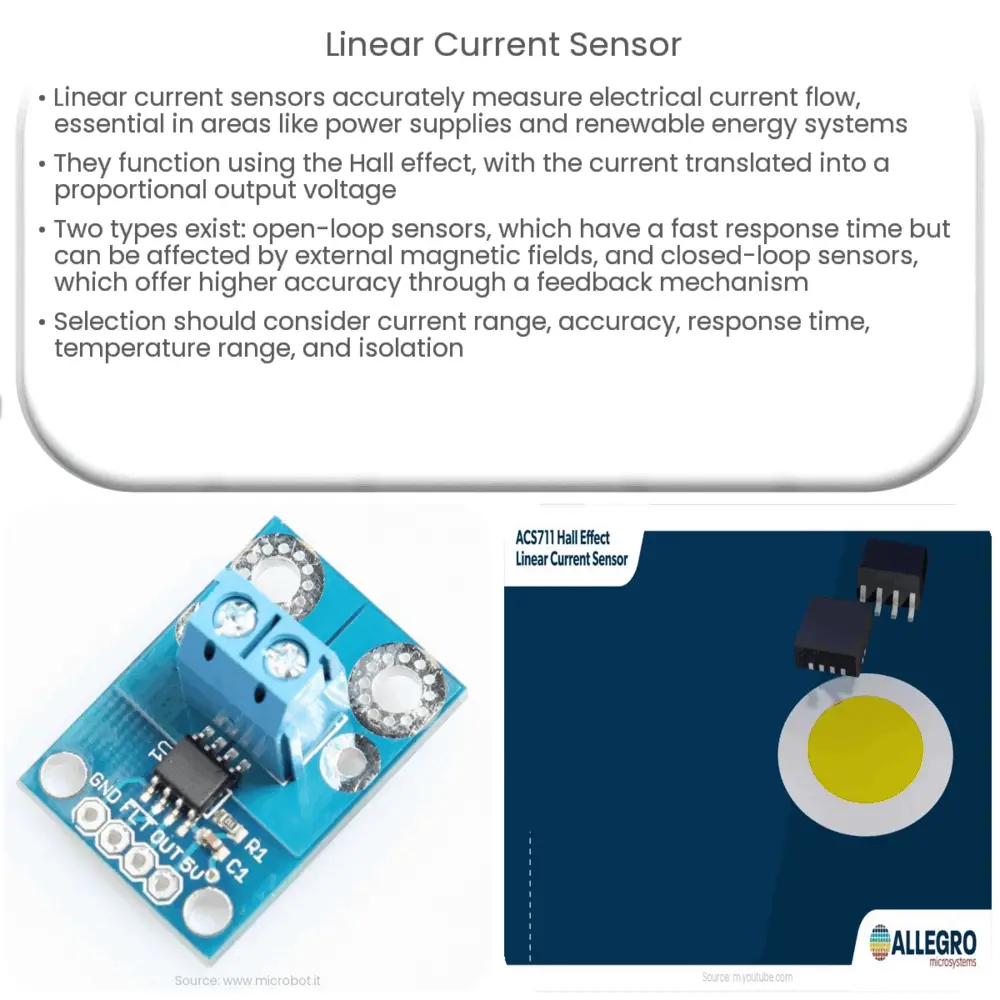
Understanding Linear Current Sensors: An Introduction
What is a Linear Current Sensor?
A linear current sensor is an electronic device used to measure the flow of electrical current in a circuit with high precision and accuracy. This type of sensor operates by translating the current passing through it into a linear and proportional output voltage, which can be easily processed and analyzed by other electronic components. Linear current sensors are essential in various applications, such as power supplies, motor control, and renewable energy systems, where accurate current measurement and monitoring are crucial.
Working Principle of Linear Current Sensors
Linear current sensors typically use a magnetic field sensing technology called the Hall effect to measure current flow. The Hall effect is a phenomenon in which a voltage difference is created across a conductor when a magnetic field is applied perpendicular to the current flowing through it. As the current flowing through the conductor increases, the magnetic field generated around it also increases, resulting in a higher voltage difference across the Hall element.
In a linear current sensor, a Hall-effect sensor is placed in close proximity to the conductor carrying the current. As the current flows through the conductor, it generates a magnetic field that induces a voltage in the Hall-effect sensor proportional to the current’s intensity. This voltage is then amplified, filtered, and converted into a linear output signal that can be read and interpreted by other electronic components, such as microcontrollers or digital signal processors.
Types of Linear Current Sensors
There are two primary types of linear current sensors: open-loop and closed-loop.
Open-Loop Current Sensors
Open-loop current sensors, also known as passive current sensors, use a single Hall-effect sensor to measure the magnetic field generated by the current-carrying conductor. Since the sensor is not part of the current path, it does not experience any power losses or heating, allowing it to have a fast response time and excellent linearity. However, open-loop current sensors are more susceptible to external magnetic field interference and can have reduced accuracy under high temperature conditions.
Closed-Loop Current Sensors
Closed-loop current sensors, also known as active current sensors, utilize a feedback mechanism to improve measurement accuracy and linearity. In addition to the Hall-effect sensor, a closed-loop current sensor includes a secondary coil wound around a magnetic core. The output voltage from the Hall-effect sensor is used to drive a current through the secondary coil, which generates a magnetic field opposite to the one created by the current-carrying conductor. This opposing magnetic field effectively cancels out the original magnetic field, leading to a more accurate measurement of the current flowing through the conductor. Closed-loop current sensors generally offer better performance and higher accuracy than open-loop sensors but are more complex and costly.
Advantages of Linear Current Sensors
Linear current sensors offer several advantages over other current sensing technologies, including:
- High accuracy and linearity
- Galvanic isolation between the sensor and the measured circuit
- Wide dynamic range and bandwidth
- Low power consumption and low heat dissipation
- Resistance to external magnetic field interference (in closed-loop sensors)
Applications of Linear Current Sensors
Linear current sensors are utilized in a wide range of applications due to their versatility, accuracy, and reliability. Some common applications include:
- Power Supplies: In power supplies, linear current sensors are used to monitor and regulate the output current, ensuring a stable and reliable supply of power to the load.
- Motor Control: Accurate current measurement is crucial for controlling and protecting electric motors. Linear current sensors provide real-time feedback on motor current, enabling precise control of motor torque and speed.
- Renewable Energy Systems: In solar panels and wind turbines, linear current sensors are used to monitor the generated power and optimize the efficiency of the energy conversion process.
- Automotive: In electric vehicles, linear current sensors are employed to monitor the battery’s charge and discharge current, ensuring optimal performance and prolonging battery life.
- Industrial Automation: Linear current sensors are used to monitor and control various industrial processes, such as welding, heating, and conveyor systems, ensuring consistent quality and performance.
Selecting the Right Linear Current Sensor
When choosing a linear current sensor for a specific application, several factors should be considered:
- Current Range: Select a sensor with a current range that matches the expected current levels in the application. It is important to consider both maximum and minimum current levels for accurate measurements.
- Accuracy: Choose a sensor with an accuracy that meets the requirements of the application. Higher accuracy sensors provide better performance but may be more expensive.
- Response Time: Fast response times are critical for certain applications, such as motor control and power supplies. Ensure that the sensor’s response time meets the needs of the application.
- Temperature Range: Consider the operating temperature range of the sensor, especially for applications exposed to extreme temperature conditions.
- Isolation: Select a sensor with appropriate galvanic isolation to prevent electrical noise and potential damage to the measured circuit or the sensor itself.
Conclusion
Linear current sensors play a vital role in various applications, offering high precision and accurate current measurements. Understanding the working principle, types, advantages, and selection criteria of linear current sensors is crucial for engineers and designers to choose the right sensor for their specific applications. By selecting the appropriate linear current sensor, it is possible to optimize system performance, enhance efficiency, and ensure the safety and reliability of various electronic devices and systems.



