
Explore the fundamentals of closed-loop current sensors, their working mechanism, advantages, applications, and key selection criteria.
Closed-Loop Current Sensor: Understanding the Basics
Closed-loop current sensors, also commonly known as Hall-effect current sensors, are crucial components in various electrical and electronic applications. They are known for their high accuracy, efficiency, and ease of use in an array of applications.
What is a Closed-Loop Current Sensor?
As the name suggests, a closed-loop current sensor operates in a closed-loop system to provide precise current measurement. It uses the Hall Effect – a principle in physics discovered by Edwin Hall in 1879. According to this principle, a voltage difference is induced in a conductor that is transverse (or perpendicular) to the electric current and the magnetic field. This phenomenon is widely used in current sensors to measure the current through a conductor without direct electrical contact, which significantly improves safety and convenience in many applications.
Key Components and Working
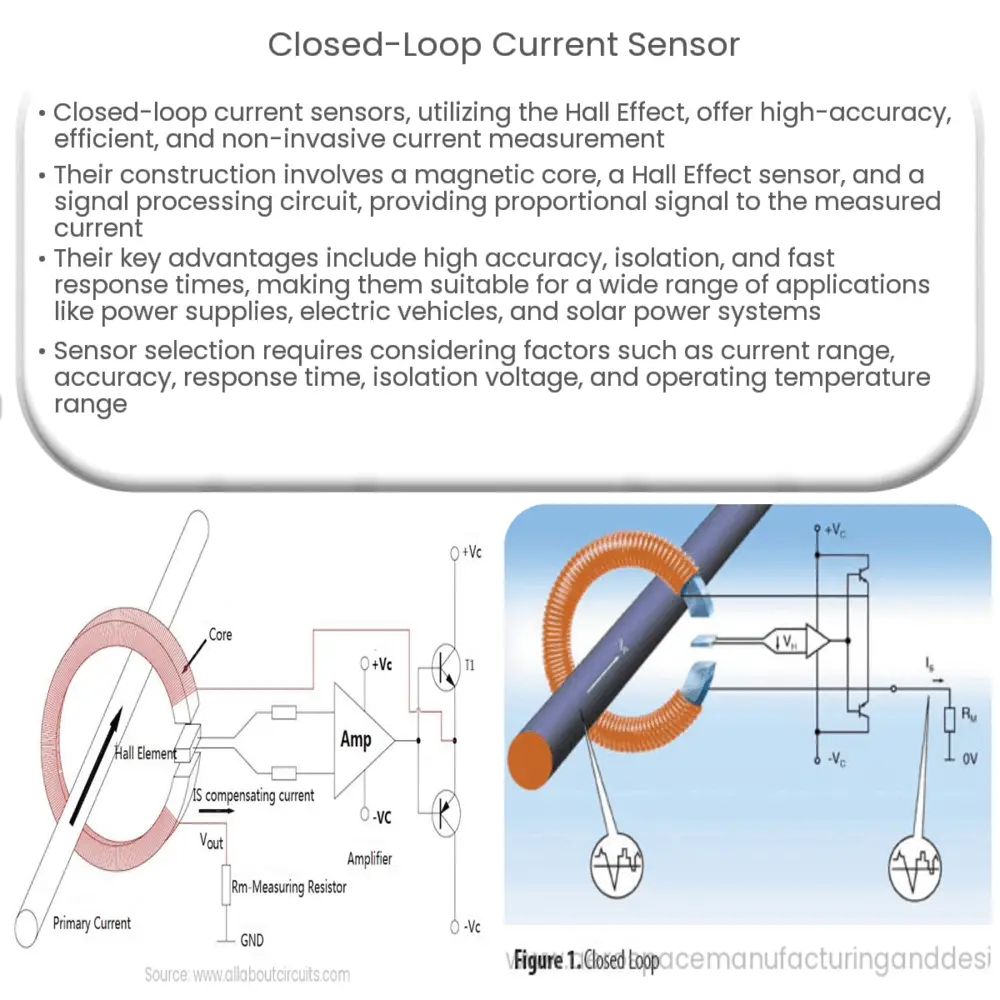
A typical closed-loop current sensor is made of a few key components: a magnetic core, a Hall Effect sensor, and an electronic circuit for signal processing. In simple terms, the sensor measures the magnetic field generated by the current through the core, and then the sensor output is processed by the circuit to generate a precise, proportional signal to the current.
- Magnetic core: The magnetic core is used to concentrate the magnetic field generated by the current flowing through the primary conductor.
- Hall Effect sensor: The Hall Effect sensor detects the magnetic field produced by the current. This is where the Hall Effect comes into play.
- Signal processing circuit: The signal processing circuit receives the output from the Hall Effect sensor. It amplifies and conditions the signal to provide a usable output that’s proportional to the measured current.
Due to the closed-loop feedback mechanism, the secondary current is adjusted until it opposes the primary magnetic field to zero. This process results in the output being directly proportional to the primary current, leading to highly accurate measurements.
Advantages of Closed-Loop Current Sensors
Closed-loop current sensors boast several advantages that set them apart from other types of current sensors. They offer high accuracy, isolation, and a fast response time. Moreover, they demonstrate superior performance, even in high current applications, owing to their ability to handle wide current ranges and maintain a high level of precision.
Applications of Closed-Loop Current Sensors
Closed-loop current sensors find a broad spectrum of applications in industries requiring precise current monitoring and control. Here are some common applications:
- Power supplies: These sensors are used in switched-mode power supplies (SMPS) to monitor the current for safety and efficiency purposes.
- Electric vehicles: In the growing electric vehicle sector, these sensors are used to manage battery charging and discharging and to monitor motor control systems.
- Solar power systems: Closed-loop current sensors aid in tracking the current in solar power systems to optimize efficiency.
- Industrial automation: In industrial control systems, these sensors help in detecting overcurrent conditions and maintaining safe operating conditions.
Selection of a Closed-Loop Current Sensor
Choosing the right closed-loop current sensor requires considering several factors. Key among them are:
- The current range: The sensor should be capable of handling the maximum current that the application can produce.
- Accuracy requirements: Some applications may require higher accuracy than others.
- Response time: A faster response time may be necessary for applications that require rapid current changes.
- Isolation voltage: The sensor should be capable of withstanding the maximum isolation voltage in the application.
- Operating temperature range: The sensor should be able to function properly within the temperature range of the application.
Conclusion
In conclusion, closed-loop current sensors play a pivotal role in the realm of electrical and electronic systems. Leveraging the Hall Effect, these sensors offer a non-invasive, safe, and highly accurate method of measuring current. Their unique properties such as high accuracy, fast response time, and isolation make them ideal for a wide array of applications, ranging from power supplies to electric vehicles and solar power systems. When selecting a closed-loop current sensor, it’s crucial to consider factors like current range, accuracy requirements, response time, isolation voltage, and operating temperature range to ensure optimal performance. As technology continues to evolve, we can expect even more innovative uses and enhancements in the field of closed-loop current sensors.