
Explore the world of LCR meters, their types, applications, features, and importance in electrical engineering and material analysis.
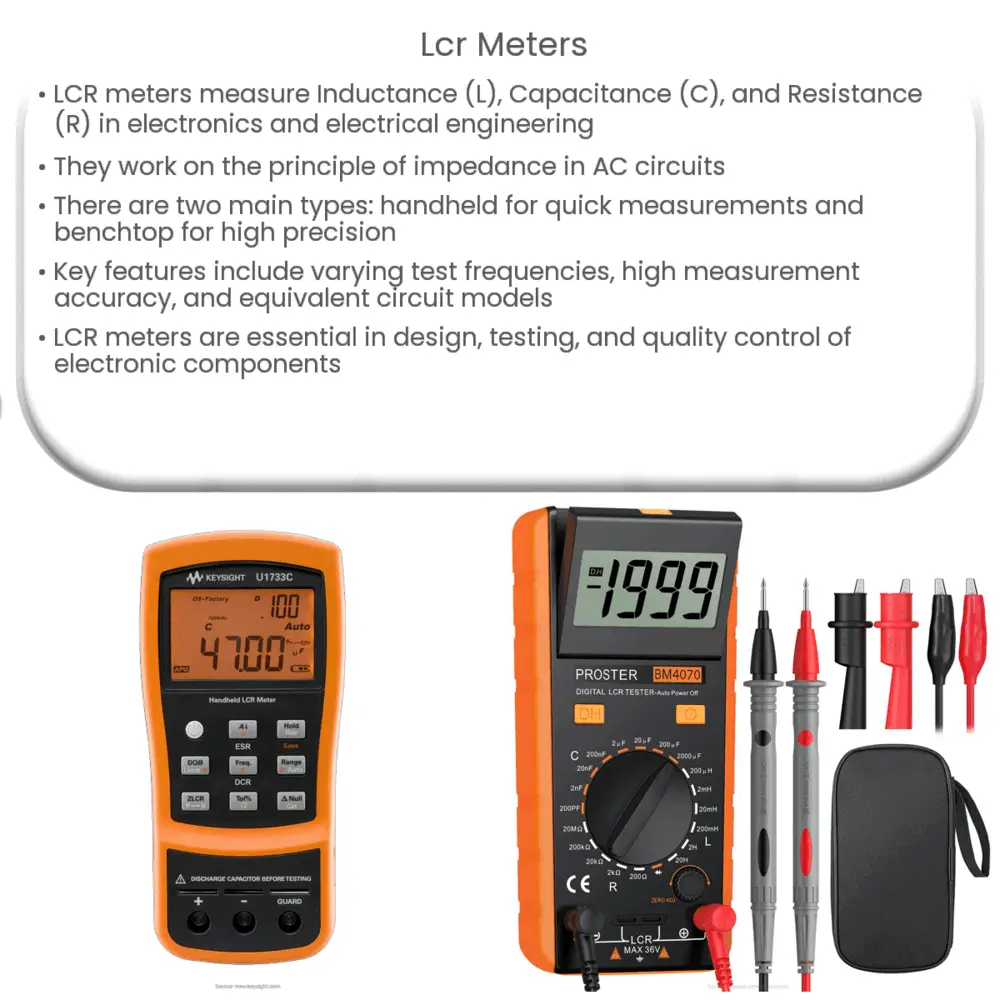
Introduction to LCR Meters
LCR meters, otherwise known as Inductance (L), Capacitance (C), and Resistance (R) meters, are versatile instruments used in the field of electronics and electrical engineering. These devices are indispensable tools for professionals and hobbyists alike, allowing for precise measurements of these three fundamental properties of an electrical circuit.
Working Principle of LCR Meters
LCR meters operate based on the principle of impedance, a measure that combines the effects of resistance, inductance, and capacitance in an AC circuit. The device sends out an AC signal and then measures the response from the component or circuit under test. The meter then analyses this response to derive the values of L, C, and R.
Types of LCR Meters
Key Features of LCR Meters
While LCR meters vary in design and functionality, there are several key features that are generally included in most models:
Applications of LCR Meters
LCR meters find use in a wide range of applications. They are employed in the design, testing, and manufacturing of electronic components and circuits, including transformers, inductors, capacitors, and resistors. They are also used in quality control, ensuring that components meet specified parameters. In research and development, LCR meters are invaluable tools, aiding in the exploration and understanding of new electronic materials and devices.
LCR Meters in Component Testing
In the field of component testing, LCR meters play a significant role. For instance, when testing capacitors, an LCR meter can help determine the capacitance value, equivalent series resistance (ESR), and dissipation factor (DF). Similarly, for inductors or transformers, the meter can measure inductance (L), quality factor (Q), and winding resistance (R).
LCR Meters in Material Analysis
Aside from component testing, LCR meters are also utilized in material analysis. By measuring the impedance of a material, an LCR meter can help characterize its electrical properties. This is particularly useful in the research and development of new materials for electronic and electrical applications.
Choosing the Right LCR Meter
The choice of an LCR meter depends largely on the specific requirements of a task. Key considerations should include the range of frequencies needed, the desired accuracy, and the type of components or materials to be measured. Moreover, the user interface, ease of use, and connectivity options (such as USB, GPIB, or LAN) can also be important factors.
Limitations of LCR Meters
While LCR meters are incredibly useful, they do have their limitations. They are less effective at measuring very small or very large values of L, C, or R. Additionally, they can be affected by factors such as temperature, humidity, and the presence of magnetic fields. Therefore, proper calibration and usage are crucial to obtaining accurate results.
Conclusion
In conclusion, LCR meters are an integral tool in electronics and electrical engineering, providing precise measurements of inductance, capacitance, and resistance. From component testing to material analysis, they offer a wide range of applications. Despite some limitations, their versatility and accuracy make them indispensable in both professional and hobbyist settings. Whether you are a researcher pushing the boundaries of material science or an electronics enthusiast tinkering with circuits, understanding and utilizing an LCR meter can significantly enhance your work and discovery process.



