
Explore the role, functioning, and future of Inductive Voltage Regulators in managing electrical stability in our comprehensive guide.
Introduction to Inductive Voltage Regulators
Inductive voltage regulators are important electrical devices used to maintain a consistent level of voltage. As the name suggests, these devices use the principle of induction to regulate the voltage across a network or device. To understand the workings and implications of these regulators, it’s vital to first establish what voltage regulation is and its significance in the world of electricity.
Understanding Voltage Regulation
Voltage regulation is the measure of change in the voltage of an electric circuit. It is a key aspect of ensuring the efficient and safe running of electrical appliances and networks. Maintaining an optimal level of voltage is crucial as both undervoltage and overvoltage can lead to inefficient operation, or even damage, of electrical equipment.
The Role of Inductive Voltage Regulators
Inductive voltage regulators play a pivotal role in maintaining the balance of voltage in a power supply system. They essentially work on the principle of electromagnetic induction, where changes in magnetic fields produce electric currents. The core of these regulators consists of windings or coils of wire, with their functionality rooted in Faraday’s Law of electromagnetic induction.
Working Principle of Inductive Voltage Regulators
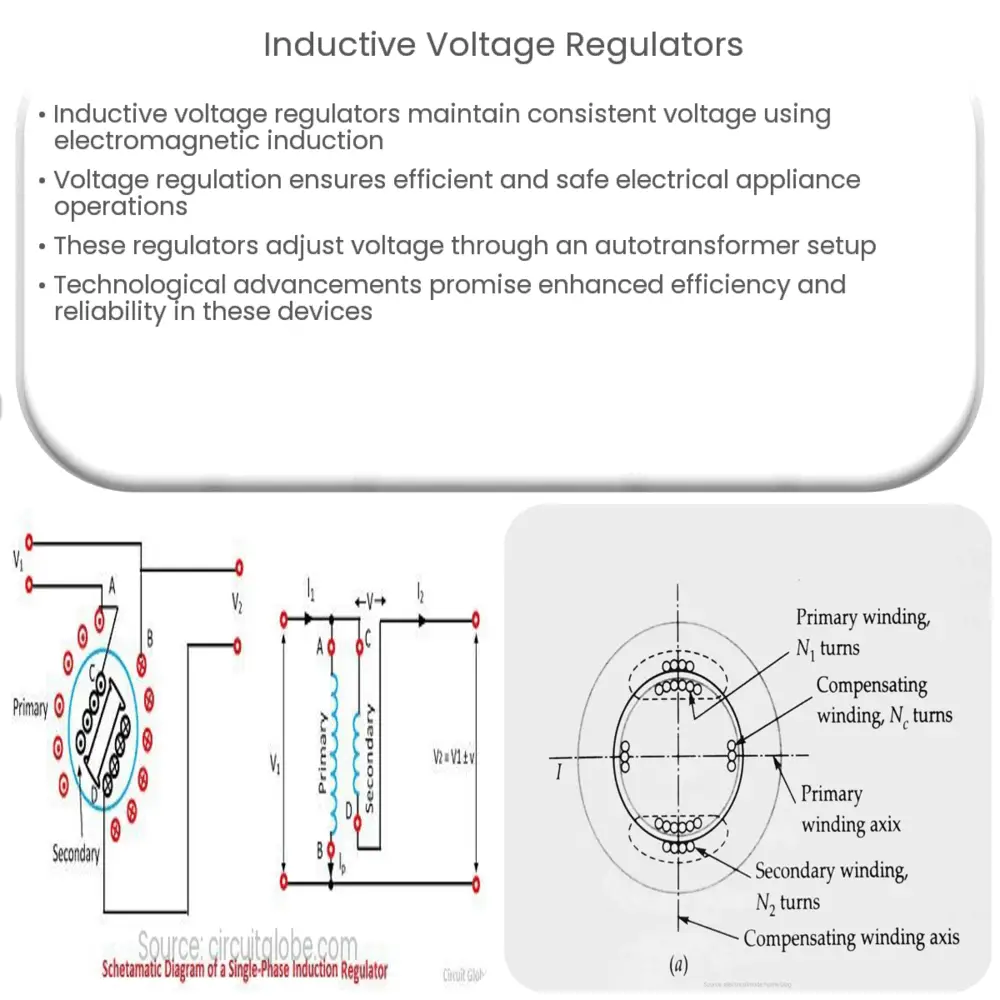
Inductive voltage regulators function using an autotransformer arrangement. The primary winding, also known as the input winding, receives the incoming fluctuating voltage. The secondary winding, or output winding, is mechanically adjustable and controls the amount of induction between the primary and secondary windings. By varying the relative position of the secondary winding, the regulator can adjust the output voltage.
Types of Inductive Voltage Regulators
- Single-Phase Inductive Voltage Regulator: This type of regulator is designed for single-phase systems and features a single input and output phase. They are generally used in domestic and light commercial applications.
- Three-Phase Inductive Voltage Regulator: These are designed for three-phase systems and contain three separate phase regulators. These are widely used in industrial applications and larger electrical networks.
Despite their widespread usage, inductive voltage regulators also have certain limitations, which will be discussed in the following section. As technology evolves, new methods and innovations continue to enhance the efficiency and reliability of these indispensable devices.
Limitations and Challenges
Inductive voltage regulators, while essential in managing voltage regulation, do have some inherent limitations. These include inefficiency at low voltage levels, susceptibility to changes in frequency, and a need for regular maintenance. In addition, they can introduce phase shift into the circuit, causing harmonic distortion, which can be detrimental to some electrical devices. Furthermore, these regulators tend to be bulky and may produce audible noise due to electromagnetic vibrations.
Overcoming Limitations: The Role of Technology
Despite the challenges, advancements in technology have facilitated significant improvements in the design and functioning of inductive voltage regulators. The use of high-quality magnetic materials, precision engineering, and sophisticated control systems has allowed for more efficient and reliable regulators. Digital control systems, for instance, offer high accuracy and flexibility, enabling the regulators to respond quickly and effectively to changes in the load or input voltage.
The Future of Inductive Voltage Regulators
The future of inductive voltage regulators is indeed promising. With the emergence of new materials, such as high-temperature superconductors, and advances in power electronics, these devices will continue to evolve. The integration of artificial intelligence and machine learning could enable predictive control, enhancing efficiency and minimizing maintenance requirements. Furthermore, with the ongoing shift towards renewable energy, there is a growing demand for highly efficient and reliable voltage regulation devices to ensure the stability of power grids.
Conclusion
In conclusion, inductive voltage regulators play a critical role in maintaining the stability of electrical systems by effectively managing voltage levels. While they have their challenges and limitations, ongoing technological advancements promise a future of improved performance and reliability. As we transition towards a more sustainable future with renewable energy, the role of inductive voltage regulators will only become more vital. They stand as an important testament to the power of induction in the realm of electricity, demonstrating its utility and significance in our everyday lives.



