
Explore the function, applications, advantages, and limitations of Inductive Total Harmonic Distortion (THD) Analyzers in our detailed guide.
Introduction to Inductive Total Harmonic Distortion (THD) Analyzers
The inductive Total Harmonic Distortion (THD) Analyzer is a crucial instrument in the field of electrical and electronic engineering. It is primarily used to measure the harmonic distortion present in a signal and is a vital tool for analyzing power quality in various types of electrical equipment.
Understanding Total Harmonic Distortion
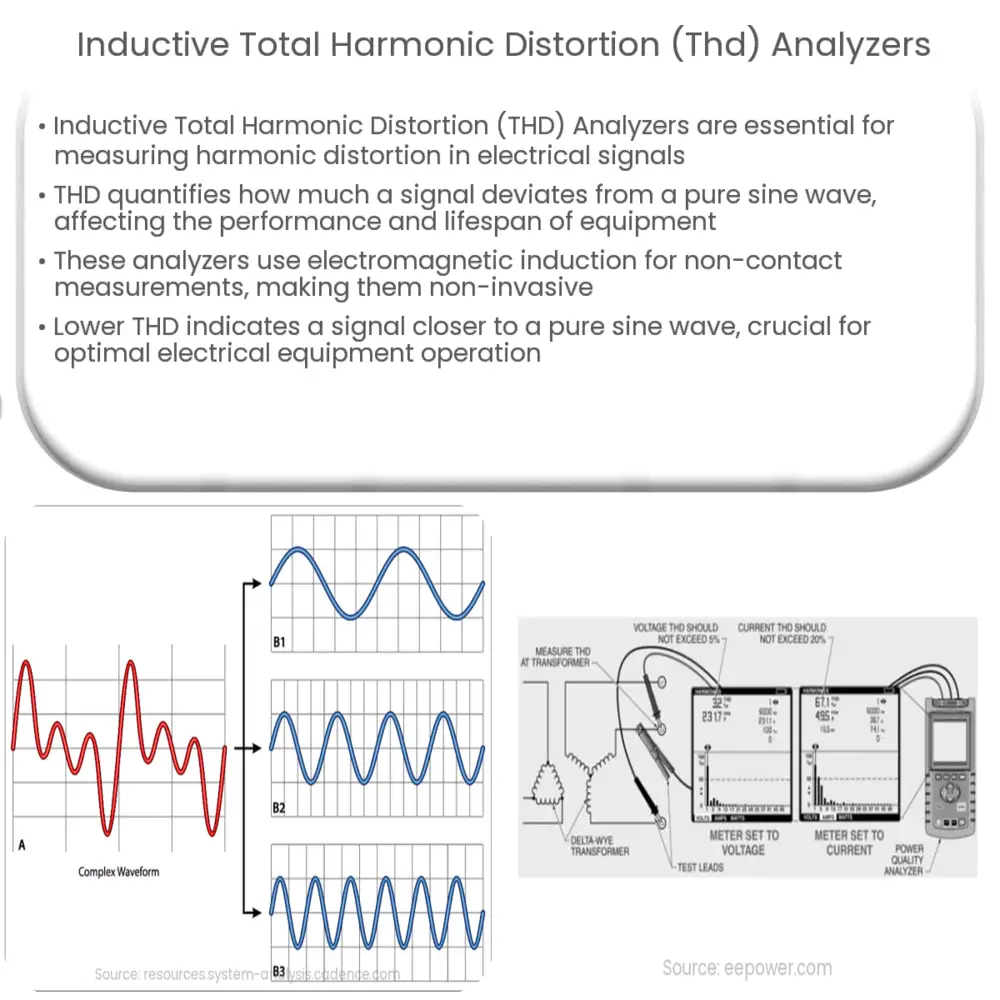
Total Harmonic Distortion (THD) is a measure that is used to quantify the extent of harmonic distortion in a signal. In essence, it’s a parameter that quantifies the deviation of a signal from a pure sine wave. Most electronic and electrical devices are designed to operate with sinusoidal input signals, and any distortion from this ideal can cause a variety of issues, including increased energy usage, overheating, and reduced lifespan of the equipment.
Role of Inductive THD Analyzers
The inductive Total Harmonic Distortion Analyzer comes into play to measure this distortion and provide critical data for system troubleshooting and optimization. These analyzers use inductive methods to evaluate the THD, leveraging principles of electromagnetic induction for non-contact and efficient measurement. This non-invasive approach reduces the risk of damaging sensitive electrical equipment during the testing process.
Functioning of Inductive THD Analyzers
The functioning of inductive THD Analyzers is based on the fundamental principles of Fourier analysis. The signal to be measured is first acquired via an inductive pickup. This signal, which is likely a complex waveform, is then processed to decompose it into a series of sinusoidal components, each with their frequency, phase, and amplitude.
The analyzer then calculates the ratio of the sum of the powers of all harmonics to the power of the fundamental frequency, providing the THD measurement. The harmonic components are considered ‘distortion’ because they represent frequencies not present in the original pure sine wave.
- 1 Lower THD values represent a closer approximation to a pure sine wave, which is often the desired condition for optimal operation of electrical equipment.
- 2 Higher THD values indicate a greater level of distortion and can serve as an early warning sign of potential equipment malfunction.
Applications of Inductive THD Analyzers
Inductive THD Analyzers find their applications across various industries and sectors. In power quality analysis, they are used to evaluate and maintain the health of power systems. High levels of harmonic distortion can negatively impact the quality of power supplied to various electrical loads, affecting their performance and efficiency.
In the audio industry, the analyzers are used to assess the fidelity of audio amplification and reproduction equipment. A lower THD value in audio equipment often signifies better audio reproduction, as it implies that the reproduced audio signal closely matches the original.
Advantages of Inductive THD Analyzers
- 1 Non-invasive measurement: The inductive nature of these analyzers enables non-contact measurement, reducing the risk of damaging sensitive equipment.
- 2 Accurate and reliable: They offer a precise and reliable method for measuring THD, providing valuable insights into the quality of signals.
- 3 Versatility: Their applications span multiple industries, from power quality assessment to audio fidelity testing.
Limitations of Inductive THD Analyzers
Despite their benefits, it’s important to note the limitations of inductive THD Analyzers. The accuracy of their measurements can be affected by factors such as electromagnetic interference and the physical positioning of the inductive pickup. In addition, while these analyzers excel in measuring THD, they do not provide detailed information on the nature or cause of the distortion, which may require additional diagnostic tools.
Conclusion
In summary, inductive Total Harmonic Distortion (THD) Analyzers are crucial tools for assessing and maintaining the quality of signals in various electrical and electronic systems. By offering a non-invasive, accurate, and versatile solution for THD measurement, they serve as vital assets in diverse fields, from power quality management to audio system design. However, like all tools, they have their limitations and are often used in conjunction with other diagnostic instruments for a comprehensive assessment. As technology advances, it’s anticipated that these tools will continue to evolve, offering even greater accuracy and convenience in THD analysis.



