
Explore the world of Inductive Phase Meters: understand their principles, operations, uses, and impact on various industries.
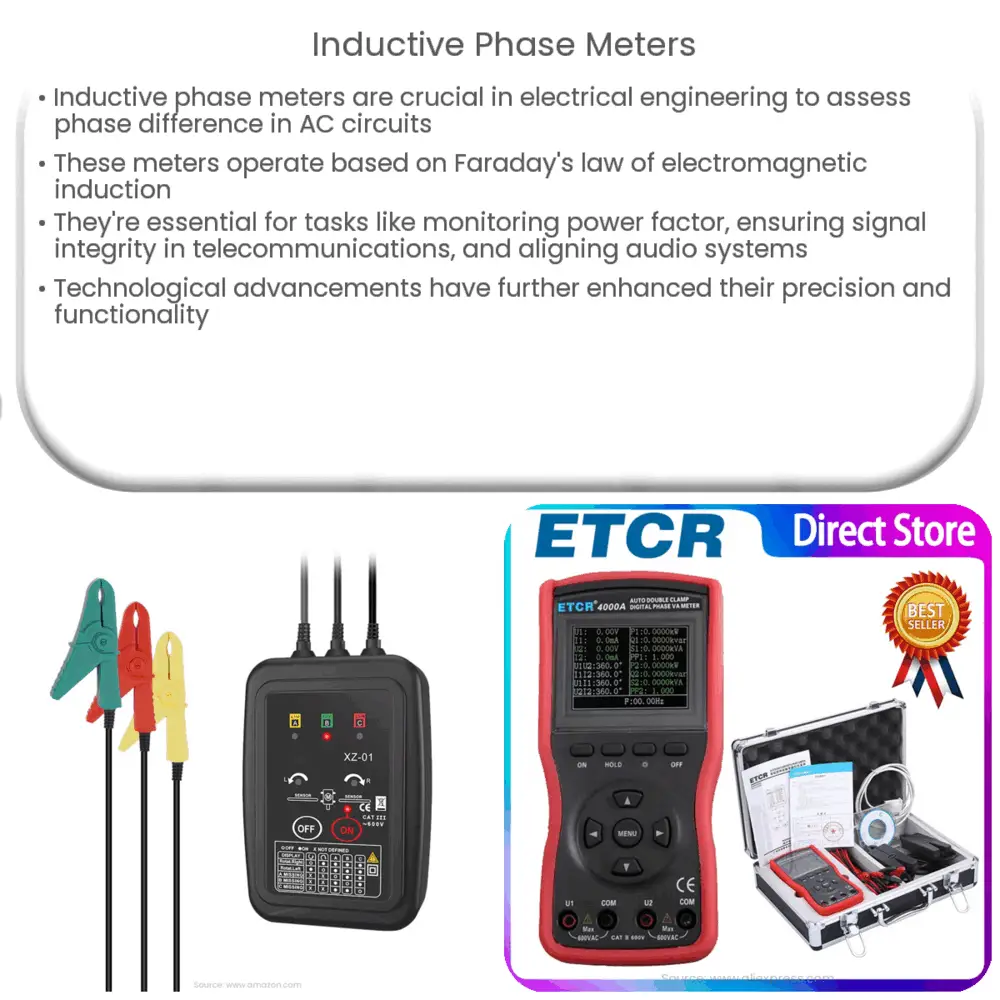
Introduction to Inductive Phase Meters
Inductive phase meters are pivotal components in the field of electrical engineering and electronics, particularly for evaluating the phase difference between voltage and current in an alternating current (AC) circuit. An understanding of their principle, operation, and uses is critical for individuals who wish to explore in-depth the world of AC circuits and their applications.
The Principle of Induction
The foundation of inductive phase meters is in Faraday’s law of electromagnetic induction, a central concept in electromagnetism linking magnetic field change to induced electric current. This principle is the basic premise for the operation of an inductive phase meter.
Operation of Inductive Phase Meters
The operation of an inductive phase meter involves detecting the phase difference between two sinusoidal quantities. It typically comprises two essential components: a phase comparator and a low pass filter. The phase comparator measures the phase difference, and the low pass filter aids in getting a steady reading by reducing rapid variations in the signal.
Uses of Inductive Phase Meters
Monitoring Power Factor: Inductive phase meters are essential for monitoring the power factor in electrical systems. The power factor is a key determinant of an electrical system’s efficiency, and any variations can significantly impact system performance. Inductive phase meters offer an accurate and reliable method for power factor measurement.
Telecommunication: In telecommunication, accurate phase measurement is crucial to maintaining signal integrity. Inductive phase meters play a pivotal role in this, helping to ensure the proper synchronization of signals.
Audio Systems: In audio systems, an inductive phase meter is vital for aligning speakers for accurate stereo or surround sound. It can also aid in troubleshooting signal issues in audio circuits.
Inductive Phase Meter Designs
There are several designs of inductive phase meters, but the basic principle remains the same: they use the principle of induction to measure the phase difference between two alternating signals. The primary types of inductive phase meters include single-phase and three-phase meters. The choice between these two largely depends on the requirements of the specific application.
Accuracy and Precision
Inductive phase meters are renowned for their accuracy and precision. They are carefully designed to provide accurate measurements even under challenging conditions. Some high-end models can offer an accuracy of up to 0.1 degree, making them a trusted tool for professionals in the field.
Calibration and Maintenance
Like any precision tool, inductive phase meters require regular calibration and maintenance to ensure accuracy over time. A variety of factors, such as temperature changes, aging, or mechanical shocks, can affect the performance of the meter. Therefore, regular calibration and proper care can significantly increase their lifespan and accuracy.
Choosing the Right Inductive Phase Meter
Choosing the right inductive phase meter depends on several factors including the type of application, required accuracy, and budget. For industrial applications where high accuracy is needed, a high-end model might be the best choice. For more general uses, a basic model can be sufficient. Furthermore, some models come with additional features such as data logging and digital displays for enhanced user experience.
Application: Industrial applications generally require a higher degree of accuracy than home or small-scale applications. Thus, you need to consider the environment in which the meter will be used.
Accuracy: If high precision is needed, a high-end model might be the best choice. However, for general uses, a basic model might suffice.
Budget: Cost can also be a determining factor. While high-end models offer more features and better accuracy, they are also more expensive. Balancing the cost against the needed functionality is important.
Impact of Technological Advancements
Technological advancements have played a significant role in the evolution of inductive phase meters. The advent of digital technology and microcontrollers has greatly enhanced the functionality and reliability of these devices. Nowadays, digital inductive phase meters are becoming more common and offer various advantages, such as increased accuracy, ease of use, and the ability to store and retrieve data.
Conclusion
In conclusion, inductive phase meters are indispensable tools in the field of electronics and electrical engineering. Their capability to measure the phase difference in AC circuits with great accuracy and precision makes them valuable in a wide array of applications. With continued technological advancements, these devices are expected to become even more accurate and easier to use, expanding their usefulness in diverse areas from power distribution to audio systems and telecommunications. By understanding how they operate and their key uses, one can make informed decisions about the right inductive phase meter for their specific needs.



