
Induction magnetic actuators use magnetic induction to generate precise linear or rotary motion, offering high precision and minimal wear.
Induction Magnetic Actuator: Understanding the Fundamentals
Introduction
An induction magnetic actuator (IMA) is a cutting-edge electromechanical device that leverages the principles of magnetic induction to generate precise linear or rotary motion. These advanced actuators have increasingly found applications in various industries due to their superior performance, minimal wear, and high reliability. In this article, we’ll explore the underlying principles, components, and advantages of IMAs.
Principles of Magnetic Induction
To understand the workings of an IMA, it’s crucial to first grasp the concept of magnetic induction. When an alternating current flows through a coil, it generates a magnetic field around the coil. This magnetic field induces a current in nearby conductive materials. This phenomenon, known as electromagnetic induction, is the foundational principle behind the operation of IMAs.
Components of an Induction Magnetic Actuator
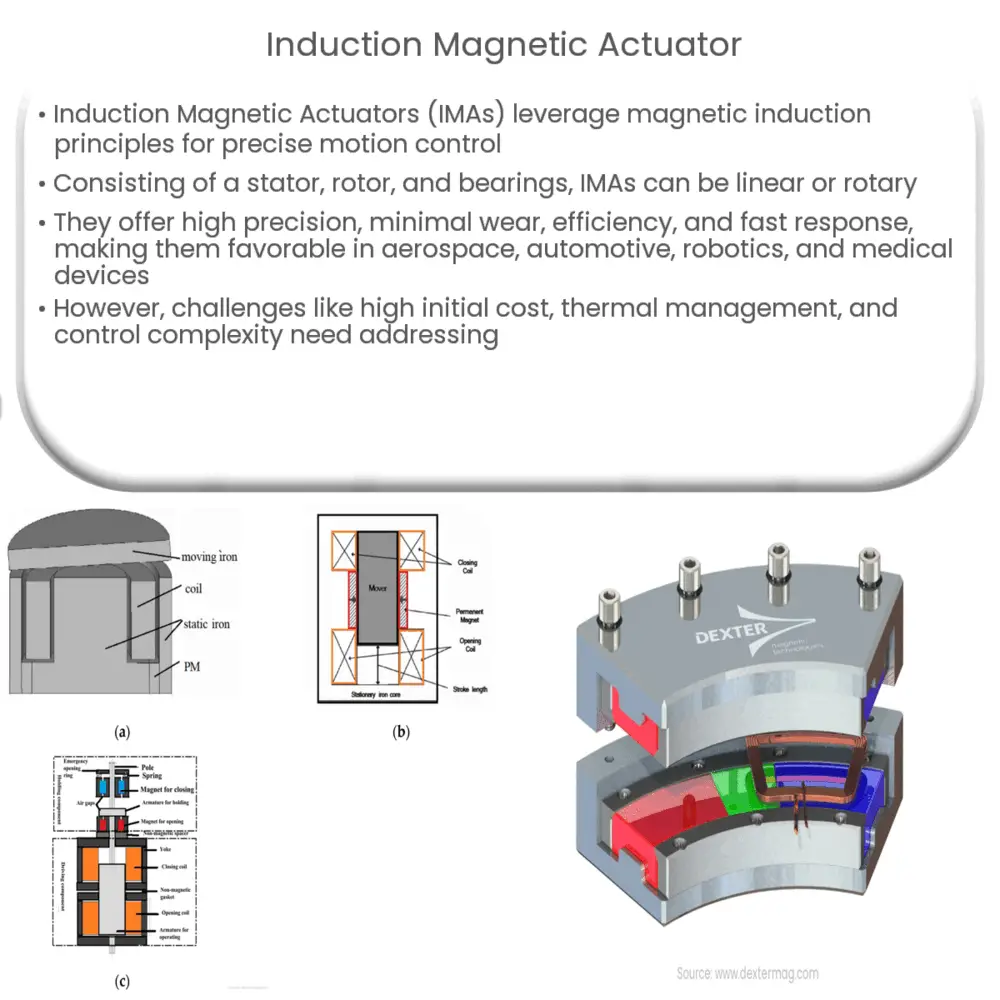
An IMA typically consists of three main components: the stator, the rotor, and the bearings. The stator is the stationary part of the actuator, which houses the coil that generates the magnetic field. The rotor, on the other hand, is the moving component that converts the magnetic field’s energy into motion. The bearings support the rotor and allow it to move with minimal friction.
Depending on the application, IMAs can be designed to produce linear or rotary motion. In a linear IMA, the stator and rotor are arranged in a linear fashion, with the rotor moving along the stator’s length. Conversely, in a rotary IMA, the stator and rotor are arranged in a circular configuration, with the rotor rotating around the stator.
Advantages of Induction Magnetic Actuators
IMAs offer numerous advantages over traditional actuators like hydraulic, pneumatic, or mechanical ones. Some of the most notable benefits include:
- High precision: IMAs can achieve extremely precise positioning and motion control due to the absence of mechanical linkages and the direct coupling of the magnetic field to the rotor.
- Minimal wear: Since there are no physical contacts between the stator and the rotor, IMAs exhibit minimal wear and tear, resulting in longer service life and reduced maintenance costs.
- High efficiency: IMAs are highly efficient, as they convert a large portion of the electrical energy into motion, with minimal energy loss to heat or friction.
- Fast response: The absence of mechanical linkages allows IMAs to have a rapid response time, enabling them to quickly adjust to changing loads and operating conditions.
Owing to these advantages, IMAs are finding increasing use in various industries, including aerospace, automotive, robotics, and medical devices. In the next part of this article, we will delve into the different types of IMAs, their specific applications, and the challenges that need to be addressed for their widespread adoption.
Induction Magnetic Actuator: Exploring Types, Applications, and Challenges
Types of Induction Magnetic Actuators
Induction magnetic actuators can be broadly categorized into two types: linear and rotary. As mentioned earlier, linear IMAs produce linear motion along the stator’s length, while rotary IMAs generate rotational movement around the stator. Both types can be further subdivided into various configurations based on the arrangement of stators and rotors, such as cylindrical, flat, or segmented designs.
Applications of Induction Magnetic Actuators
IMAs have found widespread applications across numerous industries due to their unique advantages. Some of these applications include:
- Aerospace: IMAs are used in aircraft control surfaces, such as flaps, ailerons, and rudders, where high precision, fast response, and minimal wear are critical requirements.
- Automotive: Electric vehicle manufacturers use IMAs for applications like throttle control, brake-by-wire systems, and active suspension systems, improving vehicle performance and safety.
- Robotics: IMAs enable precise and smooth motion control in robots, particularly in applications like robotic arms, where high accuracy and responsiveness are essential.
- Medical devices: IMAs are used in medical equipment such as surgical robots, drug delivery systems, and imaging devices, where precise motion control and reliability are crucial.
Challenges and Future Prospects
Despite their numerous advantages and expanding applications, IMAs still face some challenges that need to be addressed for their widespread adoption. Some of these challenges include:
- Cost: The initial cost of IMAs can be high due to the complex manufacturing processes and materials required. However, their long service life and reduced maintenance costs can offset this in the long run.
- Thermal management: IMAs can generate significant heat due to the high currents and magnetic fields involved. Effective thermal management solutions are necessary to prevent overheating and maintain optimal performance.
- Control complexity: The control algorithms for IMAs can be complex, particularly in applications requiring precise motion control and rapid response. Continued development of advanced control strategies will be essential to fully leverage the capabilities of IMAs.
As research and development efforts continue to address these challenges, the prospects for induction magnetic actuators remain promising. Their inherent advantages, coupled with ongoing advancements in material science, control algorithms, and manufacturing processes, will likely drive the adoption of IMAs in an even broader range of applications in the future.
Conclusion
Induction magnetic actuators represent a versatile and innovative technology that offers numerous advantages over traditional actuators. Their ability to deliver high precision, minimal wear, high efficiency, and fast response make them well-suited for a wide range of applications across various industries. As research progresses and challenges are addressed, the potential for IMAs to revolutionize motion control systems and improve overall system performance will continue to grow.



