
Explore the working, types, applications, and maintenance of humidity sensors in this comprehensive guide. Stay ahead with the latest in sensor tech.
Understanding Humidity Sensors
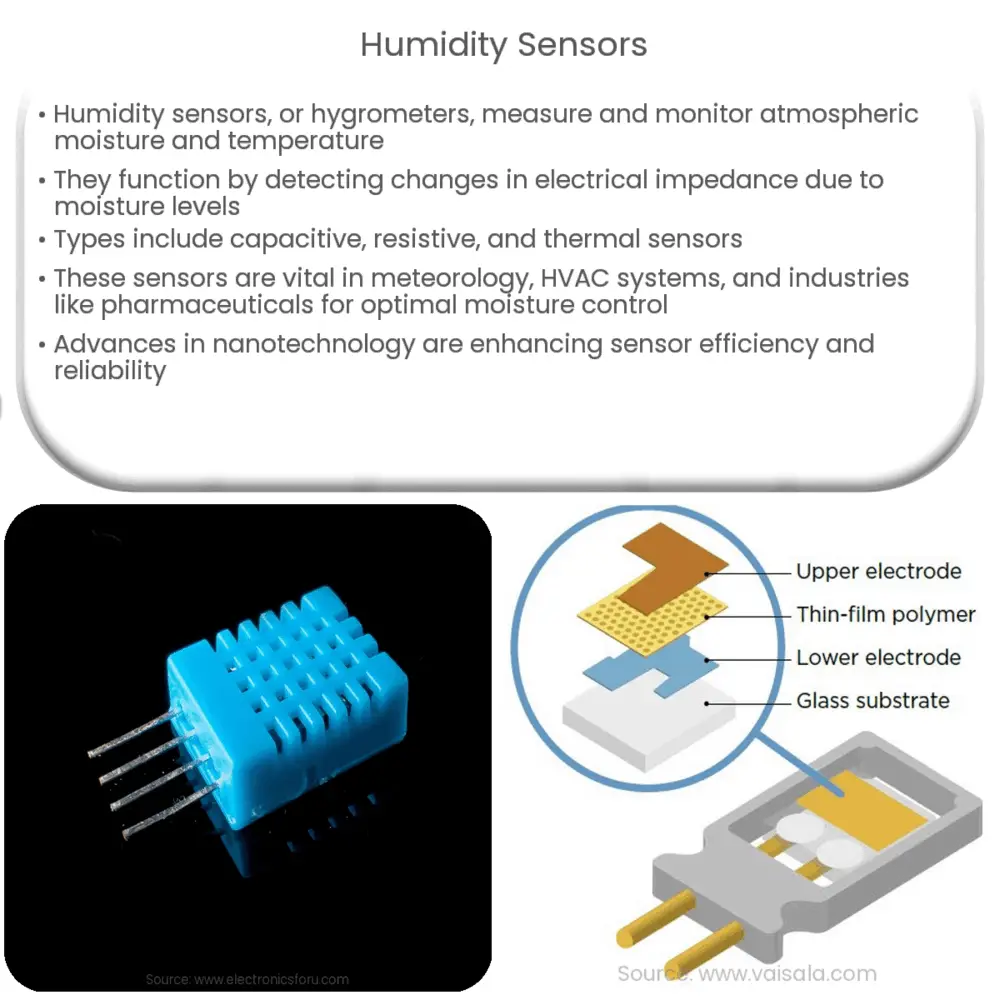
A humidity sensor, also known as a hygrometer, is a device used to measure and monitor the moisture and air temperature in the atmosphere. It is an essential tool in various sectors, including meteorology, HVAC systems, and industrial spaces, where accurate humidity readings are crucial.
How Humidity Sensors Work
Humidity sensors operate on the principle of change in electrical impedance with varying moisture levels. The sensor’s active component, typically a hygroscopic substance (a material that absorbs water), absorbs or desorbs water vapor from the surrounding air. This alters the voltage or capacitance across the component, which is then converted into a reading of relative humidity.
Types of Humidity Sensors
- Capacitive Humidity Sensors: These sensors use a strip of metal oxide placed between two electrodes. As humidity changes, the dielectric constant of the metal oxide changes, altering the capacitance value and allowing the humidity to be measured.
- Resistive Humidity Sensors: These sensors use ions in salts to measure the impedance change in the atmosphere. The conductivity of these sensors increases with increasing humidity.
- Thermal Humidity Sensors: These sensors use heated elements to measure humidity. The rate at which the element cools down depends on the moisture content in the air. Greater humidity results in faster cooling, and this change in temperature can be used to measure humidity.
Applications of Humidity Sensors
Humidity sensors are applied in a broad range of areas due to their utility in controlling and monitoring moisture levels. A few of these applications include:
- Meteorology: Humidity sensors play a vital role in weather forecasting, helping predict rainfall, fog, dew, and other weather conditions.
- HVAC Systems: In heating, ventilation, and air conditioning systems, these sensors maintain a comfortable and safe environment by controlling humidity levels.
- Industrial Applications: Industries like pharmaceuticals, food and beverage, paper, and textiles use humidity sensors to ensure optimal moisture levels during production.
Choosing a Humidity Sensor
When selecting a humidity sensor, several factors must be considered. These include accuracy, long-term stability, response time, and the specific conditions under which the sensor will be used, such as temperature range and humidity range. Different applications may require different types of sensors, so understanding your specific needs is crucial.
Challenges with Humidity Sensors
Despite their numerous advantages, humidity sensors also face certain challenges. The primary issue concerns accuracy and drift over time. Many humidity sensors are prone to reading inaccuracies due to factors such as temperature influence, long-term drift, and hysteresis. These issues can often be mitigated through regular calibration and appropriate sensor selection for the application.
Maintenance of Humidity Sensors
Maintaining a humidity sensor’s accuracy is vital for its long-term performance. Regular calibration ensures the sensor maintains its precision. Some humidity sensors also come with self-calibration features, which can simplify this task. In addition, it’s important to protect the sensor from environments that can damage it, such as condensation, exposure to chemicals, or extremely high temperatures or humidity.
Innovation in Humidity Sensors
Technological advances continue to drive innovation in the field of humidity sensing. For example, the development of nanotechnology-based sensors has opened up new possibilities for improved sensitivity, faster response times, and lower power consumption. These innovations continue to make humidity sensors more reliable and efficient in various applications, from consumer electronics to industrial processes and weather stations.
Conclusion
In conclusion, humidity sensors play an essential role in various sectors due to their ability to accurately measure and control moisture levels. Despite some challenges concerning accuracy and long-term drift, ongoing technological advances promise continuous improvements in the reliability and efficiency of these devices. When selecting a humidity sensor, it’s important to consider factors like accuracy, long-term stability, and the specific conditions under which the sensor will be used. Regular maintenance and calibration are also crucial to ensure the sensor’s optimal performance over time. Whether in meteorology, HVAC systems, or industrial settings, humidity sensors continue to be invaluable tools in maintaining safety, comfort, and efficiency.



