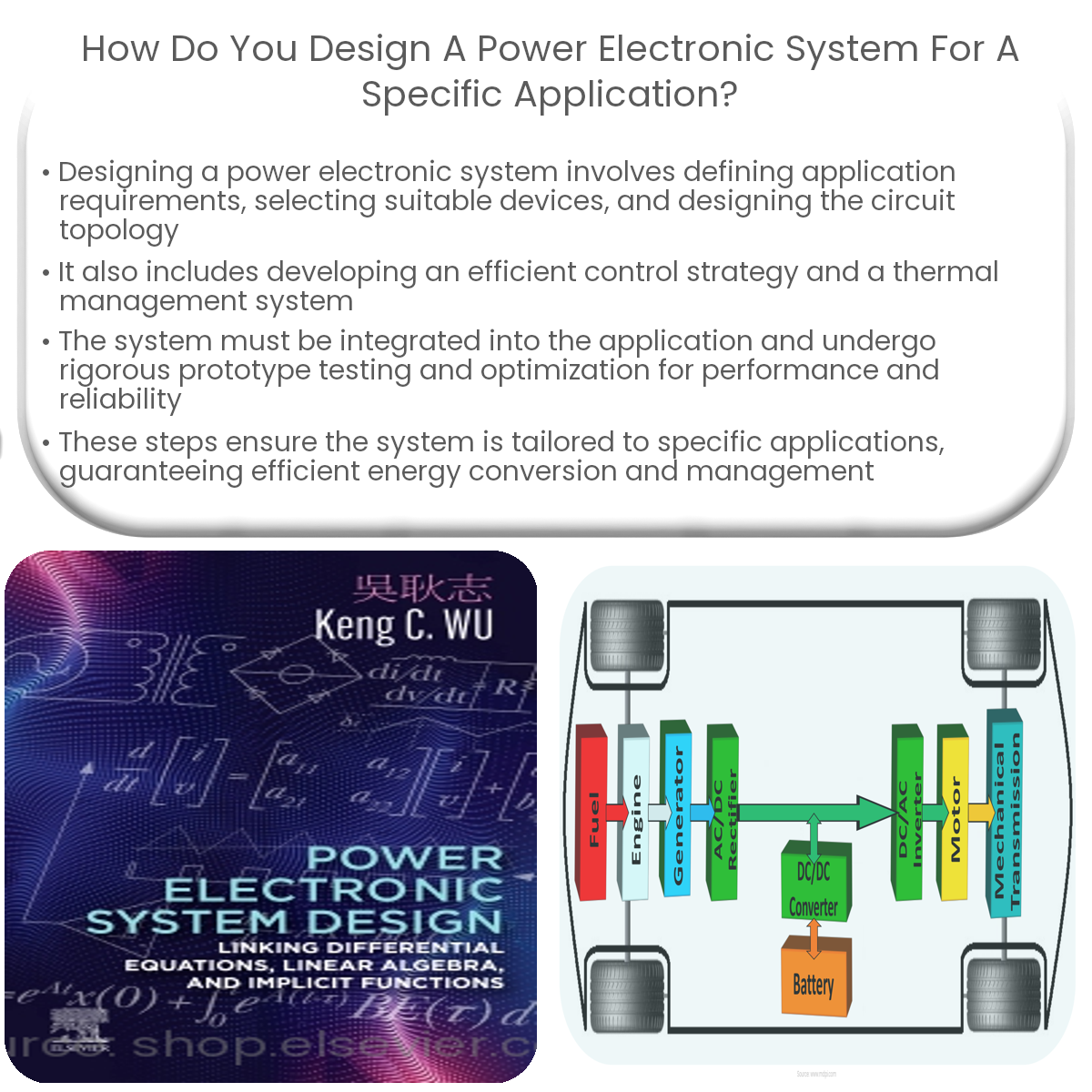
Designing a power electronic system involves defining requirements, selecting devices, designing circuit topology, control strategy, thermal management, integration, prototyping, and optimization.
Designing a Power Electronic System for a Specific Application
Designing a power electronic system for a specific application involves a series of steps to ensure efficient energy conversion, control, and management. This article outlines the key stages in designing a power electronic system tailored to a particular application.
1. Define Application Requirements
Start by identifying the specific requirements of the application, including power levels, voltage and current ratings, frequency, control, and communication needs. Understanding these parameters helps in choosing appropriate power electronic devices and designing an optimal system.
2. Select Power Electronic Devices
Select suitable power electronic devices based on the defined application requirements. Consider factors such as voltage and current ratings, switching frequency, efficiency, and thermal management. Common power electronic devices include diodes, transistors, thyristors, and IGBTs.
3. Design Circuit Topology
Design a suitable circuit topology based on the selected power electronic devices and application requirements. This includes selecting the appropriate converter or inverter type, such as buck, boost, or full-bridge converters, and designing the control and protection circuits.
4. Control Strategy and Algorithm
Develop a control strategy and algorithm to manage the power electronic system effectively. This may involve techniques such as pulse-width modulation (PWM), maximum power point tracking (MPPT), or vector control for improved efficiency and performance.
5. Thermal Management
Design a thermal management system to dissipate heat generated by the power electronic devices. Consider passive and active cooling methods, such as heat sinks, fans, or liquid cooling, depending on the power levels and environmental constraints of the application.
6. Design Integration
Integrate the power electronic system into the overall application, ensuring compatibility with other components and systems. This may involve designing custom printed circuit boards (PCBs), enclosures, or interconnections to facilitate seamless integration.
7. Prototype and Testing
Build a prototype of the power electronic system and perform rigorous testing to validate its performance and reliability. This includes electrical, thermal, and mechanical testing, as well as software validation and debugging.
8. Iteration and Optimization
Based on the testing results, refine and optimize the power electronic system design, addressing any identified issues or areas for improvement. Repeat the testing process as necessary to ensure optimal performance and reliability.
By following these steps, designers can create a power electronic system tailored to a specific application, ensuring efficient energy conversion and management while meeting the unique requirements of the application.