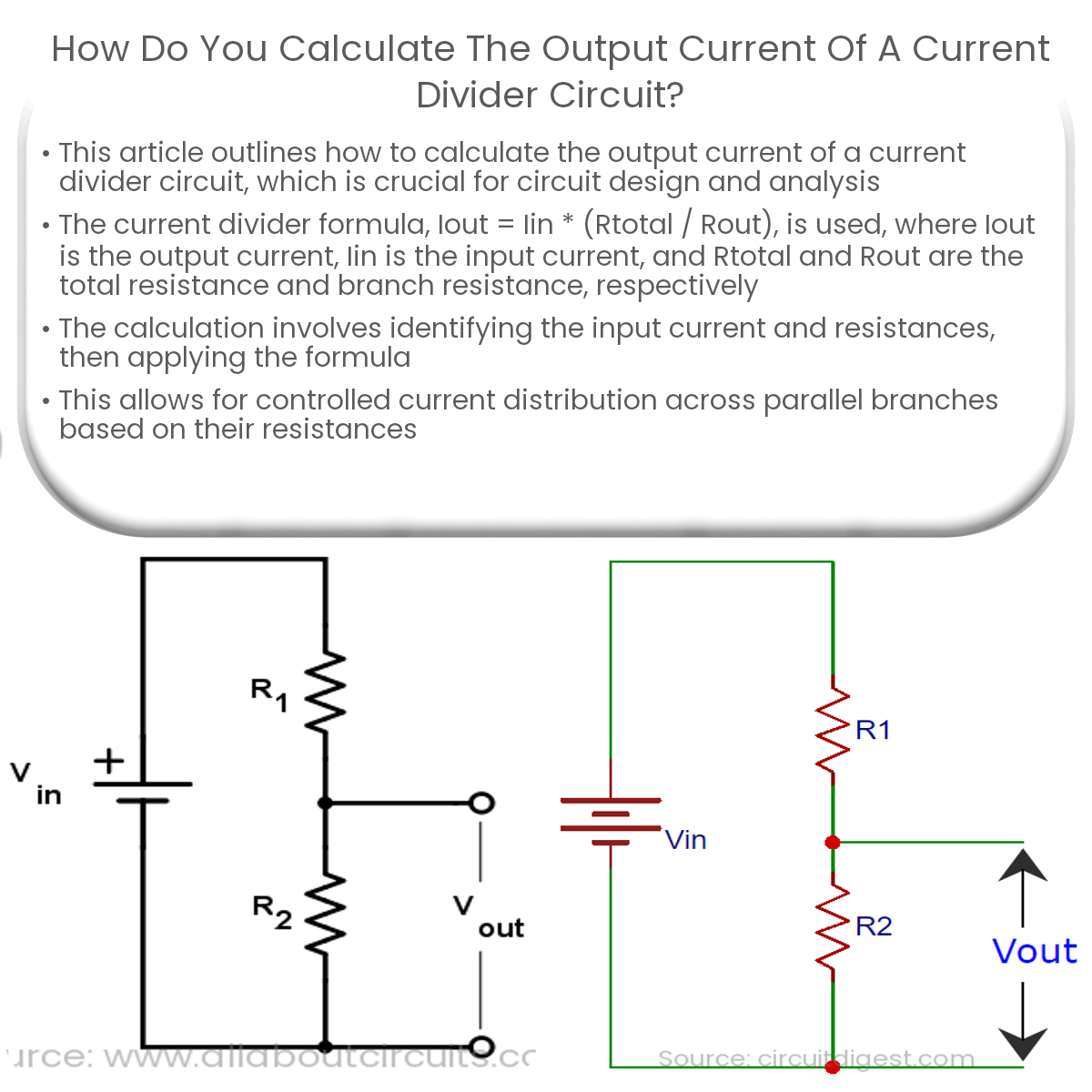
To calculate the output current of a current divider circuit, use the formula: I_out = I_in * (R_total / R_out), where I_in is the input current.
Calculating the Output Current of a Current Divider Circuit
A current divider circuit is an essential tool for distributing current among parallel branches based on their resistances. It helps control the flow of current through various components in a circuit. In this article, we will discuss the steps to calculate the output current of a current divider circuit.
Current Divider Formula
To calculate the output current of a current divider circuit, we use the current divider formula:
Iout = Iin * (Rtotal / Rout)
where:
- Iout is the output current in the branch of interest
- Iin is the total input current
- Rtotal is the total resistance of the parallel branches
- Rout is the resistance of the branch of interest
Step-by-Step Calculation
- Determine the total input current (Iin) in the circuit. This value is usually given or can be calculated using Ohm’s law or Kirchhoff’s laws.
- Identify the resistance of the branch of interest (Rout). This value is the resistance of the specific branch for which you want to calculate the output current.
- Calculate the total resistance of the parallel branches (Rtotal). For parallel resistances, the formula is:
- Now, apply the current divider formula to find the output current:
1 / Rtotal = 1 / R1 + 1 / R2 + … + 1 / Rn
Iout = Iin * (Rtotal / Rout)
By following these steps, you can calculate the output current of a current divider circuit for any branch of interest. This information is crucial for designing and analyzing electrical circuits and ensuring their proper operation.