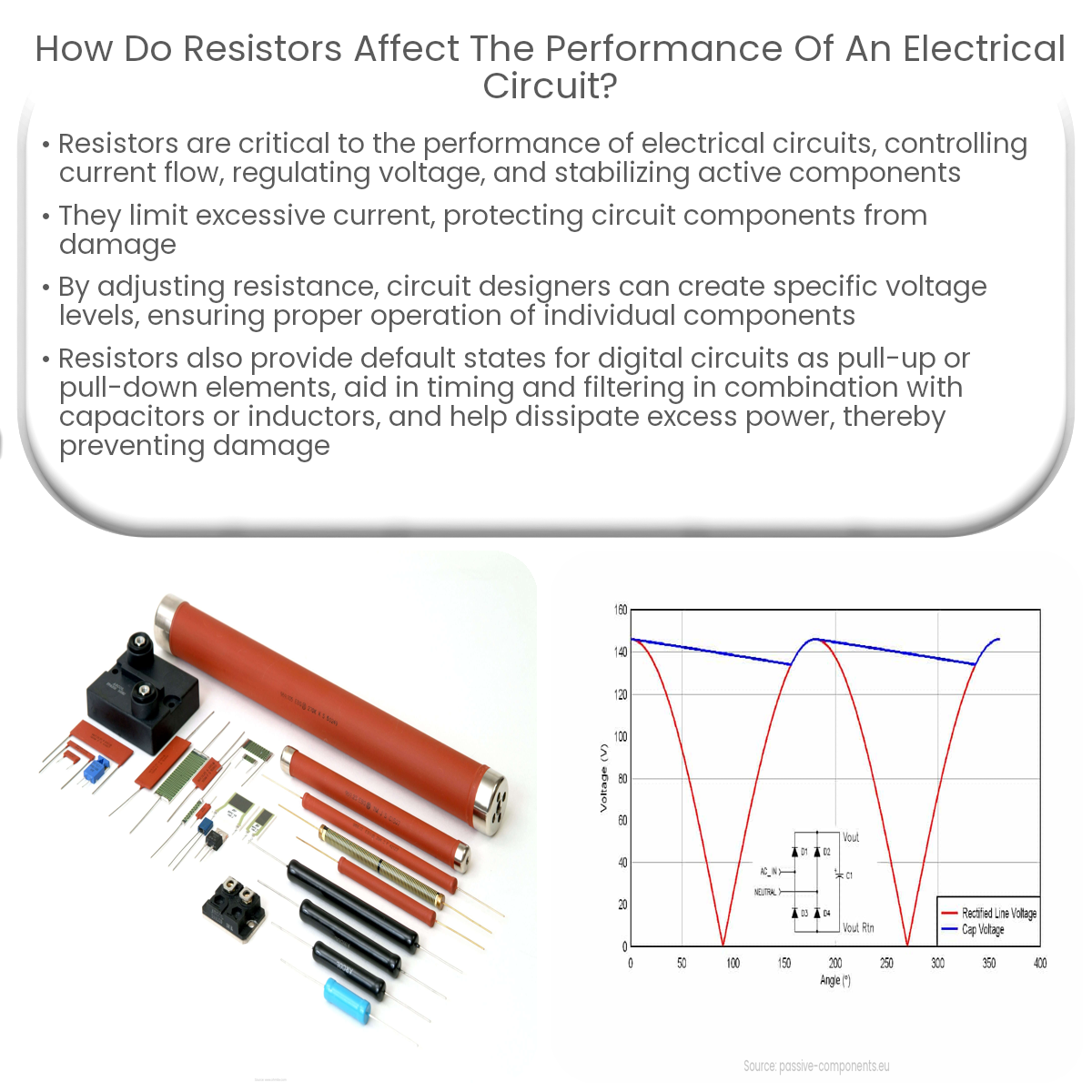
Resistors control current flow, regulate voltage levels, stabilize active components, provide default states for digital circuits, and aid in timing, filtering, and power dissipation applications.
How Resistors Affect the Performance of an Electrical Circuit
Resistors play a crucial role in the performance of electrical circuits by controlling the flow of current, regulating voltage levels, and stabilizing active components. This article highlights various ways resistors impact the functioning of electrical circuits.
Current Control
One of the primary functions of resistors is to limit the flow of current in a circuit. By introducing a resistor into the circuit, the current passing through the other components is regulated, protecting them from damage due to excessive current flow.
Voltage Regulation
Resistors are often used in voltage divider circuits to create specific voltage levels for different components. By adjusting the resistance values, circuit designers can fine-tune the voltage levels to meet the requirements of the individual components, ensuring proper operation.
Stabilizing Active Components
Active components such as transistors and operational amplifiers often require biasing to operate correctly. Resistors are used to provide proper biasing, ensuring that these active components operate within their specified limits and maintain stable performance.
Pull-up and Pull-down Resistors
Resistors can be utilized as pull-up or pull-down elements in digital circuits to establish a default state for input or output pins. By connecting a resistor to either a voltage source or ground, the voltage level on the pin is determined when no external signal is applied.
Timing and Filtering
Resistors, in combination with capacitors or inductors, create RC or RL circuits that can be used for timing and filtering applications. These configurations allow for the creation of oscillators, signal delay lines, and filters that can eliminate unwanted noise or interference in a circuit.
Power Dissipation
Resistors can also be used to dissipate excess power in a circuit. In certain applications, resistors act as “dummy loads” to consume power that would otherwise damage other components. They can also be used in voltage regulators to convert excess voltage into heat, which is then safely dissipated.
In summary, resistors are vital components in electrical circuits that contribute to their overall performance and stability. They control current flow, regulate voltage levels, stabilize active components, provide default states for digital circuits, and aid in timing, filtering, and power dissipation applications.