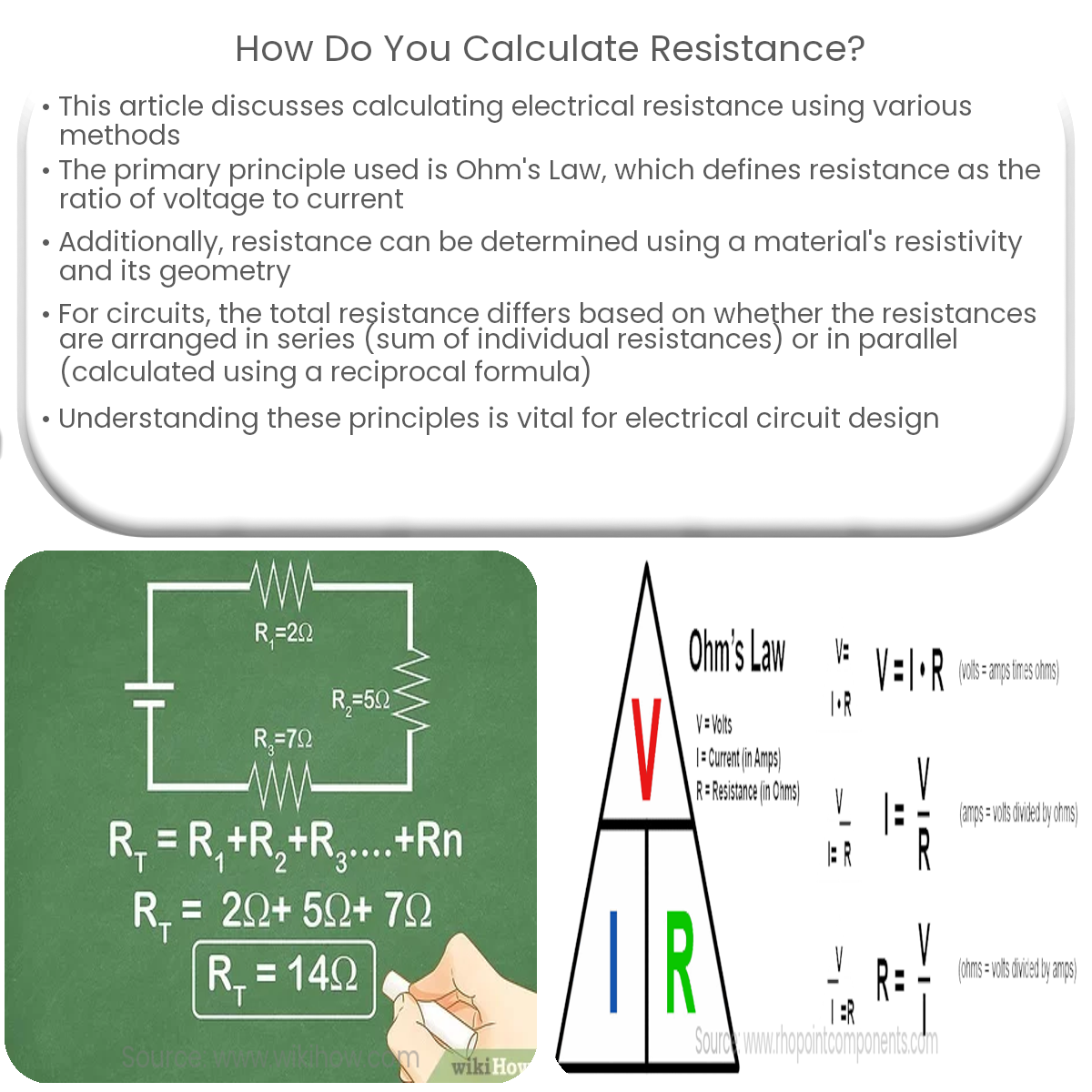
To calculate resistance, use Ohm’s Law (R = V/I), resistivity formula (R = (ρ × L) / A), or add resistances in series and use reciprocal formula for parallel.
Calculating Resistance
Resistance is an important electrical property that quantifies how a material opposes the flow of electric current. In this article, we will discuss the methods used to calculate resistance in different situations.
Ohm’s Law
Ohm’s Law is the fundamental principle used to calculate resistance in a circuit. It states that the current (I) flowing through a conductor between two points is directly proportional to the voltage (V) across the two points and inversely proportional to the resistance (R) of the conductor. Mathematically, it is expressed as:
V = I × R
To find the resistance, you can rearrange the formula as:
R = V / I
Where R is the resistance in ohms (Ω), V is the voltage in volts (V), and I is the current in amperes (A).
Resistivity and Geometry
Resistance can also be calculated using the resistivity of a material and its geometry. Resistivity (ρ) is a property of a material that describes its ability to resist the flow of electric current. The formula for calculating resistance using resistivity is:
R = (ρ × L) / A
Where R is the resistance in ohms (Ω), ρ is the resistivity in ohm-meters (Ωm), L is the length of the conductor in meters (m), and A is the cross-sectional area of the conductor in square meters (m²).
Series and Parallel Circuits
In a series circuit, resistances are connected end-to-end, and the total resistance can be calculated by simply adding up the individual resistances:
Rtotal = R1 + R2 + … + Rn
In a parallel circuit, resistances are connected side-by-side, and the total resistance can be calculated using the reciprocal formula:
1 / Rtotal = 1 / R1 + 1 / R2 + … + 1 / Rn
Conclusion
Calculating resistance is essential for understanding and designing electrical circuits. By using Ohm’s Law, resistivity, and the principles of series and parallel circuits, you can accurately determine the resistance in various scenarios. Always remember to use the correct units and consider the properties of the materials and components involved in the calculation.