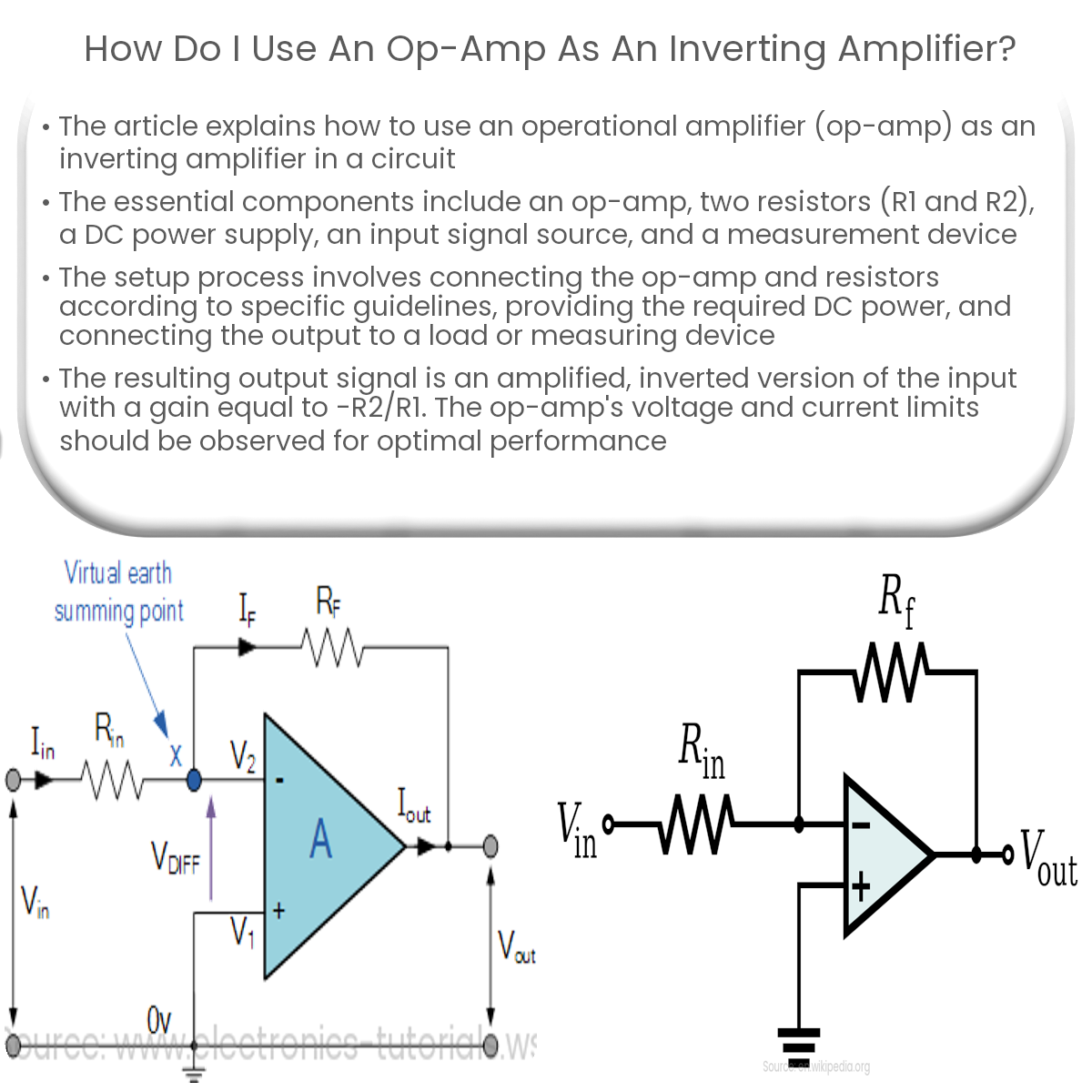
To use an op-amp as an inverting amplifier, connect input through R1 to inverting input, non-inverting input to ground, and R2 from output to inverting input.
Using an Op-Amp as an Inverting Amplifier
An inverting amplifier is a popular op-amp configuration that inverts the input signal and amplifies it by a specific gain. This article will guide you through using an op-amp as an inverting amplifier in a circuit.
Components Required
- Operational amplifier (op-amp)
- Two resistors (R1 and R2)
- DC power supply
- Input signal source
- Oscilloscope or voltmeter (optional)
Steps to Set Up the Circuit
- Choose an op-amp suitable for your application. Check the manufacturer’s datasheet for details on the op-amp’s specifications.
- Select the resistors R1 and R2 based on the desired gain. The gain of an inverting amplifier is given by the formula Gain = -R2/R1. Be sure to choose appropriate resistor values for your needs.
- Connect the non-inverting input (pin +) of the op-amp to the ground.
- Connect one end of resistor R1 to the input signal source, and the other end to the inverting input (pin -) of the op-amp.
- Connect one end of resistor R2 to the output (pin out) of the op-amp, and the other end to the inverting input (pin -) of the op-amp.
- Provide the required DC power supply voltage to the op-amp’s VCC and VEE pins, as specified in the datasheet.
- Connect the output (pin out) of the op-amp to the load or measuring device, such as an oscilloscope or voltmeter.
After completing these steps, your inverting amplifier circuit should be ready. The output signal will be an amplified, inverted version of the input signal with a gain equal to -R2/R1. Ensure that your op-amp operates within its specified voltage and current limits for optimal performance.