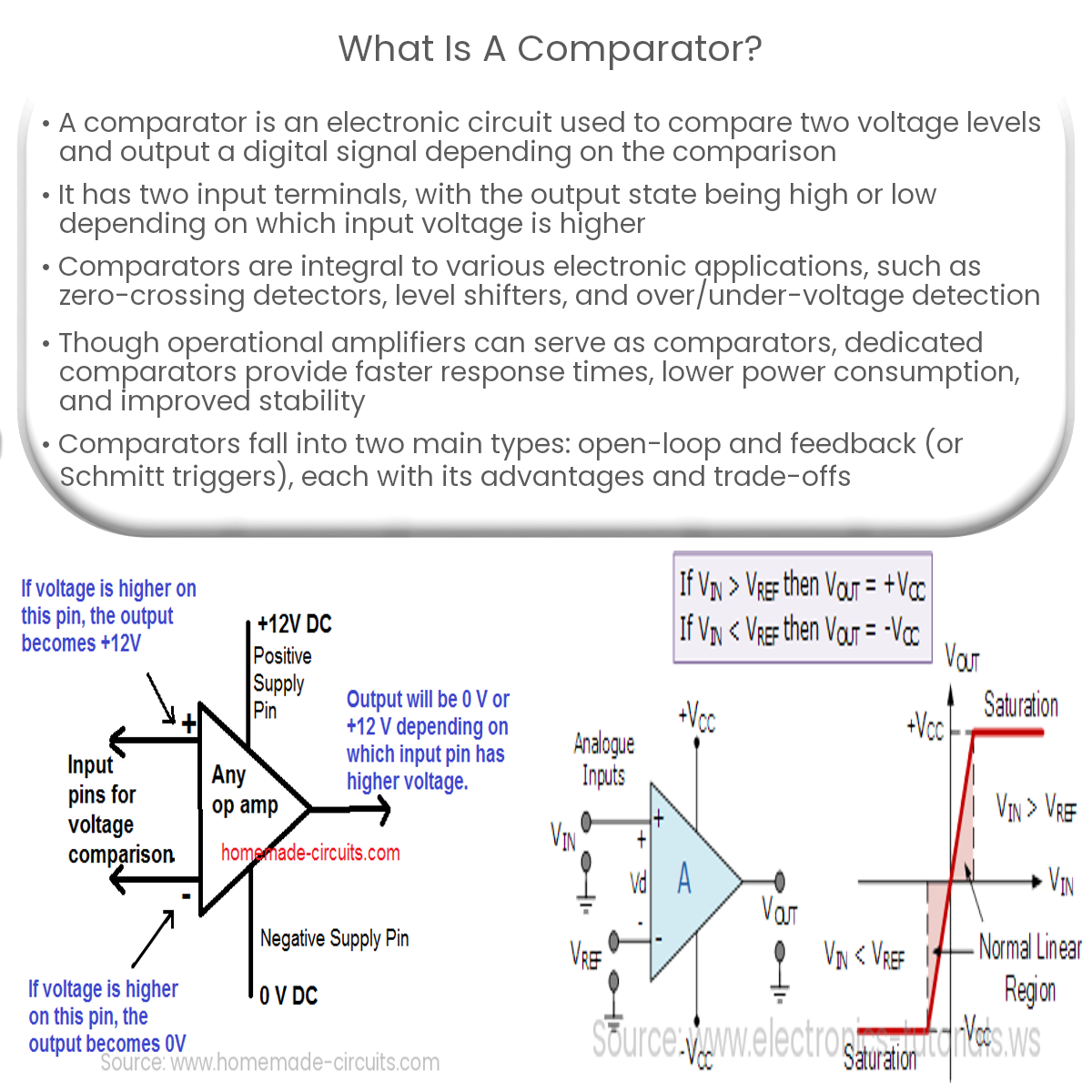
A comparator is an electronic circuit that compares two voltage levels and outputs a digital signal based on the comparison, used in various applications.
What is a Comparator?
A comparator is a type of electronic circuit designed to compare two voltage levels and output a digital signal based on the comparison. It functions as a decision-making component, determining whether one input voltage is greater or lesser than the other.
Working Principle of a Comparator
Comparators consist of two input terminals: the inverting (-) input and the non-inverting (+) input. When the voltage at the non-inverting input is greater than the voltage at the inverting input, the comparator’s output is in a high state. Conversely, if the voltage at the inverting input is greater than the non-inverting input, the output is in a low state.
Applications of Comparators
Comparators have various applications in electronic circuits, including:
- Zero-crossing detectors: In this application, comparators detect when an input waveform crosses zero voltage level, which is useful in phase-locked loops and frequency demodulation.
- Level shifters: Comparators can be used to shift signal levels between different voltage ranges, commonly employed in digital-to-analog and analog-to-digital converters.
- Over/under-voltage detection: Monitoring voltage levels in power supply circuits is essential for safety and protection, and comparators can help detect voltage deviations.
- Window comparators: By using two comparators, a window comparator can determine if an input voltage is within a specified voltage range, often used in alarm systems.
Op-Amps as Comparators
Operational amplifiers (op-amps) can be used as comparators, although they are not specifically designed for this purpose. Op-amps have high gain and can amplify small differences in voltage, which may cause slower response times and output oscillations. Dedicated comparators are designed to overcome these limitations, featuring faster response times, lower power consumption, and improved stability.
Types of Comparators
There are two main types of comparators:
- Open-loop comparators: These comparators lack feedback and rely solely on the open-loop gain. They offer faster response times but can suffer from output oscillations and instability.
- Feedback comparators: Also known as Schmitt triggers or hysteresis comparators, these circuits incorporate positive feedback to reduce output oscillations and provide greater stability. They are slower than open-loop comparators but offer improved noise immunity.
In summary, comparators are essential components in various electronic circuits, responsible for comparing voltage levels and making decisions based on the comparison. They can be found in applications such as zero-crossing detectors, level shifters, and over/under-voltage detection.