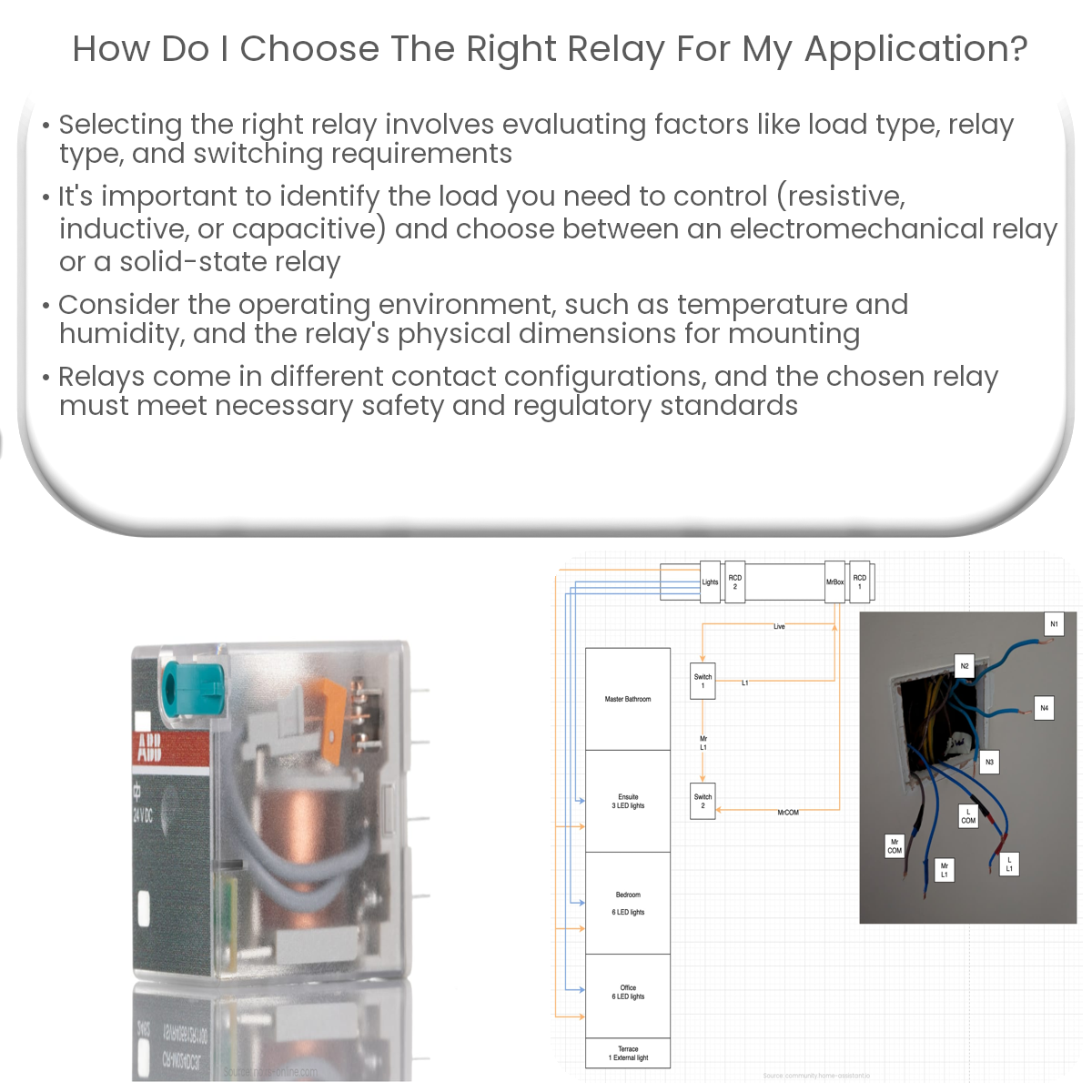
Consider load type, relay type, switching requirements, environmental conditions, mounting, contact configuration, and safety compliance.
Choosing the Right Relay for Your Application
When selecting the appropriate relay for your application, it’s essential to consider various factors such as load type, required performance, and environmental conditions. This article outlines the main points to consider when making your choice.
1. Load Type and Ratings
Identify the type of load you need to control, whether it’s resistive, inductive, or capacitive, and determine the required voltage and current ratings. These ratings help ensure the relay can handle the load without damaging the circuit or the relay itself.
2. Relay Type
Decide between an electromechanical relay (EMR) or a solid-state relay (SSR). EMRs have moving parts and generate noise, while SSRs are silent and have no mechanical parts. EMRs are typically more cost-effective, but SSRs offer faster switching and longer life.
3. Switching Requirements
Consider the switching speed and the number of times the relay will be switched on and off during its lifespan. Solid-state relays are better suited for high-speed applications, while electromechanical relays are more appropriate for lower-speed operations.
4. Environmental Conditions
Take into account the operating environment, such as temperature, humidity, and potential exposure to chemicals or contaminants. Some relays are designed to operate under extreme conditions, while others may require protective enclosures.
5. Mounting and Form Factor
Consider the physical dimensions and mounting requirements of the relay. Some relays are designed for printed circuit board (PCB) mounting, while others are built for panel or DIN rail mounting. Ensure the relay will fit within your design constraints.
6. Contact Configuration
Relays are available in different contact configurations, such as single-pole single-throw (SPST), single-pole double-throw (SPDT), double-pole single-throw (DPST), and double-pole double-throw (DPDT). Choose the configuration that best suits your application.
7. Safety and Compliance
Verify that the relay meets the necessary safety and regulatory standards for your application, such as UL, CE, or RoHS compliance.
In conclusion, selecting the right relay for your application requires a thorough understanding of your specific requirements and the available options. By carefully evaluating factors such as load type, relay type, switching requirements, environmental conditions, and safety standards, you can ensure a reliable and efficient solution for your project.