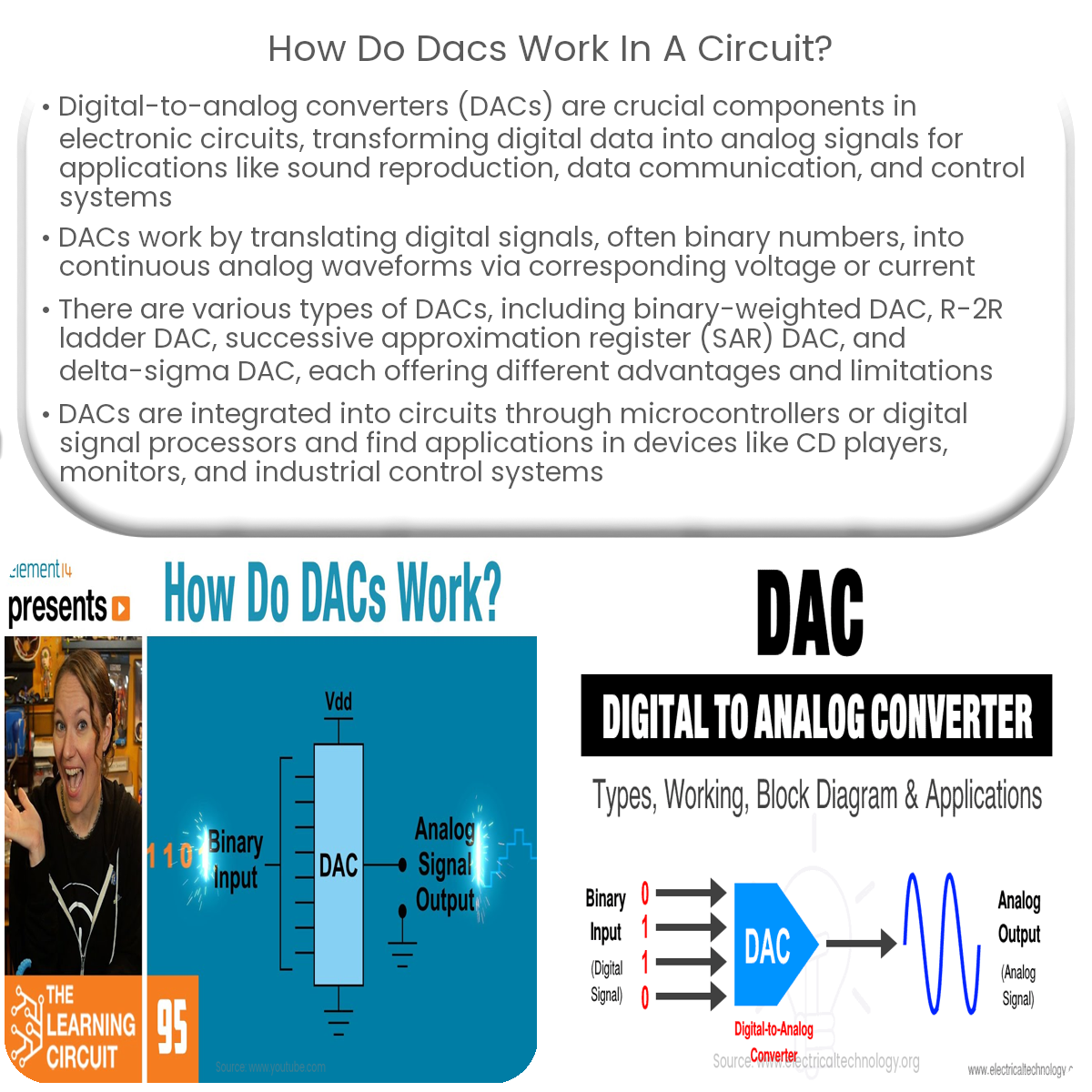
DACs convert digital signals into analog waveforms by translating digital input into corresponding voltage or current for various applications.
Understanding Digital-to-Analog Converters (DACs)
A digital-to-analog converter (DAC) is an essential component in many electronic circuits, allowing digital data to be transformed into an analog signal. This process is crucial for applications that involve sound reproduction, data communication, and control systems.
Basic Working Principle
DACs convert digital signals, typically in the form of binary numbers, into continuous analog waveforms. They achieve this by translating the digital input into a corresponding voltage or current. The output analog signal can then be used by other circuit components or devices that require a continuous waveform.
Types of DACs
There are several types of DACs, each with its own advantages and drawbacks. Some common types include:
- Binary-weighted DAC: This type uses a set of resistors, each assigned a specific binary weight. The digital input directly controls the switches that connect the resistors to the output, generating the equivalent analog voltage.
- R-2R ladder DAC: Also known as a resistor ladder DAC, this type uses an R-2R resistor network. It is more efficient than the binary-weighted DAC, providing higher resolution and more accurate output with fewer resistors.
- Successive approximation register (SAR) DAC: This type uses a comparator and a successive approximation register to determine the output voltage. It starts by comparing the digital input to a series of reference voltages, adjusting its output until the closest match is found.
- Delta-sigma DAC: This type uses a delta-sigma modulator to create a high-frequency, low-resolution digital signal that is then filtered and converted to an analog output. It is known for its high resolution and noise shaping capability.
Integrating DACs into Circuits
To integrate a DAC into a circuit, the digital input must first be fed into the DAC. This input is typically provided by a microcontroller, digital signal processor (DSP), or another digital device. The DAC then converts the digital data into an analog signal, which can be amplified, filtered, or further processed by other components in the circuit.
Applications
DACs are used in a wide range of applications, including:
- Audio playback: In devices such as CD players, MP3 players, and digital synthesizers, DACs convert digital audio data into analog signals that can be sent to speakers or headphones.
- Video display: In television and computer monitors, DACs transform digital video data into analog signals that drive the display.
- Control systems: In industrial and automotive systems, DACs are used to convert digital control signals into analog voltages or currents for controlling motors, valves, and other actuated devices.
Understanding how DACs work in a circuit is crucial for designing and implementing various electronic systems that require accurate and reliable analog signal generation from digital data.